
Question 173 marksMedium
In trapezium ABCD, AB is parallel to DC; P and Q are the mid-points of AD and BC respectively. BP produced meets CD produced at point E.
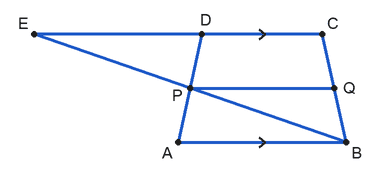
Prove that :
(i) point P bisects BE,
(ii) PQ is parallel to AB.
Confirming your payment
Sign up now and get 250 free tokens.
Mid-Point Theorem and Its Converse · Question 17 of 45
In trapezium ABCD, AB is parallel to DC; P and Q are the mid-points of AD and BC respectively. BP produced meets CD produced at point E.
Prove that :
(i) point P bisects BE,
(ii) PQ is parallel to AB.
Solution:
Concept: Mid-point theorem: the segment joining the mid-points of two sides of a triangle is parallel to the third side and equal to half of it. A.S.A.: two angles and the side between them equal in two triangles make them congruent.
Given: ABCD is a trapezium with AB ∥ DC; P, Q are the mid-points of AD, BC; BP produced meets CD produced at E.
Step 1 — Part (i): compare ΔAPB and ΔDPE.
AP = DP (P is the mid-point of AD)
∠APB = ∠DPE (vertically opposite angles)
∠PAB = ∠PDE (alternate angles, AB ∥ DE with AD as transversal)
So ΔAPB ≅ ΔDPE by A.S.A., and by C.P.C.T.C. BP = PE: P bisects BE.
Step 2 — Part (ii).
In ΔBEC, P and Q are the mid-points of BE and BC, so PQ ∥ EC. EC lies along DC, and DC ∥ AB, so PQ ∥ AB.
Watch out: Part (ii) needs P to be the mid-point of BE, which is exactly what part (i) proves.
Therefore, (i) P bisects BE and (ii) PQ ∥ AB. Hence proved.