
Question 231 markMCQEasy
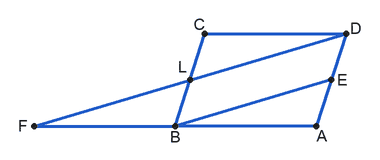
The given figure shows a parallelogram ABCD in which E is mid-point of AD and DL//EB. Then, BF is equal to :
Confirming your payment
Sign up now and get 250 free tokens.
Mid-Point Theorem and Its Converse · Question 23 of 45
The given figure shows a parallelogram ABCD in which E is mid-point of AD and DL//EB. Then, BF is equal to :
(A) AD
(B) BE
(C) AE
(D) AB
Answer: (D) AB
Concept: Converse of the mid-point theorem: a line drawn through the mid-point of one side of a triangle, parallel to a second side, bisects the third side.
Step 1 — Look at ΔAFD.
AB is produced to F, so A, B, F lie on one line and ΔAFD has sides AF, FD and DA. E is the mid-point of AD, and EB ∥ DF (given DL ∥ EB, and L lies on DF).
Step 2 — Use the converse.
A line through the mid-point E of AD, parallel to DF, bisects the third side AF. So B is the mid-point of AF.
Step 3 — Conclude.
B is the mid-point of AF, so BF = AB.
Watch out: The triangle to use is ΔAFD, with AF along AB produced; ABCD itself is only used for the position of the points.
Why the other options are wrong:
Therefore, BF = AB, option (D).