
Question 263 marksEasy
Use the following figure to find :
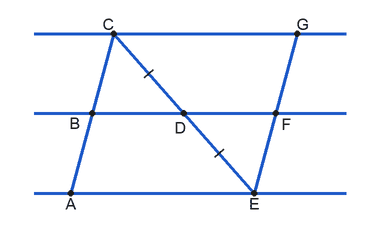
(i) BC, if AB = 7·2 cm.
(ii) GE, if FE = 4 cm.
(iii) AE, if BD = 4·1 cm.
(iv) DF, if CG = 11 cm.
Confirming your payment
Sign up now and get 250 free tokens.
Mid-Point Theorem and Its Converse · Question 26 of 45
Use the following figure to find :
(i) BC, if AB = 7·2 cm.
(ii) GE, if FE = 4 cm.
(iii) AE, if BD = 4·1 cm.
(iv) DF, if CG = 11 cm.
Solution:
Concept: Intercept theorem: if three or more parallel lines make equal intercepts on one transversal, they make equal intercepts on every other transversal. Mid-point theorem: the segment joining the mid-points of two sides of a triangle is parallel to the third side and equal to half of it.
Given: Three parallel lines with CD = DE (marked).
Step 1 — Equal intercepts on every transversal.
The three lines are parallel and make equal intercepts CD = DE on the transversal CE. By the intercept theorem they make equal intercepts on CA and on GE too: CB = BA and GF = FE.
Step 2 — Part (i).
BC = AB, so BC = 7.2 cm.
Step 3 — Part (ii).
GF and FE are equal (each 4 cm), so GE is twice FE.
Step 4 — Part (iii).
In ΔCAE, B and D are the mid-points of CA and CE, so BD is half of AE, and AE is twice BD.
Step 5 — Part (iv).
In ΔECG, D and F are the mid-points of EC and EG, so DF is half of CG.
Watch out: Parts (iii) and (iv) use different triangles: ΔCAE for BD and ΔECG for DF.
Therefore, (i) BC = 7·2 cm, (ii) GE = 8 cm, (iii) AE = 8·2 cm and (iv) DF = 5·5 cm.