Solution:
Concept: Converse of the mid-point theorem: a line drawn through the mid-point of one side of a triangle, parallel to a second side, bisects the third side. Mid-point theorem: the segment joining the mid-points of two sides of a triangle is parallel to the third side and equal to half of it.
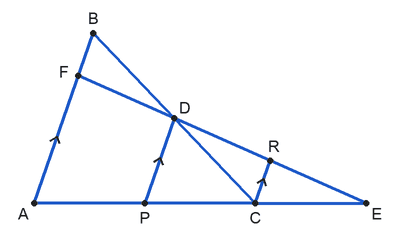
Given: AC is produced to E with CE=21AC; D is the mid-point of BC; ED produced meets AB at F; DP ∥ AB meets AC at P and CR ∥ AB meets EF at R.
Step 1 — P is the mid-point of AC.
In ΔABC, D is the mid-point of BC and DP ∥ AB. By the converse of the mid-point theorem, P is the mid-point of AC, and then by the mid-point theorem DP is half of AB.
Step 2 — C is the mid-point of EP.
CP is half of AC, and CE is also half of AC (given), so CP = CE: C is the mid-point of EP.
Step 3 — R is the mid-point of ED.
In ΔEDP, C is the mid-point of EP and CR ∥ DP (both are parallel to AB). By the converse, R is the mid-point of ED, so ER = RD, and by the mid-point theorem CR is half of DP.
Step 4 — Part (i): compare ΔDCR and ΔDBF.
CD = BD (D is the mid-point of BC)
∠CDR = ∠BDF (vertically opposite angles)
∠DCR = ∠DBF (alternate angles, CR ∥ AB with BC as transversal)
So ΔDCR ≅ ΔDBF by A.S.A., and by C.P.C.T.C. DR = DF.
Step 5 — Part (i): add the parts of EF.
ER = RD and RD = DF, so the three parts of EF are equal.
EF=ER+RD+DF=DF+DF+DF=3DF
Step 6 — Part (ii).
CR is half of DP, and DP is half of AB.
CR=21DP=21×21AB=41AB
Watch out: CE is half of AC, not half of AE; that is why C turns out to be the mid-point of EP.
Therefore, (i) 3DF = EF and (ii) 4CR = AB. Hence proved.