
Question 293 marksMedium
In triangle ABC, the medians BP and CQ are produced upto points M and N respectively such that BP = PM and CQ = QN.
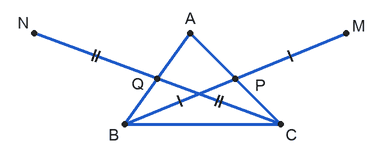
Prove that :
(i) M, A and N are collinear.
(ii) A is the mid-point of MN.
Confirming your payment
Sign up now and get 250 free tokens.
Mid-Point Theorem and Its Converse · Question 29 of 45
In triangle ABC, the medians BP and CQ are produced upto points M and N respectively such that BP = PM and CQ = QN.
Prove that :
(i) M, A and N are collinear.
(ii) A is the mid-point of MN.
Solution:
Concept: A quadrilateral is a parallelogram when both pairs of opposite sides are parallel, or when one pair of opposite sides is equal and parallel, or when its diagonals bisect each other. Through a point there is only one line parallel to a given line.
Given: BP and CQ are medians of ΔABC, produced to M and N with BP = PM and CQ = QN.
Step 1 — Part (i): ABCM is a parallelogram.
P is the mid-point of AC (BP is a median) and of BM (BP = PM). So the diagonals AC and BM of ABCM bisect each other, and ABCM is a parallelogram: AM ∥ BC and AM = BC.
Step 2 — Part (i): ANBC is a parallelogram.
Q is the mid-point of AB (CQ is a median) and of NC (CQ = QN). So the diagonals AB and NC of ANBC bisect each other, and ANBC is a parallelogram: AN ∥ BC and AN = BC.
Step 3 — Part (i): collinear.
AM and AN are both parallel to BC and both pass through A. Only one line through A is parallel to BC, so M, A and N lie on it.
Step 4 — Part (ii).
AM = BC and AN = BC, so AM = AN, and A lies on MN between M and N. So A is the mid-point of MN.
Watch out: A median goes to the MID-POINT of a side; that is the second bisection each diagonal needs.
Therefore, (i) M, A and N are collinear and (ii) A is the mid-point of MN. Hence proved.