
Opening your dashboard
Class 12 Physics Chapter 3: Electric Potential Solutions
97 textbook questions with step-by-step answers, free to read, for ISC 2026-27.
Get talked through Ch 3, not just shown the answer
Reading a finished solution is not the same as being able to do it. The AI tutor takes one question at a time and works it with you, in your own words, until you can.
- Ask it out loud, in your own words
- It gives you the next step, not the answer
- Stuck on part (ii)? Start there
97 questions with solutions
1–5 marks · Mixed difficulty
The first 27 solutions are on this page. This chapter is a long one, so the rest open on their own page to keep this one quick to load.
- 11 mark
Question 1
A ball of mass 1 g carrying a charge of moves from point A at potential 600 V to a point B at zero potential. The change in its kinetic energy is
Solve with AIAnswer
- Correct
(A)
(B)
(C)
(D)
Answer: (A)
Key idea: When a charge moves from a point at potential to a point at potential , the field does work on it. If only the field acts, this work appears as the gain in kinetic energy.
Step 1 — Find the potential difference.
The ball moves from to , so it falls through .
Step 2 — Find the change in kinetic energy.
We multiply the charge by the fall in potential.
The mass of the ball is not needed for the energy; it would be needed only to find the speed.
Why the other options are wrong:
- (B) is wrong: The charge moves to lower potential, so the field does positive work and the kinetic energy increases; this option has both the wrong sign and the wrong power of ten.
- (C) is wrong: A gain of through would need a charge of , not .
- (D) is wrong: A gain of through would need a charge of about , far more than the ball carries.
Therefore, the kinetic energy of the ball increases by : option (A).
- 21 mark
Question 2
The potential at a point due to a positive charge of at a distance of 9 m is
Solve with AIAnswer
(A)
(B)
- Correct
(C)
(D)
Answer: (C)
Key idea: The potential at distance from a point charge is , with .
Step 1 — Write the charge in coulomb.
The charge is , which in coulomb is .
Step 2 — Put the values into the formula.
We use .
Why the other options are wrong:
- (A) is wrong: Dividing by instead of gives about , which is the field in , not the potential.
- (B) is wrong: A potential of would need ; at the potential is ten times smaller.
- (D) is wrong: A potential of would need , a hundred times closer than the point asked about.
Therefore, the potential at the point is : option (C).
- 31 mark
Question 3
When a charge of 3 C is placed in a uniform electric field, it experiences a force of 3000 N. With this field, the potential difference between two points separated by a distance 1 cm is
Solve with AIAnswer
(A) 1000 V
(B) 100 V
(C) 300 V
- Correct
(D) 10 V
Answer: (D) 10 V
Key idea: The electric field is the force per unit charge, .
In a uniform field the potential difference between two points a distance apart along the field is .
Step 1 — Find the field.
We divide the force by the charge.
Step 2 — Find the potential difference over cm.
We multiply the field by the distance, (1 cm).
Why the other options are wrong:
- (A) is wrong: The number is the field in ; it has not been multiplied by the distance of cm.
- (B) is wrong: Using instead of gives V; cm is one hundredth of a metre.
- (C) is wrong: A potential difference of V over cm would need a field of , thirty times the field found from .
Therefore, the potential difference between the two points is 10 V: option (D).
- 41 mark
Question 4
How much work is required to carry a charge from the negative terminal to the positive terminal of 9 V battery?
Solve with AIAnswer
(A)
- Correct
(B)
(C)
(D)
Answer: (B)
Key idea: The work needed to carry a charge through a potential difference is . The positive terminal of a V battery is V above the negative terminal.
Step 1 — Write the charge in coulomb.
The charge is .
Step 2 — Find the work.
We multiply the charge by the potential difference of V.
Why the other options are wrong:
- (A) is wrong: The power treats the charge as mC; a microcoulomb is C, not C.
- (C) is wrong: The power treats the charge as nC, a thousand times too small.
- (D) is wrong: The power treats the charge as pC, a million times too small.
Therefore, the work required is : option (B).
- 51 mark
Question 5
The electric potential V is given as a function of distance (metre) by volt. Value of electric field at m is
Solve with AIAnswer
- Correct
(A)
(B)
(C)
(D)
Answer: (A)
Key idea: The electric field is the negative of the potential gradient. For a potential that depends only on , the field is along the x-axis.
Step 1 — Differentiate the potential.
We differentiate term by term; the constant gives zero.
Step 2 — Find the field at x = 1 m.
We put into the gradient and change its sign.
The minus sign means the field points along the negative x-direction, because increases with there. This is option (A).
Why the other options are wrong:
- (B) is wrong: Its sign is right, but a size of 23 V/m would need a gradient of 23 V/m at m, but is only 20 V/m there.
- (C) is wrong: Putting into itself gives 11 (from 5 + 10 − 4), which is the potential in volt, not the field.
- (D) is wrong: A positive value would mean the field points along , but the potential rises with at this point, so the field must point along .
Therefore, the electric field at m is (20 V/m along the negative x-direction): option (A).
- 61 mark
Question 6
An electric field exists in space around a point charge . A positive charge is carried from A to B and A to C where B and C lie on the circle with at the centre as shown in the figure. Work done is
 Solve with AI
Answer
(A) greater along path AC than along AB
(B) greater along path AB than along AC
- Correct
(C) same in both cases
(D) zero in both cases
Answer: (C) same in both cases
Key idea: Work done in moving a charge in an electrostatic field depends only on the potentials of the start and end points, , not on the path.
Step 1 — Compare the potentials of B and C.
B and C lie on a circle centred on , so both are the same distance from . The potential of a point charge depends only on distance, so the circle is an equipotential.
Step 2 — Write the work for each path.
Both paths start at the same point A, so we use the same starting potential .
Step 3 — Compare the two works.
Since , the two expressions are equal.
The work is the same in both cases. This is option (C).
Why the other options are wrong:
- (A) is wrong: Path AC is longer in the figure, but in an electrostatic field the work does not depend on the length of the path, only on its end points.
- (B) is wrong: For the same reason, path AB cannot need more work than AC; both end on the same equipotential.
- (D) is the closest alternative: In the figure as drawn A also lies on the circle, so A, B and C are all at the same potential and the work happens to be zero in both cases. The question tests that the work is the same for both paths, which holds wherever A is.
Note: If A is a point on the circle, as the figure shows, both works are zero, so statement (D) is also true; the key (C) is the answer that holds for any position of A.
Therefore, the work done is the same in both cases: option (C).
- 71 mark
Question 7
A charge of 5 C is given a displacement of 0.5 m. The work done in the process is 10 J. The potential difference between the two points will be
Solve with AIAnswer
(A) 30 V
(B) 5 V
(C) 0.25 V
- Correct
(D) 2 V
Answer: (D) 2 V
Key idea: The potential difference between two points is the work done per unit charge in moving a charge between them.
Step 1 — Note what is given.
The work is J and the charge is C. The displacement of 0.5 m is not needed, because potential difference is work per unit charge, not per unit length.
Step 2 — Divide the work by the charge.
We put the work and the charge into .
This is option (D).
Why the other options are wrong:
- (A) is wrong: A potential difference of 30 V would need J of work, fifteen times the 10 J given.
- (B) is wrong: Multiplying the work by the displacement, , gives 5; that product is not work per unit charge.
- (C) is wrong: Working out gives 0.25; it divides the wrong way and brings in the displacement.
Therefore, the potential difference between the two points is 2 V: option (D).
- 81 mark
Question 8
The work done in moving a charge of 20 C from A to B over a distance of 0.2 m is 2 J. Then is
Solve with AIAnswer
(A)
- Correct
(B)
(C)
(D)
Answer: (B)
Key idea: The work done (by an external agent) in moving a charge from A to B is . It depends only on the end points, so the distance moved does not enter.
Step 1 — Find .
We divide the work by the charge.
Step 2 — Reverse the order to get .
Swapping the two potentials changes the sign.
The answer is negative because positive work was needed, so B is at the higher potential. This is option (B).
Why the other options are wrong:
- (A) is wrong: Multiplying by the distance, , gives V; the distance does not enter, and the sign must be negative.
- (C) is wrong: It is positive, but B is at the higher potential, so must be negative; its size is also three times .
- (D) is wrong: It is positive as well, so it has the wrong sign, and its size V is not V.
Therefore, : option (B).
- 91 mark
Question 9
A work of 100 J is performed in carrying a charge of C from infinity to a particular point in an electrostatic field. The potential of this point is
Solve with AIAnswer
(A) 500 V
(B) 5 V
- Correct
(C) V
(D) V
Answer: (C) V
Key idea: The potential at a point is the work done per unit charge in bringing a charge from infinity to that point (potential at infinity is zero).
Step 1 — Put in the work and the charge with its sign.
The work is J and the charge is C. The sign of the charge must be kept.
Step 2 — Simplify.
Dividing a positive work by a negative charge gives a negative potential.
Positive work was needed to bring a negative charge in, so the point is at a negative potential. This is option (C).
Why the other options are wrong:
- (A) is wrong: Multiplying the work by the size of the charge, , gives 500; potential is work divided by charge.
- (B) is wrong: It is positive, but bringing a negative charge in needed positive work, so the potential must be negative.
- (D) is wrong: A potential of V would need J of work, not 100 J.
Therefore, the potential of the point is V: option (C).
- 101 mark
Question 10
The S.I. unit of line integral of electric field is
Solve with AIAnswer
(A) N/C
- Correct
(B) J/C
(C) V/m
(D)
Answer: (B) J/C
Key idea: The line integral of the electric field, , multiplies a field (N/C) by a length (m). Its negative is the potential difference between the end points.
Step 1 — Multiply the units.
The unit of field is N/C and the unit of is m.
Step 2 — Write N m as joule.
One newton metre is one joule, so the unit is joule per coulomb, which is the volt.
This is option (B).
Why the other options are wrong:
- (A) is wrong: N/C is the unit of the field itself, before it is multiplied by a length.
- (C) is wrong: V/m is another way of writing the unit of field (1 V/m = 1 N/C), so it also leaves out the length.
- (D) is wrong: This unit is field times area, the unit of electric flux, not field times length.
Therefore, the S.I. unit of the line integral of electric field is J/C (volt): option (B).
- 111 mark
Question 11
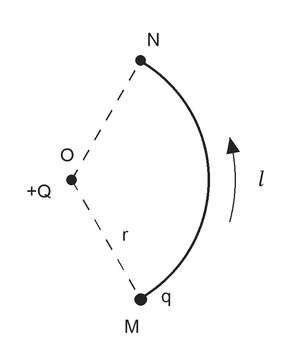
In the adjoining figure, a charge is fixed. Another charge is moved along a circular arc MN of radius around it from the point M to the point N such that the length of the arc MN . The work done in this process is
 Solve with AI
Answer
- Correct
(A) zero
(B)
(C)
(D)
Answer: (A) zero
Key idea: Work done in an electrostatic field is ; points at equal distance from a point charge are at equal potential.
Step 1 — Compare the directions of force and motion.
The force on due to acts along the radius, while each small displacement along the arc is along the tangent. The two are at .
Step 2 — Check with potentials.
M and N are both a distance from , so they are at the same potential.
Both methods give zero work. This is option (A).
Why the other options are wrong:
- (B) is wrong: It is the Coulomb force multiplied by the arc length, which treats the force as if it acted along the path; here it is perpendicular to the path.
- (C) is wrong: It equals times option (B), so it repeats the same force-times-length mistake.
- (D) is wrong: It has no length factor at all; is twice the Coulomb force, with the unit newton, not joule.
Therefore, the work done in moving along the arc MN is zero: option (A).
- 121 mark
Question 12
The electric potential energy of a system of two positive point charges of each placed in air 1 m apart is
Solve with AIAnswer
(A)
(B)
- Correct
(C)
(D)
Answer: (C)
Key idea: The potential energy of two point charges , a distance apart in air is
Step 1 — Write the data in S.I. units.
Each charge is C, the distance is m, and .
Step 2 — Substitute.
We put the two charges and the distance into the formula.
The energy is positive because both charges are positive (they repel). This is option (C).
Why the other options are wrong:
- (A) is wrong: Taking as (milli) instead of gives J.
- (B) is wrong: Leaving out the micro prefixes treats each charge as 1 C, and two 1 C charges 1 m apart would have J.
- (D) is wrong: The number is right, but the formula gives joule in S.I. units, not electron volt.
Therefore, the electric potential energy of the system is : option (C).
- 131 mark
Question 13
A point charge is kept at each of the vertices of an equilateral triangle having each side . Total electrostatic potential energy of the system is
Solve with AIAnswer
(A)
(B)
- Correct
(C)
(D)
Answer: (C)
Key idea: The potential energy of a system of point charges is the sum of over every pair, each pair counted once.
Step 1 — Count the pairs.
Three charges at the corners of a triangle make three pairs, and each pair is a side apart.
Step 2 — Write the energy of one pair.
Each pair has two charges separated by a distance .
Step 3 — Add the three equal pairs.
The three pairs have equal energies, so we multiply one pair's energy by 3.
This is option (C).
Why the other options are wrong:
- (A) is wrong: The in the denominator belongs to force or field; potential energy falls as .
- (B) is wrong: With to the first power it has the unit of potential (volt), not energy (joule).
- (D) is wrong: (times ) has the unit of electric field, not energy.
Therefore, the total electrostatic potential energy is : option (C).
- 141 mark
Question 14
The electrostatic potential energy of two point charges each placed 1 metre apart in air is
Solve with AIAnswer
(A)
(B)
- Correct
(C)
(D)
Answer: (C)
Key idea: The potential energy of two point charges , a distance apart in air is
Step 1 — Write the data in S.I. units.
Each charge is C, the distance is m, and .
Step 2 — Substitute.
We put the two charges and the distance into the formula.
The energy is positive because both charges are positive (they repel). This is option (C).
Why the other options are wrong:
- (A) is wrong: Taking as (milli) instead of gives J.
- (B) is wrong: Leaving out the micro prefixes treats each charge as 1 C, and two 1 C charges 1 m apart would have J.
- (D) is wrong: The number is right, but the formula gives joule in S.I. units, not electron volt.
Therefore, the electric potential energy of the two charges is : option (C).
- 151 mark
Question 15
An electric dipole of moment is placed in a uniform electric field . It has maximum (negative) potential energy when the angle between and is
Solve with AIAnswer
(A)
- Correct
(B) zero
(C)
(D)
Answer: (B) zero
Key idea: A dipole of moment in a uniform field has potential energy
Step 1 — Write the energy in terms of the angle.
If is the angle between and , the dot product gives a cosine.
Step 2 — Find where U is most negative.
The energy is most negative when has its largest value, 1. This happens at .
At the dipole points along the field and is in stable equilibrium. This is option (B).
Why the other options are wrong:
- (A) is wrong: At , , so , not the most negative value.
- (C) is wrong: At , , so , the largest positive energy (unstable equilibrium).
- (D) is wrong: At , again, so .
Therefore, the potential energy is maximum negative () when the angle between and is zero: option (B).
- 161 mark
Question 16
The charges , and are placed on the circumference of a circle of radius 1.0 m as shown in the figure. What is the value of charge placed on the same circle, if the potential at the centre is zero?
 Solve with AI
Answer
(A)
(B)
(C)
- Correct
(D) 0
Answer: (D) 0
Key idea: Potential is a scalar, so the potentials of several charges add with their signs. A charge at distance gives .
Step 1 — Use the common distance.
All four charges are on the circle, so each is m from the centre C. The total potential at C is the common factor times the sum of the charges.
Step 2 — Set the potential to zero.
A zero potential at C means the sum of the charges is zero.
Step 3 — Solve for .
We move the three known charges to the other side.
The three given charges already add to zero, so no fourth charge is needed. This is option (D).
Why the other options are wrong:
- (A) is wrong: Adding cancels only and leaves a net charge of .
- (B) is wrong: Adding cancels only and leaves a net charge of .
- (C) is wrong: Adding cancels only and leaves a net charge of .
Therefore, : option (D).
- 171 mark
Question 17
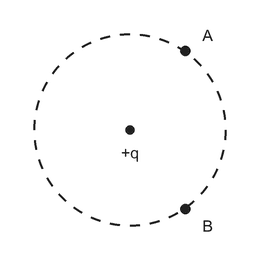
What would be the work done if a point charge is taken from a point A to a point B on the circumference of a circle drawn with another point charge at the centre?
 Solve with AI
Written solution
Solution:
Key idea: The work done in moving a charge between two points is , and a point charge has the same potential at every point a fixed distance from it.
Step 1 — Compare the potentials of A and B.
A and B are both on the circle, so both are one radius from the central charge . The potential of a point charge depends only on distance, so the circle is an equipotential.
Step 2 — Find the work.
We put the equal potentials into the work formula.
Therefore, the work done in taking from A to B is zero.
- 181 mark
Question 18
In a certain of space, the electric potential is found to be 5 V throughout. What is the electric field in the region?
Solve with AIWritten solution
Solution:
Key idea: The electric field is the negative of the potential gradient, , so it depends on how the potential changes from point to point, not on its value.
Step 1 — See how the potential changes.
The potential is 5 V at every point of the region, so it does not change with distance.
Step 2 — Find the field.
A zero change in potential gives a zero gradient.
Therefore, the electric field in the region is zero.
- 191 mark
Question 19
What is the shape of equipotential surfaces for a uniform electric field?
Solve with AIWritten solution
Solution:
Key idea: An equipotential surface is always perpendicular to the electric field at every point, since no work is done in moving a charge along it.
Step 1 — Use the direction of a uniform field.
A uniform field has the same direction everywhere, so every surface perpendicular to it is a flat plane.
Step 2 — Find the spacing of the planes.
In a uniform field changes by the same amount over each distance along the field, so planes for equal steps of potential are equally spaced.
Therefore, the equipotential surfaces of a uniform field are parallel planes perpendicular to the field, equally spaced for equal potential steps.
- 201 mark
Question 20
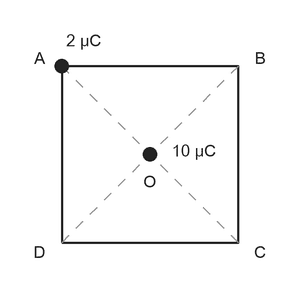
What is the work done in moving a point charge from the corner A to corner B of a square ABCD, when charge exists at the centre of the square?
 Solve with AI
Written solution
Solution:
Key idea: The work done in moving a charge is , and points at equal distance from a point charge are at equal potential.
Step 1 — Compare the distances from the centre.
The charge is at the centre O of the square. A and B are corners, and every corner of a square is the same distance (half a diagonal) from its centre.
Step 2 — Compare the potentials.
Equal distances from the same charge give equal potentials.
Step 3 — Find the work.
We put the equal potentials and the charge into the work formula.
Therefore, the work done in moving the charge from A to B is zero.
- 211 mark
Question 21
How much work is done in moving a charge of between two points on an equipotential surface?
Solve with AIWritten solution
Solution:
Key idea: The work done in moving a charge through a potential difference is .
Step 1 — Find the potential difference.
Every point of an equipotential surface is at the same potential, so two points on it have no potential difference.
Step 2 — Find the work.
We multiply the charge by the zero potential difference.
The size of the charge does not matter.
Therefore, no work is done (the work is zero) in moving the charge between two points on an equipotential surface.
- 221 mark
Question 22
A charge of 2 C moves between two plates maintained at a potential difference of 1 V. What is the energy acquired by the charge?
Solve with AIWritten solution
Solution:
Key idea: A charge that moves through a potential difference gains energy equal to the work done on it by the field.
Step 1 — Note the data.
The charge is C and the potential difference is V.
Step 2 — Multiply.
We multiply the charge by the potential difference.
Therefore, the energy acquired by the charge is 2 J.
- 231 mark
Question 23
Name the physical quantity which has its unit joule . Is it scalar or vector?
Solve with AIWritten solution
Solution:
Key idea: A joule per coulomb is work (energy) per unit charge, which is how potential is defined.
Step 1 — Name the quantity.
Electric potential at a point is the work done per unit positive charge in bringing a charge from infinity to that point, so its unit is (the volt). Potential difference has the same unit.
Step 2 — Decide scalar or vector.
Work and charge are both scalars, so their ratio has size only and no direction. Potentials of several charges are added as plain numbers with signs.
Therefore, is the unit of electric potential (or potential difference), and it is a scalar quantity.
- 241 mark
Question 24
What is an equipotential surface?
Solve with AIWritten solution
Solution:
Key idea: The electric potential due to a charge distribution has a value at every point of space; points with the same value can be joined into a surface.
Step 1 — State the definition.
A surface on which the electric potential is the same at every point is called an equipotential surface. It is the locus of all points at the same potential due to the given charges.
Step 2 — Note its main property.
Since between any two of its points, no work is done in moving a charge along it, so the field is perpendicular to the surface everywhere.
Therefore, an equipotential surface is a surface on which every point is at the same electric potential.
- 251 mark
Question 25
Define electric potential at a point in an electric field.
Solve with AIWritten solution
Solution:
Key idea: Potential measures the work needed per unit charge to bring a charge in from infinity, where the potential is taken as zero.
Step 1 — State the definition.
The electric potential at a point is the work done in bringing a unit positive test charge from infinity to that point, without acceleration, against the electric field.
Step 2 — Write it as a formula.
If work is needed to bring a small test charge from infinity, the potential is
Its S.I. unit is the volt (), and it is a scalar.
Therefore, electric potential at a point is the work done per unit positive charge in bringing a test charge from infinity to that point without acceleration.
- 261 mark
Question 26
Define the unit of electric potential.
Solve with AIWritten solution
Solution:
Key idea: From , the unit of potential is the unit of work divided by the unit of charge.
Step 1 — Name the unit.
The S.I. unit of electric potential is the volt (V).
Step 2 — Define one volt.
When 1 J of work is done per 1 C of charge, the ratio is one joule per coulomb, which is one volt.
Therefore, the potential at a point is 1 volt if 1 joule of work is done in bringing a charge of 1 coulomb from infinity to that point.
- 271 mark
Question 27
Distinguish between electric potential and potential energy and state the relation connecting them.
Solve with AIWritten solution
Solution:
Key idea: Potential belongs to a point in the field of a source charge; potential energy belongs to a charge placed at that point (strictly, to the system of charges).
Step 1 — Describe electric potential.
The electric potential at a point is the work done per unit positive charge in bringing a test charge from infinity to that point. For a source charge at distance :
It is measured in volt and does not depend on any charge placed at the point.
Step 2 — Describe potential energy.
The potential energy is the total work done in bringing a given charge from infinity to that point. For the pair:
It is measured in joule and depends on both charges.
Step 3 — Connect the two.
Comparing the two formulae, the potential energy is the potential times the charge placed at the point.
Therefore, potential is work per unit charge (volt), potential energy is the work for the actual charge (joule), and they are related by .
- 281 mark
Question 28
Two charges and are placed at points A and B, 0.06 m apart. Identify an equipotential surface of the system.
- 291 mark
Question 29
Write the unit of electric potential in terms of basic units of S.I.
- 301 mark
Question 30
Three charges , and are placed on the circumference of a circle of radius 1.0 m as shown in the figure. What is the value of charge placed on the same circle, if the potential at the centre ?

- 311 mark
Question 31
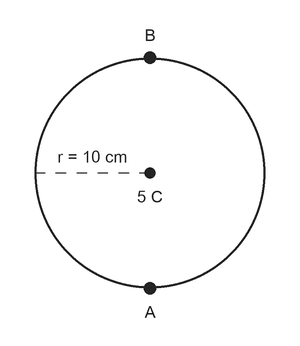
A charge of 5 C is placed at the centre of a circle of radius 10 cm as shown in the figure. Calculate the work done in moving a charge of 2 C from point A to B on the circumference of the circle.
- 321 mark
Question 32
What will be the nature of electric potential at a place where the electric field is zero?
- 331 mark
Question 33
How much work will be done by an external agent to turn an electric dipole of moment through (i) , (ii) (end-for-end) and (iii) from the direction of uniform electric field ?
- 341 mark
Question 34
How much kinetic energy is gained by an electron, initially at rest, when it moves through a potential difference of 1000 V? Give your answer in joule.
- 351 mark
Question 35
In an electric dipole, what is the locus of a point of zero potential?
- 361 mark
Question 36
How much work is done in taking an electron around a nucleus in circular orbit?
- 371 mark
Question 37
In an electric dipole, at which point is the electric potential zero?
- 381 mark
Question 38
(i) Define equipotential surface. (ii) Can two equipotential surfaces intersect?
- 391 mark
Question 39
The electric potential at any point (all in metre) in space is given by volt. What is the electric field at the point (1 m, 0, 2 m)?
- 401 mark
Question 40
A hollow metal sphere of radius 10 cm is charged such that the potential on its surface is 20 volt. What is the potential at the centre of the sphere?
- 412 marks
Question 41
What is meant by 'electric potential'? How is it measured?
- 422 marks
Question 42
What is meant by the line integral of an electric field?
- 432 marks
Question 43
What is electron volt? How is it related to joule?
- 442 marks
Question 44
The electric potential in a region is constant. Does it mean that the electric field is also zero?
- 452 marks
Question 45
Define potential difference. Give its S.I. unit.
- 462 marks
Question 46
Give the dimensional formula of potential. Name the quantity whose S.I. unit is V/m.
- 472 marks
Question 47
Potential is a scalar quantity. Is potential gradient also a scalar quantity?
- 482 marks
Question 48
Write down the expression for the electric potential due to a charged hollow conductor.
- 492 marks
Question 49
Derive an expression for the velocity acquired by a charged particle moving in an electric field.
- 502 marks
Question 50
Write down the expression for the electric potential energy of two charges and separated by a distance . To which charge, this potential energy belong? Explain.
- 512 marks
Question 51
Draw diagrams to show the equipotential surface of (a) an isolated positive charge and (b) a positive and a negative charge separated by a distance.
- 522 marks
Question 52
"The electric potential due to an electric dipole at a point on the broad side on position is zero". Why?
- 532 marks
Question 53
Show that the work done to rotate an electric dipole in a uniform field is , where is the dipole moment.
- 542 marks
Question 54
Show that the electric intensity is equal to the negative potential gradient.
- 552 marks
Question 55
Obtain an expression for the potential due to a collection of point charges.
- 562 marks
Question 56
Write down the expression for kinetic energy acquired by a charged particle accelerated under a potential difference.
- 572 marks
Question 57
Obtain an expression for the potential energy of a system of three charges.
- 582 marks
Question 58
Draw a graph to show the variation of electric potential and electric intensity due to a charged conducting sphere with distance .
- 592 marks
Question 59
What is electrostatic shielding?
- 602 marks
Question 60
The electrostatic potential energy of a system of three charges , and is given by . State very briefly in words, or by mathematical equations, what does each of the terms on the right-hand side stand for.
- 612 marks
Question 61
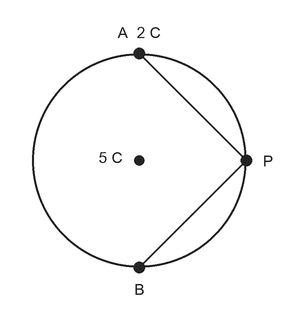
(a) A charge of 5 C is placed at the centre of a circle of radius 10 cm as shown in the figure. Calculate the work done in moving a charge of 2 C from point A to B on the circumference of the circle.
(b) If the charge 2 C be first taken from A to P and then from P to B, then along which path more work will be done.
- 622 marks
Question 62
Three equal charges of each are placed at the three vertices of an equilateral triangle of side 5.0 cm each. Calculate the electrostatic potential energy of the system of charges.
- 632 marks
Question 63
An electron revolves around the nucleus of hydrogen atom in a circular orbit of radius m. Calculate the (a) intensity of electric field of the nucleus at the position of the electron and (b) electrostatic potential energy of the hydrogen nucleus and electron system.
- 643 marks
Question 64
Derive an expression for the electric potential due to an electric dipole at any point.
- 653 marks
Question 65
Derive an expression for the work done to rotate an electric dipole through an angle in a uniform electric field.
- 663 marks
Question 66
Obtain an expression for the electric potential at a point, which is at a distance from the point charge Q.
- 673 marks
Question 67
Show that the electric potential at a point P, at a distance from a fixed point charge Q is given by .
- 683 marks
Question 68
Obtain an expression for the electric potential at a point in an end on position, i.e., axial position of an electric dipole.
- 695 marks
Question 69
What is an electric dipole? Derive an expression for the electric potential due to a dipole at (a) an axial point (or a point on the end on position) and (b) an equatorial point.
- 705 marks
Question 70
Derive an expression for the potential energy of an electric dipole placed in a uniform electric field. What is the minimum value and maximum value of the potential energy?
- 715 marks
Question 71
Derive an expression for the potential of a (a) uniformly charged ring and (b) uniformly charged disc at a point on the axis.
- 725 marks
Question 72
(a) Explain the concept of (i) potential and (ii) potential difference.
(b) Derive the relation connecting electric intensity and potential. Show that the electric intensity at a point in an electrostatic field is the negative potential gradient.
- 735 marks
Question 73
(a) What is meant by electric potential energy?
(b) Derive an expression for the potential energy of a system of (i) two charges and (ii) charges.
- 743 marks
Question 74
The work done to carry a charge of C from a point where the potential is V to another point whose potential is not known, is J. Calculate the unknown potential.
- 753 marks
Question 75
Calculate the potential at a point due to a charge at a distance of m from it.
- 763 marks
Question 76
Two protons are separated by a distance of m. Calculate the mutual potential energy of the system. Charge of a proton C.
- 773 marks
Question 77
A charged spherical conductor has a surface density of . When its charge is increased by C, the charge density changes by . Find the radius of the sphere.
- 783 marks
Question 78
The electric potential at any point is given by . Find the cartesian components of the electric field at that point.
- 793 marks
Question 79
The potential difference between two parallel conducting plates is V and the electric field at any point between the plates is V/m. Calculate the distance between the plates.
- 803 marks
Question 80
Two parallel plates are cm apart. The electric intensity between them is N/C. Calculate the potential difference between the plates.
- 813 marks
Question 81
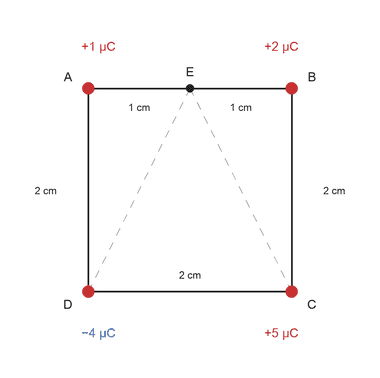
Charges , , and are placed at the corners of a square taken in order as shown in the figure. If the length of the side is cm, find the potential at the middle point of the side joining and .
- 823 marks
Question 82
Two point charges and are separated by a distance of cm. Calculate the potential at a point midway between them.
- 833 marks
Question 83
A conductor carrying of charge is placed at at a distance of cm from and cm from . Calculate the work done in taking a charge of from to in the field of the charge.
- 843 marks
Question 84
In a spark plug, the gap between the two electrodes is m. An electric field of about V/m is needed to produce an electric spark in a gasoline-air mixture. Calculate the minimum voltage supplied by the ignition circuit when the car is started.
- 853 marks
Question 85
A spherical shell of radius is given a charge . What is the work done in taking a unit charge once along a complete great circle?
- 863 marks
Question 86
When a positron is accelerated under certain potential difference, it acquires a speed of of the speed of light (the mass of the positron is same as that of an electron). Calculate the speed acquired by a proton accelerated from rest under the same potential difference.
- 873 marks
Question 87
In a typical television picture tube, an electron beam is accelerated through a potential difference of kV before striking the screen of TV. Calculate the speed of the electron when it strikes the screen.
- 883 marks
Question 88
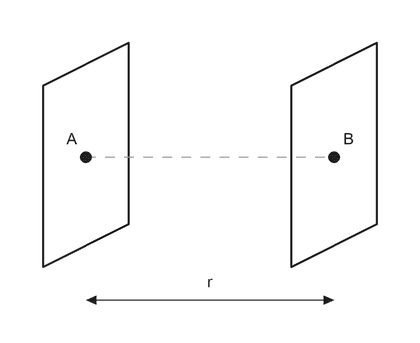
The given figure shows two parallel equipotential surfaces and kept at a small distance from each other. A point charge of C is taken from the surface to . Calculate the work done to carry a point charge of C from the surface to .
- 893 marks
Question 89
When a charge of C is placed in a uniform electric field, it experiences a force of N. What is the potential difference between two points separated by a distance of cm?
- 903 marks
Question 90
The electric intensity due to a point charge at a point distant from the charge is N/C and the electric potential at the same point is V. Find the values of and .
- 913 marks
Question 91
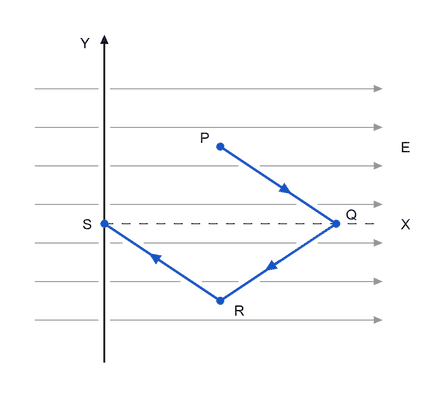
A point charge moves from point to point along the path as shown in the figure, in a uniform electric field pointing coparallel to the positive direction of the -axis. The coordinates of the points , , and are , , and respectively. Calculate the work done by the field in the above process.
- 923 marks
Question 92
Two small balls having equal positive charge C on each are suspended by two insulating strings of equal length m from a hook fixed to a stand. The whole setup is taken in a satellite into space where there is no gravity. What is the angle between the strings?
- 933 marks
Question 93
An electric dipole consists of two charges and separated by a distance of cm. The dipole is placed in an external uniform field of intensity . Calculate the work done in rotating the dipole through .
- 943 marks
Question 94
An electric dipole consists of two charges and separated by a distance of cm. Calculate the electric potential due to this dipole at a point on the dipole axis distant cm from the centre of the dipole.
- 953 marks
Question 95
The work done to rotate an electric dipole in a uniform electric field of intensity N/C is J. Calculate the dipole moment of the dipole.
- 963 marks
Question 96
Calculate the work done to rotate an HCl molecule of dipole moment C m in a uniform electric field of N/C through .
- 973 marks
Question 97
The surface charge density of an infinite charged sheet is . How far apart are the equipotential surfaces whose potentials differ by volt?
What Class 12 Physics Ch 3 covers
The sections of the chapter, in the order the book takes them. Every question above comes from one of these.
- 01Electric Potential and Potential Difference
- 02Potential due to a Point Charge
- 03Relation between Electric Field and Potential
- 04Potential due to an Electric Dipole
- 05Potential due to a System of Charges
- 06Potential Energy of a Charge and the Electron Volt
- 07Potential Energy of a System of Charges
More ways to study this chapter
The same chapter asked three other ways. Practise it, revise it, and see what the board has set on Ch 3 before.
- Competency-Based Questions (CBQ)Case study questions: a situation, and the part of the chapter that answers it.40questionsOpen
- Previous Year QuestionsQuestions that have actually appeared in board papers, each tagged with its year.11questionsOpen
- Practice QuestionsExtra questions per chapter, for when one attempt at a method is not enough.121questionsOpen
Ch 3 in past ISC papers
The same chapter as the board has actually asked it. These are worded differently from the textbook exercise, which is the point of reading them.
- 11 mark
Board paper question 1
Two point charges of each are kept at a distance of in vacuum. Calculate their electrostatic potential energy.
Solve with AIWritten solution
Solution:
Key idea: The electrostatic potential energy of two point charges and a distance apart is . It is the work done in bringing one charge from infinity to its place near the other.
Step 1 — Write down the data.
Both charges are , the distance is , and the paper gives as .
Step 2 — Substitute in the formula.
We put the two charges and their separation into the formula.
The energy is positive because the two like charges repel, so work has to be done to bring them together.
Therefore, the electrostatic potential energy is .
- 21 mark
Board paper question 2
In Figure 1 below, a charge is fixed. Another charge is moved along a circular arc MN of radius around it, from the point M to the point N such that the length of the arc MN . The work done in this process is:
 Solve with AI
Answer
- Correct
(A) zero
(B)
(C)
(D)
Answer: (A) zero
Key idea: Work done in moving a charge between two points is . Every point on a circle centred on the point charge is at the same distance , so the arc MN lies on an equipotential surface.
Step 1 — Find the potentials at M and N.
Both points are a distance from , so they have the same potential.
Step 2 — Find the work done.
The potential difference between N and M is zero, so the work is zero.
We can see the same thing from the force: the electric force on acts along the radius, which is at to the arc at every point, so it does no work along the path.
Why the others are wrong:
- (B) This is the size of the force multiplied by the arc length, which would be the work only if the force acted along the path; here the force is perpendicular to the path.
- (C) This equals times force arc length; it has a wrong factor and, like (B), wrongly treats the radial force as acting along the arc.
- (D) This is twice the force ; it has the unit of force, not of work, and contains no length at all.
Therefore, the correct option is (A): the work done is zero.
- 31 mark
Board paper question 3
The electrostatic potential energy of two point charges, each, placed 1 metre apart in air is :
Solve with AIAnswer
(A)
(B)
- Correct
(C)
(D)
Answer: (C)
Key idea: The potential energy of two point charges and a distance apart in air is , with equal to .
Step 1 — Convert the charges to coulomb.
One microcoulomb is , so each charge is .
Step 2 — Substitute in the formula.
We put both charges and the distance of into the formula.
Why the others are wrong:
- (A) This value comes from taking as (a millicoulomb), which makes the energy a million times too large.
- (B) This value comes from taking each charge as , forgetting the factor for micro.
- (D) The number is right but the unit is wrong: is about , not .
Therefore, the correct option is (C): the potential energy is .
- 44 marks
Board paper question 4
Show that electric potential at a point P, at a distance 'r' from a fixed point charge Q, is given by:
Solve with AIWritten solution
Solution:
Key idea: The electric potential at a point is the work done in bringing a unit positive test charge from infinity to that point, against the electric field, without any change in its kinetic energy.
Step 1 — Set up the arrangement.
A point charge is fixed at O. We want the potential at P, where . Let the unit positive test charge be at a point A on the line OP produced, at a distance from O.
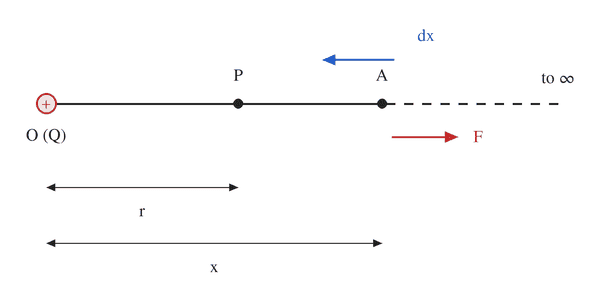
Step 2 — Force on the test charge at A.
By Coulomb's law, the force on a unit positive charge at A is directed away from (along OA).
Step 3 — Work done in a small displacement.
To move the test charge a small distance towards O, an external agent must push against this force. The work done by the agent is the force times the displacement towards O; since decreases, we write the displacement as .
Step 4 — Add up the work from infinity to P.
The total work is found by integrating as goes from infinity to .
Step 5 — Identify the potential.
This work was done on a unit positive charge, so by definition it is the potential at P.
The potential is a scalar. It is positive for a positive and negative for a negative , and it falls off as (not like the field).
Therefore, the potential at a distance from a point charge is .
- 51 mark
Board paper question 5
Define equipotential surface
Solve with AIWritten solution
Solution:
Key idea: An equipotential surface is linked to the work done in moving a charge: if the potential is the same everywhere on a surface, moving a charge on it needs no work.
Step 1 — State the definition.
An equipotential surface is a surface on which every point has the same electric potential.
Step 2 — Give its key property.
Since the potential difference between any two points of the surface is zero, no work is done in moving a charge along it, and the electric field is everywhere at right angles to the surface. For a point charge, the equipotential surfaces are spheres centred on the charge.
Therefore, an equipotential surface is a surface whose every point is at the same electric potential.
- 63 marks
Board paper question 6
Obtain an expression for electric potential V at the point in an end-on position, axial position of an electric dipole.
Solve with AIWritten solution
Solution:
Key idea: Potential is a scalar, so the potential of the dipole at a point is simply the sum of the potentials due to and ; no directions are involved.
Step 1 — Set up the dipole and the point.
The dipole has at A and at B, a distance apart, with centre O. Its moment points from A to B. The point P lies on the axis, beyond B, at a distance from O.

Step 2 — Distances of P from the charges.
P is nearer to B.
Step 3 — Potential due to each charge.
We use for a point charge at a distance .
Step 4 — Add the two potentials.
We add the two scalars and bring the bracket to a common denominator.
Step 5 — Bring in the dipole moment.
Since is the dipole moment :
Step 6 — Short dipole.
When is very small compared with , can be neglected beside .
The potential is positive on the side of and negative at the matching point beyond .
Therefore, at an axial point (and for a short dipole).
All 11 board paper questions for this chapter, solved the same way.
Class 12 Physics Ch 3 questions students ask
How many questions are there in Class 12 Physics Ch 3?
97 questions. Every one is solved step by step on this page.
Are these Class 12 Physics solutions free?
Yes. Every question and its full working is free to read, with no account needed.
Can I download the Class 12 Physics Ch 3 solutions as a PDF?
There is no PDF to download. Every solution is on this page instead, which means it is searchable, always the current syllabus, and readable on a phone. Use your browser's print option if you want it on paper.