
Question 683 marksMedium
Obtain an expression for the electric potential at a point in an end on position, i.e., axial position of an electric dipole.
Confirming your payment
Sign up now and get 250 free tokens.
Electric Potential · Question 68 of 97
Obtain an expression for the electric potential at a point in an end on position, i.e., axial position of an electric dipole.
Solution:
Concept: Potential is a scalar, so the potential of a dipole at a point is the algebraic sum of the potentials of and . No directions need to be resolved.
Step 1 — Describe the set-up and the distances.
The dipole has at A and at B, with , centre O and dipole moment . P lies on the axis on the side of , with , as in the figure. So P is a distance from and from .
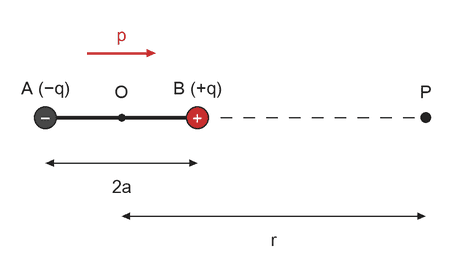
Step 2 — Write the potential of each charge.
The positive charge gives a positive potential and the negative charge a negative one.
Step 3 — Add the two potentials.
The total potential is the sum, which we simplify over a common denominator.
Step 4 — Simplify for a short dipole.
When is much larger than , the term is negligible compared with .
Step 5 — Note the other side of the axis.
On the side of the axis the nearer charge is , so the potential there has the same size but is negative.
Therefore, the potential at an axial point is , which for a short dipole becomes .