
Question 695 marksMedium
What is an electric dipole? Derive an expression for the electric potential due to a dipole at (a) an axial point (or a point on the end on position) and (b) an equatorial point.
Confirming your payment
Sign up now and get 250 free tokens.
Electric Potential · Question 69 of 97
What is an electric dipole? Derive an expression for the electric potential due to a dipole at (a) an axial point (or a point on the end on position) and (b) an equatorial point.
Solution:
Concept: Potential is a scalar, so the potential of a dipole is the algebraic sum of the potentials of its two charges, each of the form .
Step 1 — Define an electric dipole.
An electric dipole is a pair of equal and opposite point charges and separated by a small distance . Its dipole moment is a vector of size , directed from to ; its S.I. unit is the coulomb metre (C m).
Step 2 — Set up the axial point (part a).
Let the dipole have at A and at B, with centre O. P is on the axis on the side of , with , as in the figure. So P is a distance from and from .
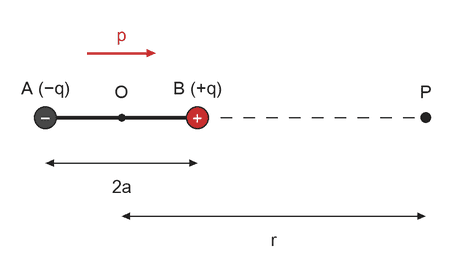
Step 3 — Add the potentials at the axial point.
The scalar sum of the two potentials is simplified over a common denominator.
Step 4 — Simplify for a short dipole.
When is much larger than , the term can be neglected compared with .
Step 5 — Set up the equatorial point (part b).
Now let P be on the perpendicular bisector of AB, at a distance from O, as in the second figure. By Pythagoras' theorem P is the same distance from both charges.

Step 6 — Add the potentials at the equatorial point.
The two charges are equal and opposite and at equal distances, so their scalar potentials cancel.
Watch out: The potential is zero at every point of the equatorial plane, but the electric field there is not zero; it points parallel to the axis, from the end towards the end.
Therefore, (a) at an axial point , about for a short dipole, and (b) at every equatorial point .