
Question 705 marksMedium
Derive an expression for the potential energy of an electric dipole placed in a uniform electric field. What is the minimum value and maximum value of the potential energy?
Confirming your payment
Sign up now and get 250 free tokens.
Electric Potential · Question 70 of 97
Derive an expression for the potential energy of an electric dipole placed in a uniform electric field. What is the minimum value and maximum value of the potential energy?
Solution:
Concept: The potential energy of a dipole in a uniform field is the work done by an external agent in turning it, slowly, from a chosen reference orientation to its actual orientation. The usual reference is the dipole perpendicular to the field, where the energy is taken as zero.
Step 1 — Find the torque on the dipole.
A dipole of moment makes an angle with a uniform field , as in the figure. The forces on and on are equal and opposite, so they form a couple whose arm is .
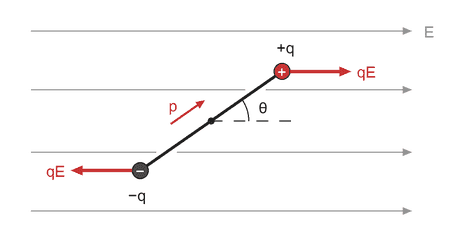
Step 2 — Find the work done in turning it.
Turning the dipole slowly through a small angle against this torque needs work . Integrating from to gives the work for a finite turn.
Step 3 — Choose the zero of potential energy.
Take the energy as zero when the dipole is perpendicular to the field, so . The potential energy at angle is then the work done in turning it from to .
In vector form this is the negative dot product of the dipole moment and the field.
Step 4 — Find the minimum value.
The energy is least when is greatest, that is when and points along . This is the position of stable equilibrium: if the dipole is turned a little, the torque turns it back.
Step 5 — Find the maximum value.
The energy is greatest when , that is when and points opposite to . This is the position of unstable equilibrium: a small turn makes the torque turn it further away.
Watch out: Some books take the zero of energy at and write . Only differences in energy have a physical meaning, and both choices give the same differences.
Therefore, the potential energy of the dipole is , the negative dot product of and , with minimum value (along the field, stable) and maximum value (opposite to the field, unstable).