
Question 715 marksHard
Derive an expression for the potential of a (a) uniformly charged ring and (b) uniformly charged disc at a point on the axis.
Confirming your payment
Sign up now and get 250 free tokens.
Electric Potential · Question 71 of 97
Derive an expression for the potential of a (a) uniformly charged ring and (b) uniformly charged disc at a point on the axis.
Solution:
Concept: Potential is a scalar, so the potential of a continuous charge is found by dividing it into small elements , writing for each, and adding (integrating). No directions have to be resolved.
Step 1 — Set up the ring (part a).
A thin ring of radius carries a charge spread uniformly round it. P is on its axis at a distance from the centre O, as in the figure.
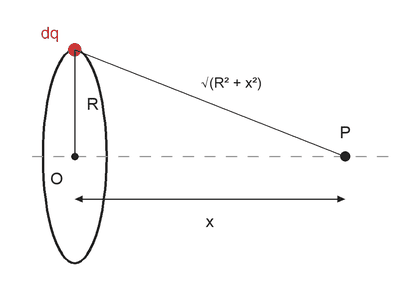
Step 2 — Write the potential of one element of the ring.
Every element of the ring is the same distance from P, which by Pythagoras' theorem is .
Step 3 — Add the potentials of all the elements.
The distance is the same for every element, so it comes outside the sum, and the elements add up to the whole charge .
At the centre () this becomes .
Step 4 — Set up the disc (part b).
A thin disc of radius has a uniform surface charge density . P is on its axis at a distance from the centre. We divide the disc into thin rings, as in the figure; a ring of radius and width has area .

Step 5 — Write the potential of one thin ring.
By the ring result of part (a), with in place of and in place of , the potential of this ring at P is as follows.
Step 6 — Add the potentials of all the rings.
The rings run from the centre, , to the rim, . The integral of is .
Step 7 — Write it in terms of the total charge and check it.
The total charge of the disc is , so can be replaced by .
Far from the disc () the bracket is close to , so the potential approaches , the potential of a point charge, as it should.
Therefore, (a) on the axis of the ring , and (b) on the axis of the disc .