(a) Explain the concept of (i) potential and (ii) potential difference.
(b) Derive the relation connecting electric intensity and potential. Show that the electric intensity at a point in an electrostatic field is the negative potential gradient.
Solution:
Concept: Potential and potential difference are defined by the work done per unit positive charge against the electric field. Because this work is linked to the field, the field can be found from how the potential changes with position.
Step 1 — Explain electric potential, part (a)(i).
The electric potential at a point is the work done in bringing a unit positive test charge from infinity to that point, without acceleration, against the electric field. If work W is needed for a test charge q0, the potential is the work per unit charge.
V=q0W
It is a scalar, measured in volts (1V=1J C−1), and the potential at infinity is taken as zero. A positive charge produces a positive potential around it and a negative charge a negative potential.
Step 2 — Explain potential difference, part (a)(ii).
The potential difference between two points A and B is the work done in moving a unit positive charge from A to B, without acceleration, against the field. If the work is WAB for a test charge q0, the potential difference is that work per unit charge.
VB−VA=q0WAB
It is also measured in volts, and it does not depend on the path taken, because the electrostatic field is conservative. A positive charge left free moves from higher to lower potential.
Step 3 — Set up two close points for part (b).
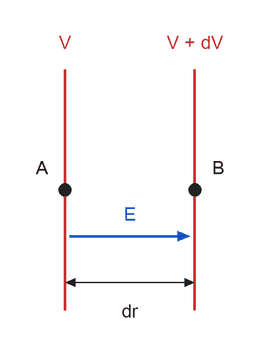
Let A and B be two very close points on the same field line, at distances r and r+dr measured along E, as in the figure. Their potentials are V and V+dV, where dV is negative because the potential falls along the field. Over this small distance E is uniform.
Step 4 — Find the work done against the field.
The force on a unit positive charge is E, from A towards B. To move it from B back to A, against the field, an agent must apply a force E through the distance dr.
WBA=Edr
Step 5 — Write the same work as a potential difference.
By the definition in Step 2, this work per unit charge equals the potential of A minus the potential of B.
WBA=VA−VB
WBA=V−(V+dV)
WBA=−dV
Step 6 — Equate the two expressions.
Both expressions give the same work, so we set them equal and divide by dr.
Edr=−dV
E=−drdV
Step 7 — Interpret the result.
The quantity drdV is the potential gradient, so the electric intensity equals the negative potential gradient. The minus sign shows that E points in the direction in which the potential decreases most rapidly. In three dimensions each component of the field is the negative rate of change of V along that axis, for example Ex=−∂x∂V.
Therefore, potential is the work per unit charge from infinity to a point, potential difference is the work per unit charge between two points, and the electric intensity is E=−drdV, the negative potential gradient.