
Question 643 marksMedium
Derive an expression for the electric potential due to an electric dipole at any point.
Confirming your payment
Sign up now and get 250 free tokens.
Electric Potential · Question 64 of 97
Derive an expression for the electric potential due to an electric dipole at any point.
Solution:
Concept: Potential is a scalar, so the potential of a dipole at any point is the algebraic sum of the potentials of its two charges. For a short dipole (point far away compared with the size of the dipole) the distances can be simplified.
Step 1 — Describe the set-up.
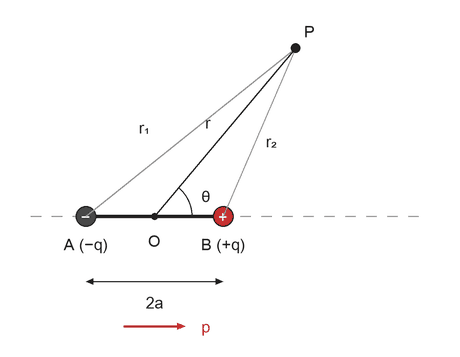
An electric dipole has charge at A and at B, a distance apart, with centre O. Its dipole moment has size , written , and points from to . P is a point at a distance from O, and the line OP makes an angle with OB. The distances AP and BP are called and .
Step 2 — Add the potentials of the two charges.
The charge is at distance and is at distance , so the scalar sum is as follows.
Step 3 — Find the distances for a far point.
Drop perpendiculars from A and B onto the line OP. When is much larger than , the lines AP and BP are almost parallel to OP. A is then farther from P than O is by the projection of OA on OP, and B is nearer by the same amount.
Step 4 — Find the difference and the product of the distances.
Subtracting and multiplying the two distances gives the quantities needed in Step 2.
For the term is negligible compared with .
Step 5 — Substitute and bring in the dipole moment.
Putting these into the result of Step 2, and using , gives the potential.
Step 6 — Check the special cases.
On the axis (), is 1, and on the equatorial line (), is 0.
Watch out: A dipole's potential falls as , faster than the of a single charge, because the two charges nearly cancel at a distance.
Therefore, the potential of a short dipole at a distance from its centre, along a line at angle to its axis, is .