
Question 653 marksMedium
Derive an expression for the work done to rotate an electric dipole through an angle in a uniform electric field.
Confirming your payment
Sign up now and get 250 free tokens.
Electric Potential · Question 65 of 97
Derive an expression for the work done to rotate an electric dipole through an angle in a uniform electric field.
Solution:
Concept: In a uniform field the two charges of a dipole feel equal and opposite forces, which form a couple. The work done by an external agent in turning the dipole slowly against this couple is found by adding torque times angle over the turn.
Step 1 — Find the torque on the dipole.
The figure shows a dipole of moment at an angle to a uniform field . The force on is along the field and the force on is opposite to it. The perpendicular distance between their lines of action is , so the torque of the couple is one force times this distance.
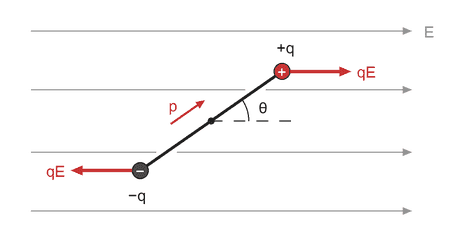
This torque tends to turn the dipole into line with the field.
Step 2 — Find the work for a small turn.
To turn the dipole through a further small angle slowly, against this torque, the external agent does work equal to torque times angle.
Step 3 — Add up the work from to .
Integrating the small pieces of work between the starting angle and the final angle gives the total work.
Step 4 — Start from the field direction.
If the dipole starts along the field () and is turned through an angle , we put .
Step 5 — Check two special turns.
A turn of gives , and a turn of (end for end) gives , the largest possible value.
Therefore, the work done to rotate the dipole from the field direction through an angle is , and in general from to it is .