
Opening your dashboard
Class 12 Physics Chapter 3 Electric Potential: Practice Questions
121 questions on Chapter 3, each worked through on its own page with the AI tutor. Class 12 Physics, ICSE 2026-27.
121 questions
1–4 marks · Mixed difficulty
- 11 mark
Question 1
An electron is moved slowly (with no change in its kinetic energy) from a point at potential to a point at potential . The work done by the external agent is (take )
- 22 marks
Question 2
Three points , and in an electrostatic field are at potentials , and . (Hypothetical data.)
(i) How much work must an external agent do to carry a charge of slowly from to ?
(ii) How much work does the electric field do on the same charge if it moves from to by way of ?
- 31 mark
Question 3
Which one of the following statements about electric potential is correct?
- 43 marks
Question 4
A tiny charged particle of mass and charge moves from point to point in an electric field. Its speed rises from at to at . Only the electric force acts on it. (Hypothetical data.)
(i) Find the potential difference .
(ii) Which point is at the higher potential?
(iii) A second particle of the same mass but charge is projected from towards with a speed of . Find its speed when it reaches .
- 52 marks
Question 5
During a thunderstorm, the potential difference between the base of a cloud and the ground is . A lightning flash carries of charge through this potential difference. Assume the potential difference stays constant during the flash. (Hypothetical data.)
(i) How much energy is released in the flash?
(ii) For how many days could this energy run a electric iron?
- 61 mark
Question 6
Points and are at distances and from a point charge. The potential at is . What are the potential at and the ratio of the electric field strengths at the two points?
- 73 marks
Question 7
A small charged metal ball can be treated as a point charge. The potential at a distance of from its centre is . (Hypothetical data.)
(i) Find the charge on the ball.
(ii) Find the work an external agent must do to bring a charge of slowly from to from the centre.
(iii) Find the electric field at from the centre.
(Take .)
- 81 mark
Question 8
A point charge is fixed at . Taking the potential at infinity as zero, which statement correctly describes the potential at a distance from ?
- 92 marks
Question 9
A point charge of is placed at a point .
(i) Find the potential at a point from in air.
(ii) The charge and the point are now placed deep inside a large tank of non-conducting oil of dielectric constant . Find the new potential at the point and state why it changes. (Hypothetical data.)
(Take .)
- 103 marks
Question 10
A student measures the potential at different distances from the centre of a small charged sphere, which acts as a point charge. (Hypothetical data.)
(m) 0.10 0.15 0.20 0.30 0.45 (V) 900 600 450 320 200 (i) Show that, except for one reading, . Which reading is wrong, and what should it be?
(ii) Find the charge on the sphere.
(iii) At what distance from the centre is the potential ?
(Take .)
- 111 mark
Question 11
The electric field in a region is along the -axis. The potential rises steadily from at to at , stays at from to , and then falls steadily to at . What is the electric field in the region ?
- 123 marks
Question 12
In a uniform electric field lying in the -plane, three points have the potentials shown. (Hypothetical data.)
: ; : ; :
(i) Find the magnitude and direction of the electric field.
(ii) Find the potential at .
(iii) Find the work done by the field when a charge of moves from to .
- 131 mark
Question 13
The electric potential in a region is , where is in volt and , are in metre. The electric field at the point is
- 142 marks
Question 14
At a point the electric field is directed due north (horizontally), and the field is uniform close to . (Hypothetical data.)
(i) In which direction from does the potential decrease most rapidly, and at what rate (in )?
(ii) At what rate does the potential decrease as we move from towards the north-east, and towards the east?
- 154 marks
Question 15
Along the -axis the electric potential is , where is in volt and in metre. The field has no component perpendicular to the -axis. (Hypothetical data.)
(i) Find the electric field as a function of .
(ii) At what point is the field zero, and what is the potential there?
(iii) Find the force on a charge of placed at .
(iv) Is the point found in (ii) a position of stable or unstable equilibrium for a positive charge (for small displacements along the -axis)? Give a reason.
- 161 mark
Question 16
The potential at a point on the axis of a short electric dipole, at a distance from its centre on the side of the positive charge, is . What is the potential at a point at the same distance from the centre, on a line making an angle of with the direction of the dipole moment ?
- 173 marks
Question 17
A water molecule has a permanent dipole moment of . Treat it as a short dipole.
(i) Find the potential at a point on its axis from its centre.
(ii) Compare this with the potential from a single proton.
(iii) By what factor does each potential fall when the distance is doubled to ? What does this tell you about the potential of a neutral molecule?
(Take and .)
- 181 mark
Question 18
At a point on the axial line of a short dipole, at distance from its centre, the potential is and the electric field has magnitude . At a point on the equatorial line at the same distance , the potential and the magnitude of the field are
- 193 marks
Question 19
An electric dipole consists of charges and placed apart.
(i) Find the exact potential at a point on its axis, on the side of the positive charge, from the centre of the dipole.
(ii) Find the value given by the short-dipole formula at the same point, and the percentage error.
(iii) Repeat (i) and (ii) for a point from the centre. What do you conclude?
(Take .)
- 202 marks
Question 20
A short electric dipole of dipole moment is placed at the origin with its moment along the direction. Find the potential at the points and . (Hypothetical data.)
(Take .)
- 211 mark
Question 21
A thin ring of radius carries a total charge , but the charge is spread unevenly (more of it on one half of the ring). The potential at the centre of the ring is
- 223 marks
Question 22
A thin ring of radius carries a charge of spread uniformly. Point lies on the axis of the ring, from its centre .
(i) Find the potential at .
(ii) Find the potential at .
(iii) How much work must an external agent do to bring a charge of slowly from to ?
(Take .)
- 231 mark
Question 23
The electric potential at a point , due to a system of charges, is zero (potential at infinity taken as zero). Which statement must be true?
- 241 mark
Question 24
Two equal positive charges are fixed at and . How does the potential change as we move along the -axis from just right of to just left of ?
- 253 marks
Question 25
Three point charges lie on the -axis: at the origin, at and at . Point is at .
(i) Find the potential at by adding the potentials of the three charges.
(ii) Estimate the potential at by treating the whole system as a single point charge at the origin. Find the percentage difference from (i).
(iii) Explain why the estimate in (ii) is so close.
(Take .)
- 261 mark
Question 26
A point in an electric field is at a potential of . The electric potential energy of an electron placed at is ()
- 273 marks
Question 27
A proton moving at enters an electric field along the field direction and is brought to rest by the field. (, .)
(a) Through what potential difference does the proton move before it stops?
(b) Is the point where it stops at a higher or a lower potential than the point where it entered? Give a reason.
(c) An -particle (mass , charge ) enters with the same speed. Through what potential difference must it move to be stopped?
(Hypothetical data.)
- 281 mark
Question 28
A gamma-ray photon emitted by a nucleus has an energy of . In electron volt units its energy is ()
- 293 marks
Question 29
An electron passes a point , where the potential is , with a kinetic energy of . Only the electric force acts on it.
(a) Find its kinetic energy, in eV and in joule, when it reaches a point where the potential is .
(b) Can it reach a point where the potential is ? Find the potential at the point where it comes to rest for an instant.
(; hypothetical data.)
- 302 marks
Question 30
Two parallel metal plates apart are kept at a potential difference of . An electron is released from rest at the negative plate. (, .)
(a) Find its kinetic energy, in eV and in joule, when it is halfway between the plates.
(b) Find its speed just before it reaches the positive plate.
(Hypothetical data.)
- 311 mark
Question 31
An electron moves from a point to a point in an electric field, with no other force acting on it. Its kinetic energy increases by . The potential difference is
- 321 mark
Question 32
Four equal point charges are held at the corners of a square of side . The electrostatic potential energy of the system is
- 333 marks
Question 33
Two small spheres, of mass with charge and of mass with charge , are held apart on a smooth, horizontal, insulating table. Both are released together.
(a) Find the electrostatic potential energy of the pair at the start.
(b) Find the speed of each sphere when they are very far apart.
(Treat the spheres as point charges and ignore air resistance. Hypothetical data.)
- 341 mark
Question 34
The electrostatic potential energy of a system of two point charges is negative. Which statement is correct?
- 353 marks
Question 35
A charge of is fixed at and a charge of is fixed at , apart in air. is a point from both and .
(a) Find the electrostatic potential energy of the two-charge system.
(b) How much work is needed to bring a charge of from infinity to ?
(c) Find the total potential energy of the three-charge system after the charge is placed at .
(Hypothetical data.)
- 362 marks
Question 36
In a sodium chloride molecule in the gas phase, the ions (charge ) and (charge ) are about apart. Treating the ions as point charges, find
(a) the electrostatic potential energy of the pair, in joule and in eV;
(b) the energy that must be supplied, according to this simple model, to pull the ions apart to infinity.
(.)
- 371 mark
Question 37
The electrostatic potential energy of two point charges at a separation is . If each charge is doubled and the separation is also doubled, the potential energy becomes
- 381 mark
Question 38
A dipole of moment is held at to a uniform electric field of . Its potential energy is (hypothetical data)
- 393 marks
Question 39
A dipole is made of charges and placed apart. It is in a uniform electric field of .
(a) Find its dipole moment.
(b) Find its potential energy when its axis makes and when it makes with the field.
(c) How much work must an external agent do to turn it slowly from to ?
(Hypothetical data.)
- 401 mark
Question 40
A dipole of moment , free to rotate about its centre, is released from rest with its axis at to a uniform field . Ignoring friction, its rotational kinetic energy as it swings through the direction of the field () is
- 412 marks
Question 41
An electric dipole in a uniform electric field has a potential energy of when it lies along the field.
(a) Find the torque on it when its axis makes with the field.
(b) How much work must an external agent do to turn it slowly from the direction of the field to with the field?
(Hypothetical data.)
- 423 marks
Question 42
A point charge of is in air. Equipotential surfaces are drawn for , and .
(a) Find the radius of each surface.
(b) Find the gaps between neighbouring surfaces.
(c) The potential steps are equal. Explain why the gaps are not.
(Hypothetical data.)
- 431 mark
Question 43
A pear-shaped metal conductor, with one rounded end much sharper than the other, is charged and isolated. Close to the conductor, the equipotential surfaces are
- 443 marks
Question 44
The figure shows four equipotential lines in a region of an electric field, with their potentials and spacings. Treat the field as uniform within each strip between neighbouring lines.

(a) Find the electric field in each strip. Where is the field strongest?
(b) State the direction of the field.
(c) Find the work done by the field when a charge of is moved from to , and when it is moved from to .
(Hypothetical data.)
- 451 mark
Question 45
The equipotential surfaces of a long, straight, uniformly charged wire are
- 462 marks
Question 46
An isolated charged conducting sphere of radius is at a potential of .
(a) Find the radius of the equipotential surface at outside it.
(b) How much work must an external agent do to carry a charge of slowly from this surface to the surface of the sphere?
(Hypothetical data.)
- 471 mark
Question 47
A small charged pith ball hangs at rest from an insulating thread inside a closed metal box, which is fixed on an insulating stand. A strongly charged rod is now brought close to the outside of the box. The pith ball
- 482 marks
Question 48
A point charge is placed inside a closed, uncharged metal shell, without touching it.
(a) The shell is insulated from the ground. Is the space outside the shell shielded from the field of ? Explain.
(b) What changes when the shell is connected to earth?
- 493 marks
Question 49
A thin hollow metal sphere of radius carries a charge of and stands in air.
(a) Find the electric field and the potential at a point from the centre.
(b) Find the electric field and the potential at a point from the centre.
(c) A small sensor inside the sphere is at a potential of more than a hundred volts, yet it is not affected by the charge. Explain why.
(Hypothetical data.)
- 502 marks
Question 50
Is the electrostatic potential necessarily zero at a point where the electric field strength is zero? Give an example to illustrate your answer.
- 511 mark
Question 51
The electric field is discontinuous across the surface of a charged conductor. Is the electric potential also discontinuous there?
- 522 marks
Question 52
What is the work done by the electric field of a nucleus in a complete circular orbit of the electron? What if the orbit is elliptical?
- 531 mark
Question 53
Name two units of electric intensity.
- 541 mark
Question 54
A metal cage is insulated and connected to 11 kV source; will a bird in it get a shock?
- 552 marks
Question 55
A charged particle is free to move in an electric field. Will it always move along electric lines of force?
- 562 marks
Question 56
Two point charges and are placed at a distance apart. What are the points at which the resultant field is parallel to the line joining the two charges?
- 572 marks
Question 57
The given figures show the field lines of single positive and negative charges, respectively.
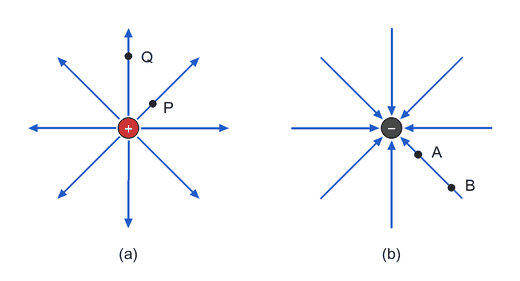
(i) Give the sign of the potential difference and
(ii) Give the sign of the potential energy difference of a small negative charge between the points Q and P; A and B.
(iii) Give the sign of the work done by the field in moving a small positive charge from Q to P.
(iv) Give the sign of the work done by an external agency in moving a small negative charge from B to A.
(v) Does the kinetic energy of a small negative charge increase or decrease in going from B to A?
- 582 marks
Question 58
Describe schematically the equipotential surfaces corresponding to
(i) a constant electric field in the z-direction
(ii) a field that uniformly increases in magnitude but remains in a constant (say z) direction
(iii) a single positive charge at the origin
- 592 marks
Question 59
A proton is released from rest in a uniform electric field. Does the electric potential energy increase or decrease? What happens to the electric potential energy?
- 602 marks
Question 60
The electric potential at a point is zero. Does it mean that there are no charges close to the point?
- 613 marks
Question 61
The electric potential at m from a point charge is V. What is the magnitude of the charge?
- 623 marks
Question 62
If joule of work must be done to move electric charge equal to C from a place where potential is V to another place where potential is volt, find the value of .
- 633 marks
Question 63
The electric field at a point due to a point charge is and the electric potential at that point is . Calculate the distance of the point from the charge and the magnitude of the charge.
- 643 marks
Question 64
Calculate the voltage needed to balance an oil drop carrying electrons, when located between the plates of a capacitor, which are mm apart. Given mass of the drop kg, charge C and .
- 653 marks
Question 65
Calculate the kinetic energy acquired by an alpha particle accelerated through a potential difference of one million volt.
- 663 marks
Question 66
At a point due to a point charge, the values of electric field intensity and potential are and , respectively. Calculate the magnitude of charge and distance of the charge from the point of observation.
- 673 marks
Question 67
An infinite thin plane sheet of charge density is held in air. How far apart are two equipotential surfaces whose potential differ by V?
- 682 marks
Question 68
An -particle is accelerated through a p.d. of V. What will be the increase in energy in electron volt?
- 692 marks
Question 69
Two positive charges each are situated cm apart from each other. What is the increase in electrostatic potential energy of the system when the two charges are brought closer by cm?
- 702 marks
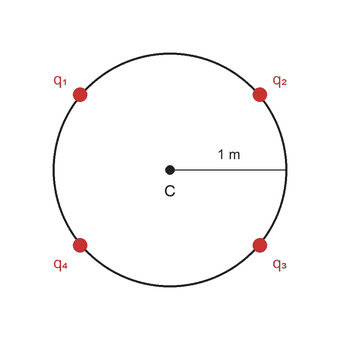
Question 70
The charges , and are placed on the circumference of a circle of radius m as shown in the figure. What is the value of charge placed on the same circle if the potential at the centre ?
- 712 marks
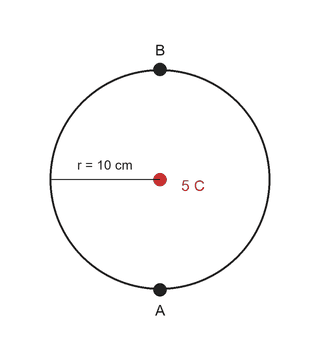
Question 71
A charge of C is placed at the centre of a circle of radius cm as shown in the figure. Calculate the work done in moving a charge of C from the point to on the circumference of the circle.
- 722 marks
Question 72
If J of work has to be done in moving an electric charge of C from a place where potential is V to another place where the potential is volt, find the value of .
- 731 mark
Question 73
A positive charge is located at a point. What is the work done if a unit positive charge is carried once around this charge along a circle of radius about this point?
- 742 marks
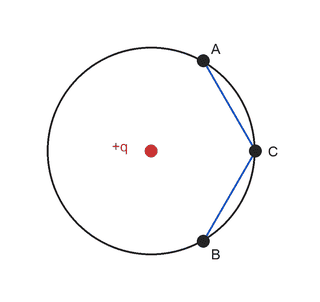
Question 74
If a point charge is taken first from to and then from to of a circle drawn with another point charge as centre (as shown in the figure), then along which path more work will be done?
- 752 marks
Question 75
A uniform electric field exists between two charged plates as shown in the figure. What would be the work done in moving a charge along the closed rectangular path ?

- 762 marks
Question 76
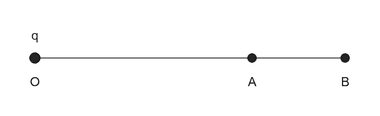
A point charge is placed at O as shown in the figure. Is positive, negative or zero, if is a (i) positive and (ii) negative charge?
- 771 mark
Question 77
A charge C placed at the centre of a spherical shell of radius cm. What will be the work done in moving a charge of on its surface through a distance cm?
- 782 marks
Question 78
Why is it necessary that the field lines from a point charge placed in the vicinity of a conductor must be normal to the surface of the conductor at every point?
- 792 marks
Question 79
The given figure shows the variation of electrostatic potential with ( being distance of the field point from the point charge) for two point charges and .

(i) What are the signs of the two charges?
(ii) Which of the two charges has a larger magnitude and why?
- 802 marks
Question 80
Electric charge is distributed uniformly on the surface of a spherical rubber balloon. Show how the value of electric intensity and potential vary (i) on the surface, (ii) inside the surface and (iii) outside the surface.
- 812 marks
Question 81
Two protons and are placed between two parallel plates having a potential difference as shown in the figure. Will these protons experience equal or unequal force?

- 821 mark
Question 82
The electric potential at a point is given by . The electric field at that point is
- 831 mark
Question 83
At a certain distance from a point charge, the electric field is and the potential is . What is this distance?
- 841 mark
Question 84
On rotating a point charge having a charge around a charge in a circle of radius , the work done will be
- 851 mark
Question 85
Which of the following statements is false for a perfect conductor?
- 861 mark
Question 86
Two conducting spheres of radii and are separated by a distance of in free space. If the spheres are charged to the same potential of each, the force of repulsion between them is
- 871 mark
Question 87
In a certain region of space with volume , the electric potential is found to be throughout. The magnitude of electric field in this region is
- 881 mark
Question 88
A conducting sphere of radius is given a charge . The electric potential and the electric field at the centre of the sphere, respectively are
- 891 mark
Question 89
Four point charges , , and are placed, one at each corner of the square. The relation between and for which the potential at the centre of the square is zero is
- 901 mark
Question 90
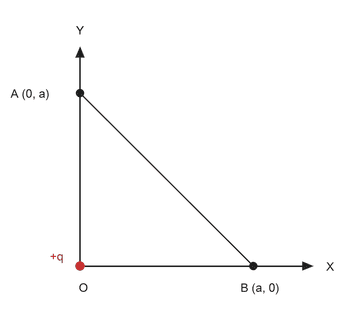
As per the given figure, a point charge is placed at the origin O. Work done in taking another point charge from the point A [coordinates ] to another point B [coordinates ] along the straight path AB is
- 911 mark
Question 91
Two charged spherical conductors of radius and are connected by a wire. Then the ratio of surface charge densities of the sphere is
- 921 mark
Question 92
The electric potential at a point in free space due to charge coulomb is volts. The electric field at that point is
- 931 mark
Question 93
A bullet of mass is having a charge of . Through what potential difference must it be accelerated, starting from rest, to acquire a speed of ?
- 941 mark
Question 94
A short electric dipole has a dipole moment of . The electric potential due to the dipole at a distance of from the centre of the dipole, situated on a line making an angle of with the dipole axis is
- 951 mark
Question 95
A, B and C are three points in a uniform electric field as shown in the figure. The electric potential is

- 961 mark
Question 96
A hollow metallic sphere of radius is charged such that potential of its surface is . The potential at the centre of the sphere would be
- 971 mark
Question 97
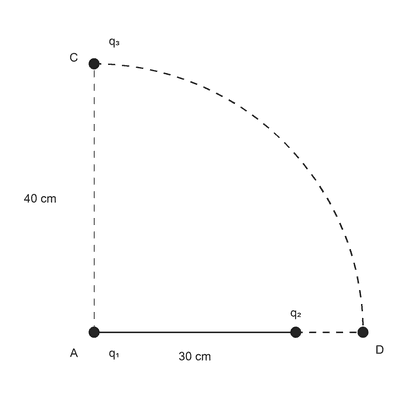
Two charges and are placed apart, as shown in the Figure. A third charge is moved along the arc of a circle of radius from C to D. The change in the potential energy of the system is , where is
- 981 mark
Question 98
A dipole is placed in an electric field as shown in the figure. In which direction will it move?

- 991 mark
Question 99
An electric dipole of moment is lying along a uniform electric field . The work done in rotating the dipole by is
- 1001 mark
Question 100
An electric dipole of dipole moment is aligned parallel to a uniform electric field . The energy required to rotate the dipole by is
- 1011 mark
Question 101
An electric dipole has the magnitude of its charge as and its dipole moment is . It is placed in a uniform electric field . If its dipole moment is along the direction of the field, the force on it and its potential energy, are respectively
- 1021 mark
Question 102
Some charge is being given to a conductor. Then its potential is
- 1031 mark
Question 103
A spherical shell of radius is carrying a charge . If the electric potential at distances , and from the centre of the spherical shell is , and respectively then
- 1041 mark
Question 104
If a charged spherical conductor of radius has potential at a point distant from its centre, then the potential at a point distant from the centre will be
- 1051 mark
Question 105
A charge is distributed over three concentric spherical shells of radii , and , such that their surface charge densities are equal to one another. The total potential at a point at distance from their common centre, where , would be
- 1061 mark
Question 106
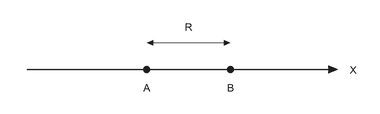
Two electric dipoles, A, B with respective dipole moments and placed on the -axis with a separation , as shown in the figure. The distance from A at which both of them produce the same potential is
- 1071 mark
Question 107
Four equal point charges each placed in the plane at , , and . The work required to put a fifth charge at the origin of the coordinate system will be
- 1081 mark
Question 108
The given graph shows variation (with distance from centre) of
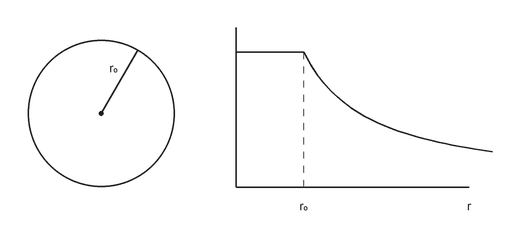
- 1091 mark
Question 109
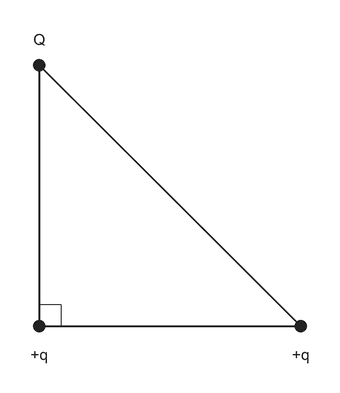
The charges , and are placed at the vertices of a right-angle i.e., isosceles triangle as shown in the figure. The net electrostatic energy of the configuration is zero, if the value of is
- 1101 mark
Question 110
A uniformly charged ring of radius and total charge is placed in -plane centred at origin. A point charge is moving towards the ring along the -axis and has speed at . The minimum value of such that it crosses the origin is
- 1111 mark
Question 111
The electric field in a region is given by , where is in and is in metres. The values of constants are SI unit, SI unit. If the potential at is and that at is , then is
- 1121 mark
Question 112
In free space, a particle A of charge is held fixed at a point P. Another particle B of the same charge and mass is kept at a distance of from P. If B is released, then its velocity at a distance of from P is
- 1131 mark
Question 113
A point dipole is kept at the origin. The potential and electric field due to this dipole on the -axis at a distance are, respectively (Take at infinity)
- 1141 mark
Question 114
Consider two charged metallic spheres and of radii and , respectively. The electric fields (on ) and (on ) on their surfaces are such that . Then the ratio (on ) / (on ) of the electrostatic potential on each sphere is
- 1151 mark
Question 115
Two isolated conducting spheres and of radius and have and charges, respectively and are at a large distance from each other. They are now connected by a conducting wire. A long time after this is done, the charges on and are respectively
- 1161 mark
Question 116
A particle of charge and mass is subjected to an electric field in the -direction, where and are constants. Initially, the particle was at rest at . Other than the initial position, the kinetic energy of the particle becomes zero when the distance of the particle from the origin is
- 1171 mark
Question 117
Concentric metallic hollow spheres of radii and hold charges and , respectively. Given that surface charge densities of the concentric spheres are equal, the potential difference is
- 1181 mark
Question 118
A short electric dipole has a dipole moment of . The electric potential due to the dipole at a point at a distance of from the centre of the dipole, situated on a line making an angle of with the dipole axis is
- 1191 mark
Question 119
In a certain region of space with volume , the electric potential is found to be throughout. The magnitude of electric field in this region is
- 1201 mark
Question 120
The two thin coaxial rings, each of radius and having charges and , respectively are separated by a distance of . The potential difference between the centres of the two rings is
- 1211 mark
Question 121
Three equal charges of are placed at the three vertices of an equilateral triangle of side each. The electrostatic potential energy of the system of charge is