
Opening your dashboard
Class 12 Physics Chapter 3 Electric Potential: Previous Year Questions
11 questions on Chapter 3, each solved step by step. Class 12 Physics, ICSE 2026-27.
11 questions with solutions
1–4 marks · Mixed difficulty
- 11 mark
Question 1
Two point charges of each are kept at a distance of in vacuum. Calculate their electrostatic potential energy.
Solve with AIWritten solution
Solution:
Key idea: The electrostatic potential energy of two point charges and a distance apart is . It is the work done in bringing one charge from infinity to its place near the other.
Step 1 — Write down the data.
Both charges are , the distance is , and the paper gives as .
Step 2 — Substitute in the formula.
We put the two charges and their separation into the formula.
The energy is positive because the two like charges repel, so work has to be done to bring them together.
Therefore, the electrostatic potential energy is .
- 21 mark
Question 2
In Figure 1 below, a charge is fixed. Another charge is moved along a circular arc MN of radius around it, from the point M to the point N such that the length of the arc MN . The work done in this process is:
 Solve with AI
Answer
- Correct
(A) zero
(B)
(C)
(D)
Answer: (A) zero
Key idea: Work done in moving a charge between two points is . Every point on a circle centred on the point charge is at the same distance , so the arc MN lies on an equipotential surface.
Step 1 — Find the potentials at M and N.
Both points are a distance from , so they have the same potential.
Step 2 — Find the work done.
The potential difference between N and M is zero, so the work is zero.
We can see the same thing from the force: the electric force on acts along the radius, which is at to the arc at every point, so it does no work along the path.
Why the others are wrong:
- (B) This is the size of the force multiplied by the arc length, which would be the work only if the force acted along the path; here the force is perpendicular to the path.
- (C) This equals times force arc length; it has a wrong factor and, like (B), wrongly treats the radial force as acting along the arc.
- (D) This is twice the force ; it has the unit of force, not of work, and contains no length at all.
Therefore, the correct option is (A): the work done is zero.
- 31 mark
Question 3
The electrostatic potential energy of two point charges, each, placed 1 metre apart in air is :
Solve with AIAnswer
(A)
(B)
- Correct
(C)
(D)
Answer: (C)
Key idea: The potential energy of two point charges and a distance apart in air is , with equal to .
Step 1 — Convert the charges to coulomb.
One microcoulomb is , so each charge is .
Step 2 — Substitute in the formula.
We put both charges and the distance of into the formula.
Why the others are wrong:
- (A) This value comes from taking as (a millicoulomb), which makes the energy a million times too large.
- (B) This value comes from taking each charge as , forgetting the factor for micro.
- (D) The number is right but the unit is wrong: is about , not .
Therefore, the correct option is (C): the potential energy is .
- 44 marks
Question 4
Show that electric potential at a point P, at a distance 'r' from a fixed point charge Q, is given by:
Solve with AIWritten solution
Solution:
Key idea: The electric potential at a point is the work done in bringing a unit positive test charge from infinity to that point, against the electric field, without any change in its kinetic energy.
Step 1 — Set up the arrangement.
A point charge is fixed at O. We want the potential at P, where . Let the unit positive test charge be at a point A on the line OP produced, at a distance from O.
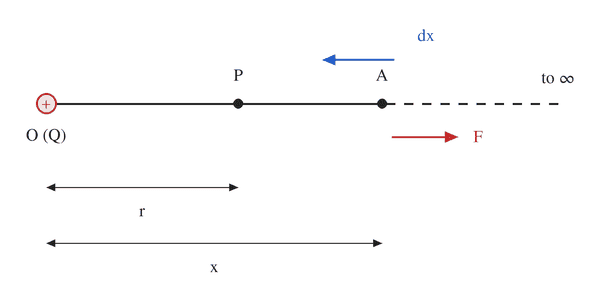
Step 2 — Force on the test charge at A.
By Coulomb's law, the force on a unit positive charge at A is directed away from (along OA).
Step 3 — Work done in a small displacement.
To move the test charge a small distance towards O, an external agent must push against this force. The work done by the agent is the force times the displacement towards O; since decreases, we write the displacement as .
Step 4 — Add up the work from infinity to P.
The total work is found by integrating as goes from infinity to .
Step 5 — Identify the potential.
This work was done on a unit positive charge, so by definition it is the potential at P.
The potential is a scalar. It is positive for a positive and negative for a negative , and it falls off as (not like the field).
Therefore, the potential at a distance from a point charge is .
- 51 mark
Question 5
Define equipotential surface
Solve with AIWritten solution
Solution:
Key idea: An equipotential surface is linked to the work done in moving a charge: if the potential is the same everywhere on a surface, moving a charge on it needs no work.
Step 1 — State the definition.
An equipotential surface is a surface on which every point has the same electric potential.
Step 2 — Give its key property.
Since the potential difference between any two points of the surface is zero, no work is done in moving a charge along it, and the electric field is everywhere at right angles to the surface. For a point charge, the equipotential surfaces are spheres centred on the charge.
Therefore, an equipotential surface is a surface whose every point is at the same electric potential.
- 63 marks
Question 6
Obtain an expression for electric potential V at the point in an end-on position, axial position of an electric dipole.
Solve with AIWritten solution
Solution:
Key idea: Potential is a scalar, so the potential of the dipole at a point is simply the sum of the potentials due to and ; no directions are involved.
Step 1 — Set up the dipole and the point.
The dipole has at A and at B, a distance apart, with centre O. Its moment points from A to B. The point P lies on the axis, beyond B, at a distance from O.

Step 2 — Distances of P from the charges.
P is nearer to B.
Step 3 — Potential due to each charge.
We use for a point charge at a distance .
Step 4 — Add the two potentials.
We add the two scalars and bring the bracket to a common denominator.
Step 5 — Bring in the dipole moment.
Since is the dipole moment :
Step 6 — Short dipole.
When is very small compared with , can be neglected beside .
The potential is positive on the side of and negative at the matching point beyond .
Therefore, at an axial point (and for a short dipole).
- 71 mark
Question 7
A point charge 'q' is kept at each of the vertices of an equilateral triangle having each side 'a'. Total electrostatic potential energy of the system Is
Solve with AIAnswer
(A)
(B)
- Correct
(C)
(D)
Answer: (C)
Key idea: The potential energy of a system of point charges is the sum of over every pair of charges, each pair counted once.
Step 1 — Count the pairs.
Three charges at the corners of a triangle form three pairs: (1, 2), (2, 3) and (1, 3). Each pair is a distance apart, because the triangle is equilateral.
Step 2 — Energy of one pair.
Each pair has two charges separated by .
Step 3 — Add the three pairs.
The three pairs are identical, so we multiply the energy of one pair by 3.
Why the others are wrong:
- (A) This uses in the denominator, as in Coulomb's force; potential energy varies as , not .
- (B) This has instead of ; the energy of each pair contains the product of its two charges, .
- (D) This makes both slips: only in the numerator and in the denominator.
Therefore, the correct option is (C): .
- 81 mark
Question 8
What is meant by an equipotential surface?
Solve with AIWritten solution
Solution:
Key idea: The word equipotential means "equal potential", so the surface is described by the potential of its points.
Step 1 — State the meaning.
An equipotential surface is a surface on which the electric potential has the same value at every point.
Step 2 — Say what follows.
Because there is no potential difference between its points, no work is done in moving a charge along such a surface, and the electric field lines cross it at right angles. Around a single point charge these surfaces are concentric spheres.
Therefore, an equipotential surface is a surface every point of which is at the same electric potential.
- 92 marks
Question 9
Calculate electric potential at a point P which is at a distance of from a point charge of .
Solve with AIWritten solution
Solution:
Key idea: The potential at a distance from a point charge is .
Step 1 — Convert to SI units.
We write the charge of as and the distance of as . We take as .
Step 2 — Substitute in the formula.
We put the charge and the distance into the formula.
Therefore, the electric potential at P is .
- 101 mark
Question 10
In an electric dipole, what is the locus of a point having zero potential?
Solve with AIWritten solution
Solution:
Key idea: The potential of a dipole at a point is the sum of the potentials of and . These cancel wherever the point is equally far from the two charges.
Step 1 — Find where the two potentials cancel.
At a point a distance from both charges, the potentials are and , where , so the total is zero. All such points lie on the perpendicular bisector of the dipole axis.
Step 2 — Name the locus.
This set of points is the equatorial line of the dipole. In space it is the equatorial plane, which passes through the centre of the dipole at right angles to its axis.
Therefore, the locus of zero potential is the equatorial line (the perpendicular bisector plane) of the dipole.
- 111 mark
Question 11
Calculate work done in moving a point charge 'q' through a distance 'd' along perpendicular bisector of an electric dipole, which consists of two-point charges and separated by a distance 'L'.
Solve with AIWritten solution
Solution:
Key idea: The work done in moving a charge from one point to another is . For a dipole, every point on the perpendicular bisector is equally far from and , so the potential there is zero.
Step 1 — Find the potential at any point of the perpendicular bisector.
A point of the bisector at a distance from each charge has potential:
This is true for every point of the bisector, whatever is.
Step 2 — Find the work done.
The starting point and the end point are both on the bisector, so both potentials are zero.
The result does not depend on the distance or on the dipole length .
Therefore, the work done is zero.