Solution:
Concept: The work done by an external agent in moving a charge q from A to B in an electrostatic field is q(VB−VA). It depends only on the end points, not on the path, because the electrostatic field is conservative.
Step 1 — Compare the potentials of A and B.
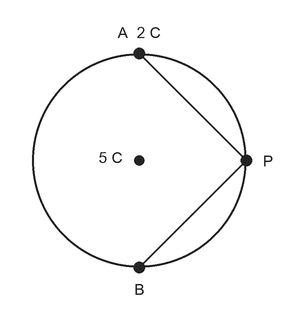
A and B are on the circle, so both are 10 cm from the 5 C charge at the centre. A point charge gives the same potential at the same distance, so the two potentials are equal.
VA=0.109×109×5 V
VA=4.5×10¹¹ V
VB=VA
Step 2 — Find the work from A to B.
The work is the charge moved times the change in potential, and the change is zero.
WAB=q(VB−VA)
WAB=2×0
WAB=0
Step 3 — Find the work along the path A to P to B.
P is also on the circle, so it is at the same potential as A and B. Each part of this path therefore needs zero work.
WAPB=WAP+WPB
WAPB=0+0
WAPB=0
Step 4 — Compare the two paths.
Both paths start at A and end at B, and work in an electrostatic field depends only on the end points. So both paths need the same work, which here is zero.
Therefore, (a) the work done in moving the 2 C charge from A to B is zero, and (b) the same work (zero) is done along A to P to B, so neither path needs more work.