
Opening your dashboard
Class 12 Physics Chapter 3 Electric Potential: Competency-Based Questions (CBQ)
40 questions on Chapter 3, each worked through on its own page with the AI tutor. Class 12 Physics, ICSE 2026-27.
40 questions
1–4 marks · Mixed difficulty
- 11 mark
Question 1
Competency: Analysis & Evaluation
A student finds the work done by the electric field on a test charge carried from point to point , once along a straight line and once along a curved path. Both answers come out the same.
Assertion (A): The potential difference between two points in an electrostatic field does not depend on the path along which a test charge is taken from to .
Reason (R): The electrostatic force is a non-conservative force.
- 23 marks
Question 2
Competency: Application
In a field-mapping experiment, a battery is connected across two metal electrodes painted on a sheet of conducting paper. A student measures the potential at points on the paper with a voltmeter whose reference lead touches the negative electrode. The readings are , and .
The teacher then moves the reference lead to the positive electrode and leaves everything else unchanged.
(a) What will the voltmeter now read at , and ?
(b) Find with each choice of reference and comment on the result.
(c) How much work does the electric field do on a small charge carried from to along any path? What can you say about a line on the paper through and along which all readings are equal?
(Hypothetical data.)
- 31 mark
Question 3
Competency: Application
The dome of a school Van de Graaff generator is a metal sphere of radius . Air next to the dome breaks down and sparks pass when the electric field at its surface reaches . Outside the dome, its charge acts as if it were concentrated at the centre. The highest potential the dome can reach is about (Hypothetical data.)
- 43 marks
Question 4
Competency: Analysis & Evaluation
A small charged metal sphere stands inside a closed display case, so its exact position cannot be measured. It can be treated as a point charge. Outside the case, a potential probe reads at a point . The probe is moved farther away from the sphere along the same straight line through its centre, to a point , where it reads . (; potential at infinity taken as zero.)
(a) Find the distance of from the centre of the sphere.
(b) Find the charge on the sphere and state its sign.
(c) How much farther beyond , along the same line, must the probe be moved to read ?
(Hypothetical data.)
- 51 mark
Question 5
Competency: Analysis & Evaluation
A lightning conductor on a tall building ends in a sharp metal point. The whole conductor is at one potential.
Assertion (A): The electric field just outside the sharp tip of the conductor is much stronger than the field just outside its flatter parts.
Reason (R): The electric field is strong where equipotential surfaces are crowded close together, because the field equals the negative potential gradient, .
- 61 mark
Question 6
Competency: Application
On a fine day, the potential of the air above flat open ground is measured with a balloon-borne probe, taking the ground as zero. It reads at a height of and at a height of . Assuming the field is uniform, the electric field near the ground is (Hypothetical data.)
- 73 marks
Question 7
Competency: Application
The membrane of a nerve cell is about thick. At rest, the inside of the cell is at relative to the outside. Treat the field inside the membrane as uniform. ()
(a) Find the magnitude and direction of the electric field inside the membrane.
(b) Find the electric force on a sodium ion (charge ) while it is inside the membrane.
(c) Find the work done by the electric field on the ion as it crosses the membrane from outside to inside. Give your answer in joule and in electron volt.
(Hypothetical data.)
- 81 mark
Question 8
Competency: Analysis & Evaluation
A student compares the potential at large distances from a single point charge with that from a short dipole made of and .
Assertion (A): Far from a short electric dipole, its potential falls off as , which is faster than the fall of the potential of a single point charge.
Reason (R): At distant points, the potentials due to and are nearly equal in size and opposite in sign, so they almost cancel.
- 91 mark
Question 9
Competency: Application
A point charge alone gives a potential of at a point , away. A charge is now fixed behind , on the line from through , so that is from . The potential at is now about (Hypothetical data.)
- 103 marks
Question 10
Competency: Analysis & Evaluation
A short electric dipole is sealed inside a small plastic bead at the origin . Its moment lies somewhere in the -plane, but its direction is not known. A potential probe, far from the bead compared with the dipole's length, gives these readings:
at : ; at : .
()
(a) Find the direction of the dipole moment . Give reasons.
(b) Find the magnitude of the dipole moment.
(c) Predict the reading at the point .
(Hypothetical data.)
- 111 mark
Question 11
Competency: Application
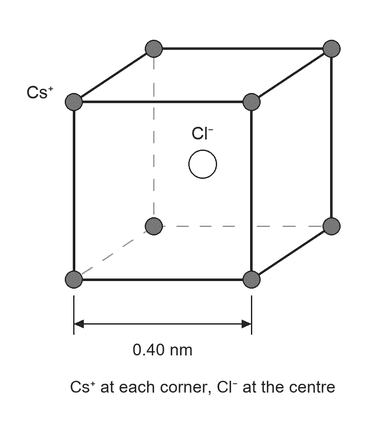
In a simple model of a caesium chloride crystal, a ion sits at the centre of a cube of side , and a ion (charge ) sits at each of the eight corners. The potential at the centre of the cube due to the eight ions is about (, ) (Hypothetical data.)
- 124 marks
Question 12
Competency: Application
In a sensor test, three small charged beads are fixed at the corners of a right-angled triangle in air, with the right angle at , and . The charges are at , at and at . is the midpoint of and is the midpoint of . ()

(a) Show that is the same distance from all three beads, and find the potential at .
(b) Find the potential at .
(c) How much work must an external agent do to carry a charge of slowly from to ?
(Hypothetical data.)
- 131 mark
Question 13
Competency: Analysis & Evaluation
In a cathode-ray tube, electrons leave the cathode, which is at a low potential, and are pulled towards the anode, which is at a high potential.
Assertion (A): When an electron moves from a point at lower potential to a point at higher potential, its electric potential energy decreases.
Reason (R): A positive charge that is free to move goes from a region of higher potential to a region of lower potential.
- 141 mark
Question 14
Competency: Application
In a photomultiplier tube, an electron leaves the photocathode (at ) with negligible energy. The first dynode is at , and each following dynode is higher than the one before it. If the electron could travel straight from the photocathode to the 6th dynode, its kinetic energy on arrival would be () (Hypothetical data.)
- 153 marks
Question 15
Competency: Application
In making computer chips, boron ions are fired into silicon by an ion implanter. Singly charged boron ions (charge , mass ) start from rest and are accelerated through a potential difference of . ()
(a) Find the kinetic energy gained by each ion, in keV and in joule.
(b) Find the speed of each ion.
(c) A few ions in the beam are doubly charged (, same mass). Through the same potential difference, what energy and speed do they gain?
(Hypothetical data.)
- 161 mark
Question 16
Competency: Analysis & Evaluation
Two students each assemble the same set of three point charges at the same three fixed positions, bringing them in from infinity one at a time, but in a different order.
Assertion (A): The electrostatic potential energy of the final system of three charges depends on the order in which the charges are brought into position.
Reason (R): The electrostatic force is conservative, so the work done against it depends only on the initial and final positions of the charges.
- 171 mark
Question 17
Competency: Application
Suppose a uranium nucleus splits into two equal fragments, each with charge , whose centres are apart just after the split. Treating them as point charges, the electrostatic potential energy of the pair, which later appears as their kinetic energy, is about (, ) (Hypothetical data.)
- 183 marks
Question 18
Competency: Analysis & Evaluation
In a scattering experiment, an alpha particle (charge ) with kinetic energy heads straight towards a gold nucleus (charge ). Treat both as point charges, and the gold nucleus as fixed. (, )
(a) What is the electrostatic potential energy of the alpha–gold system at the instant the alpha particle is closest to the nucleus? Give it in joule.
(b) Find the distance of closest approach.
(c) If the alpha particle had twice the kinetic energy, what would the distance of closest approach be?
(Hypothetical data.)
- 191 mark
Question 19
Competency: Analysis & Evaluation
A small electric dipole, free to turn about its centre, is placed in a uniform electric field with its moment pointing along .
Assertion (A): An electric dipole with its moment along a uniform electric field is in stable equilibrium.
Reason (R): The net force on an electric dipole in a uniform electric field is zero.
- 203 marks
Question 20
Competency: Analysis & Evaluation
A researcher hopes to line up ammonia molecules in a gas by applying a strong uniform electric field of . Each molecule has a dipole moment of . At room temperature, the typical energy of random thermal motion of a molecule is about . Air breaks down at about .
(a) Find the least and the greatest potential energy of one molecule in this field, and state the orientation for each.
(b) Find the energy needed to turn a molecule from its most stable orientation to its least stable one, and compare it with the thermal energy.
(c) Estimate the field for which this energy would equal the thermal energy, and use your answers to explain whether the molecules will be well lined up.
(Hypothetical data.)
- 211 mark
Question 21
Competency: Analysis & Evaluation
A student sketching equipotential surfaces in a region of strong electric field draws two of them crossing each other.
Assertion (A): Two equipotential surfaces can cross each other in a region where the electric field is strong.
Reason (R): The electric field at every point is perpendicular to the equipotential surface through that point.
- 221 mark
Question 22
Competency: Analysis & Evaluation
In a particle detector, an ion moves under the electric force alone. Over one stretch of its path, its speed stays constant. Which conclusion is correct?
- 234 marks
Question 23
Competency: Analysis & Evaluation
In a computer simulation, a charge of is placed at the origin and a charge of at the point on the -axis, from . The potential at infinity is zero. The student is asked to find the surface on which the potential is zero.
(a) Find the two points on the -axis where the potential is zero.
(b) Show that the zero-potential surface is a sphere, and find its centre and radius.
(c) How much work is needed to take a small charge of from one of these zero-potential points to infinity? Explain.
(Hypothetical data.)
- 241 mark
Question 24
Competency: Analysis & Evaluation
A sensitive electronic circuit is kept inside a closed, hollow metal box placed near a high-voltage line. There is no charge inside the box.
Assertion (A): The electric field inside the empty cavity of the box is zero, even though a strong electric field exists outside it.
Reason (R): Charges given to or induced on a conductor reside on its inner surface.
- 253 marks
Question 25
Competency: Analysis & Evaluation
A hospital records very weak electrical signals from patients' brains in a room whose walls, floor and ceiling are lined with copper sheet connected to the earth. Just outside one wall, the electric field due to nearby equipment is uniform, , and points straight towards the wall.
(a) Explain how the copper lining keeps the electric field inside the room zero.
(b) Find the potential at a point outside the wall, and the potential at the centre of the room.
(c) A technician walks into the room carrying a plastic comb that has been charged by rubbing. Is the room still free of electric field inside? Explain.
(Hypothetical data.)
- 263 marks
Question 26
A uniform electric field of points along the axis; take the potential at the origin as zero, so . A dipole has at the origin and at the point .
(a) Find the potential energy of each charge in the field, and hence the potential energy of the dipole.
(b) Find and the angle between and , and check your answer with .
(c) Show that the answer to (a) would not change if the zero of potential were taken somewhere else.
(Hypothetical data.)
- 273 marks
Question 27
Calculate the potential at the centre of a square of each side m due to charges , , and at four corners of it.
- 283 marks
Question 28
The electric potential in a region along the -axis varies with distance (in metre) according to the relation . Calculate the force experienced by a charge placed at point m.
- 293 marks
Question 29
A point charge of mC is located at the origin. Calculate the work done in taking a small charge of C from a point to point via a point .
- 303 marks
Question 30
A regular hexagon of side cm has a charge at each of its vertices. Calculate the potential at the centre of the hexagon.
- 313 marks
Question 31
The radius of the first orbit of hydrogen atom is m. What is the potential energy of the electron-proton system of the hydrogen atom?
- 323 marks
Question 32
Two charges C and C are located at cm apart. At what point of the line joining the two charges is the electrical potential zero? Take the potential at infinity to be zero.
- 334 marks
Question 33
An electron is circulating around the nucleus of a hydrogen atom in a circular orbit of radius m. Calculate (a) the electric potential at the radius and (b) the electric potential energy of the atom in eV. What would be the electric potential due to a helium nucleus at the same radius? Take C.
- 344 marks
Question 34
An infinite number of charges each equal to are placed along the -axis at , , , … and so on. (a) Find the potential at the point , due to this set of charges. (b) What will be the potential, if in the above setup, the consecutive charges have opposite sign?
- 354 marks
Question 35
An electric dipole of length cm is placed with its axis making an angle of to a uniform electric field of . If it experiences a torque of N m, calculate (a) the magnitude of the charge on the dipole and (b) the potential energy of the dipole.
- 363 marks
Question 36
Two point charges and of values and are kept cm apart in air. Calculate the work done when the charge is moved by cm towards .
- 374 marks
Question 37
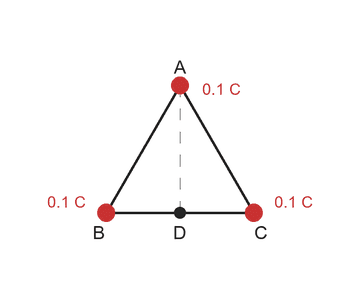
Three charges of C each are placed at the corners of an equilateral triangle as shown in the figure. If the energy is supplied at the rate of kW, how many days would be required to move this charge at A to a point D which is the midpoint of the line BC?
- 383 marks
Question 38
A charge of mC is located at the origin. Calculate the work done in taking a small charge of C from a point to a point via a point .
- 394 marks
Question 39
Two isolated metallic solid spheres of radii and are charged such that both of these have same charge density . The spheres are located far away from each other. What is the new charge density on the bigger sphere when the given spheres are connected by a thin conducting wire?
- 403 marks
Question 40
An ionised helium particle is situated at the origin . How much work is to be done in taking an electron from cm to cm?