
Question 512 marksEasy
Draw diagrams to show the equipotential surface of (a) an isolated positive charge and (b) a positive and a negative charge separated by a distance.
Confirming your payment
Sign up now and get 250 free tokens.
Electric Potential · Question 51 of 97
Draw diagrams to show the equipotential surface of (a) an isolated positive charge and (b) a positive and a negative charge separated by a distance.
Solution:
Concept: An equipotential surface is a surface on which every point has the same potential. No work is done in moving a charge along it, so the field has no component along it. Equipotential surfaces are therefore always perpendicular to the field lines.
Step 1 — Find the shape for an isolated positive charge.
The potential of a point charge depends only on the distance from it, as . All points at the same distance from the charge are at the same potential, so the equipotential surfaces are concentric spheres centred on the charge (circles in a diagram). The field lines are radial, so they cut every sphere at right angles. Spheres drawn for equal steps of potential get farther apart as increases, because falls as .
Step 2 — Find the shape for a positive and a negative charge.
For a pair and (an electric dipole), the potential at a point is the scalar sum of the two contributions. Close to each charge that charge dominates, so the equipotentials there are nearly spheres round it and are crowded together. Farther out they become flattened closed surfaces. Positive equipotentials surround and negative ones surround .
Step 3 — Locate the zero-potential surface.
Every point of the plane that perpendicularly bisects the line joining the charges is the same distance from both charges. The two equal and opposite contributions cancel there, so this plane is the zero-potential surface.
Step 4 — Draw the diagrams.
Diagram (a) shows concentric circles crossed at right angles by radial field lines. Diagram (b) shows field lines running from to , the equipotentials crossing them at right angles, and the dashed zero-potential line midway between the charges.
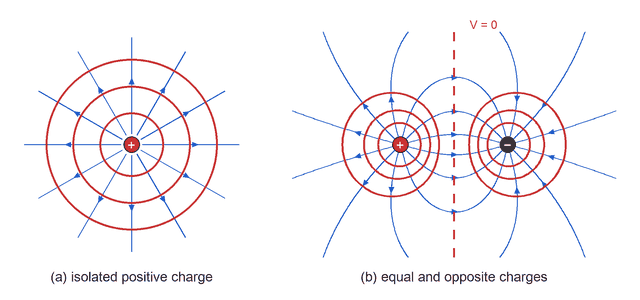
Therefore, (a) for an isolated positive charge the equipotential surfaces are concentric spheres centred on the charge, and (b) for a positive and a negative charge they are closed surfaces round each charge, with the perpendicular bisector plane as the zero-potential surface.