
Question 813 marksMedium
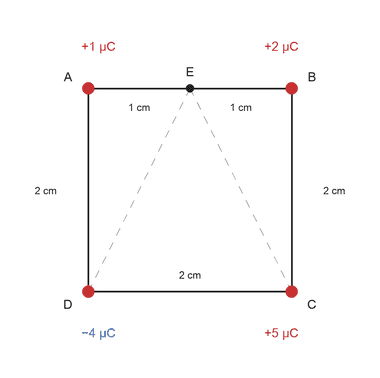
Charges , , and are placed at the corners of a square taken in order as shown in the figure. If the length of the side is cm, find the potential at the middle point of the side joining and .
Confirming your payment
Sign up now and get 250 free tokens.
Electric Potential · Question 81 of 97
Charges , , and are placed at the corners of a square taken in order as shown in the figure. If the length of the side is cm, find the potential at the middle point of the side joining and .
Solution:
Key idea: Potential is a scalar. The potential at a point due to several charges is the sum of for each charge, taken with its own sign; no directions are involved.
Step 1 — Name the point and the charges.
Let E be the midpoint of AB. Taking the corners in order, is at A, at B, at C and at D. The side is .
Step 2 — Find the distances of E from A and B.
E is the midpoint of the side AB, so it is half a side from each of these corners.
EB is the same, .
Step 3 — Find the distances of E from C and D.
The line from E to C is the hypotenuse of a right triangle with legs EB (1 cm) and BC (2 cm), so we use Pythagoras' theorem.
By symmetry ED is the same, .
Step 4 — Add the contributions of A and B.
These two charges are at the same distance, so we add the charges first and divide by the distance.
Step 5 — Add the contributions of C and D.
These two charges are also at one distance, and the charge at D is negative, so it is subtracted.
Step 6 — Find the total potential at E.
We add the two results and multiply by .
Therefore, the potential at the midpoint of AB is about .