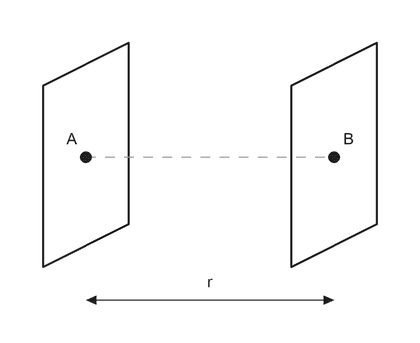
Solution:
Key idea: The work done in carrying a charge q0 from A to B is W=q0(VB−VA). It is zero only when the start and end points are at the same potential.
Step 1 — Write the general result.
Here the charge carried is q0=−q, so we put this into the formula.
W=−q(VB−VA)
W=q(VA−VB)
Step 2 — Apply the book's reading.
The book treats the charge as moving between points at the same potential, so VA=VB.
W=q×0
W=0
Note: the book's printed answer is zero; this holds only if the two surfaces are at the same potential. If they are different equipotentials with a field E between them, the work done is ±qEr (the sign depending on which surface is at the higher potential), not zero.
Therefore, the work done is zero when VA=VB (the book's answer).