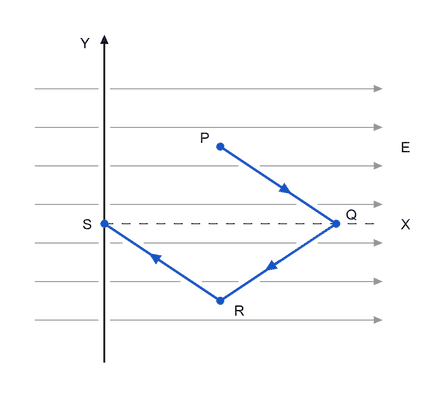
A point charge q moves from point P to point S along the path PQRS as shown in the figure, in a uniform electric field…
Question 913 marksMedium
A point charge q moves from point P to point S along the path PQRS as shown in the figure, in a uniform electric field E pointing coparallel to the positive direction of the x-axis. The coordinates of the points P, Q, R and S are (a,b,0), (2a,0,0), (a,−b,0) and (0,0,0) respectively. Calculate the work done by the field in the above process.
Solution:
Key idea: The electrostatic force qE is conservative, so the work it does depends only on the start point P and the end point S, never on the path PQRS. In a uniform field along +x, the force is qE along +x, so only the change of the x-coordinate matters.
W=qE(xS−xP)
Step 1 — Read the x-coordinates of the end points.
P is at (a,b,0) and S is at (0,0,0), so the x-coordinates are:
xP=a
xS=0
Step 2 — Find the displacement along the field.
We subtract the starting x-coordinate from the final one.
xS−xP=0−a
xS−xP=−a
The charge ends up a distance a further back against the field.
Step 3 — Find the work done by the field.
We multiply the force qE by the displacement along it.
W=qE×(−a)
W=−qEa
Going the long way through Q and R makes no difference: the work along PQ, QR and RS adds up to the same −qEa.