
Question 542 marksMedium
Show that the electric intensity is equal to the negative potential gradient.
Confirming your payment
Sign up now and get 250 free tokens.
Electric Potential · Question 54 of 97
Show that the electric intensity is equal to the negative potential gradient.
Solution:
Concept: The potential difference between two points is the work done per unit positive charge in moving a test charge from one point to the other against the field, without acceleration.
Step 1 — Set up two very close points on a field line.
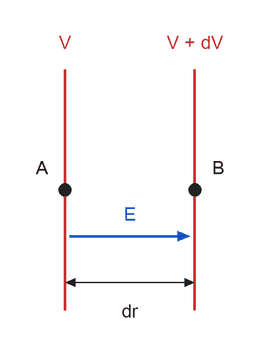
Let A and B be two very close points on the same field line, at distances and measured along , as in the figure. Their potentials are and , where is the change in potential (it is negative, since the potential falls along the field). The distance is so small that is uniform over it.
Step 2 — Find the work done against the field.
The force on a unit positive charge is , directed from A towards B. To move the charge from B back to A, an external agent must push with a force against the field through the distance .
Step 3 — Write the same work as a potential difference.
By definition, the work per unit charge from B to A equals the potential of A minus the potential of B.
Step 4 — Equate the two expressions.
Both expressions give the same work, so we set them equal and divide by .
Step 5 — Interpret the minus sign.
The quantity is the potential gradient. The minus sign shows that the potential decreases along the field, so points in the direction in which the potential falls most rapidly.
Therefore, : the electric intensity at a point equals the negative of the potential gradient there.