
Opening your dashboard
Class 10 Maths Chapter 19: Constructions Solutions
26 textbook questions with step-by-step answers, free to read, for ICSE 2026-27.
Get talked through Ch 19, not just shown the answer
Reading a finished solution is not the same as being able to do it. The AI tutor takes one question at a time and works it with you, in your own words, until you can.
- Ask it out loud, in your own words
- It gives you the next step, not the answer
- Stuck on part (ii)? Start there
26 questions with solutions
1–3 marks · Mixed difficulty
- 11 mark
Question 1
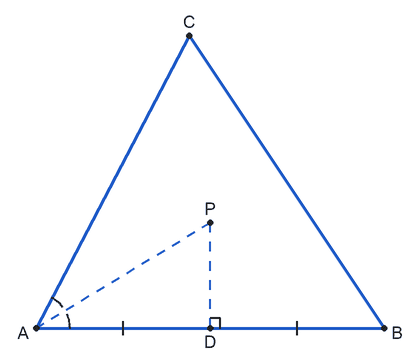
In the given figure, AP is bisector of angle A of ΔABC and DP is perpendicular bisector of side AB, then :
 Solve with AI
Answer
(A) P is incentre of ΔABC.
(B) P is circumcentre of ΔABC.
(C) PB bisects angle B.
- Correct
(D) none of these
Answer: (D) none of these
Concept: A point on the bisector of an angle is equally far from the two arms of the angle. A point on the perpendicular bisector of a segment is equally far from the two ends of the segment. The incentre needs two angle bisectors, and the circumcentre needs two perpendicular bisectors.
Step 1 — Read what each line tells us about P.
P lies on the bisector of ∠A, so P is equally far from the sides AB and AC. P also lies on the perpendicular bisector DP of AB, so PA = PB.
Step 2 — Test whether P is the incentre.
To be the incentre, P would also have to lie on the bisector of ∠B or ∠C. We are told only about ∠A, and an angle bisector together with a perpendicular bisector does not, in general, meet at the incentre.
Step 3 — Test whether P is the circumcentre.
To be the circumcentre, P would also have to be equally far from C (PC = PA). Nothing in the question gives this, and in general PC is not equal to PA.
Step 4 — Test whether PB bisects ∠B.
Since PA = PB, triangle PAB is isosceles, so its base angles are equal:
and ∠PAB is half of ∠A, because AP bisects ∠A. So ∠PBA is half of ∠A. PB would bisect ∠B only if half of ∠B were the same as half of ∠A, that is only when ∠A = ∠B, which is not given.
Watch out: Do not mix up the two kinds of bisector. An angle bisector leads to the incentre; a perpendicular bisector of a side leads to the circumcentre. One of each gives neither.
Why the other options are wrong:
- (A) P is incentre of ΔABC: the incentre needs a second angle bisector (of ∠B or ∠C). DP is a perpendicular bisector of a side, not an angle bisector.
- (B) P is circumcentre of ΔABC: the circumcentre needs a second perpendicular bisector (of BC or CA). AP is an angle bisector, not a perpendicular bisector.
- (C) PB bisects angle B: from PA = PB, ∠PBA is half of ∠A; this is half of ∠B only when ∠A = ∠B, which is not given.
Therefore, none of the statements (A), (B), (C) must be true, option (D).
- 21 mark
Question 2
Incentre of a triangle is the point of intersection of the :
Solve with AIAnswer
(A) perpendicular bisectors of its sides.
- Correct
(B) bisectors of its angles.
(C) one perpendicular of its side and bisector of any one angle of it.
(D) none of these.
Answer: (B) bisectors of its angles.
Concept: The incentre is the centre of the circle that touches all three sides of a triangle, so it must be equally far from all three sides.
Step 1 — Recall which points are equidistant from two sides.
Every point on the bisector of an angle is equally far from the two arms (sides) of that angle.
Step 2 — Find the point equidistant from all three sides.
The bisectors of ∠A and ∠B meet at one point. It is equally far from AB and AC, and from BA and BC, so it is equally far from all three sides. The bisector of ∠C also passes through it. This point is the incentre.
Watch out: The perpendicular bisectors of the sides give the circumcentre (equally far from the vertices), not the incentre.
Why the other options are wrong:
- (A) perpendicular bisectors of its sides: the perpendicular bisectors of the sides meet at the circumcentre, the centre of the circle through the vertices.
- (C) one perpendicular of its side and bisector of any one angle of it: a perpendicular bisector and an angle bisector do not, in general, meet at a special point (see Q1(a)).
- (D) none of these: option (B) is correct, so 'none of these' is wrong.
Therefore, the incentre is the point of intersection of the bisectors of the angles, option (B).
- 31 mark
Question 3
For a regular hexagon, inscribing a circle, the length of the side of the hexagon and the radius of the circle are :
Solve with AIAnswer
- Correct
(A) equal
(B) not equal
(C) side of hexagon is bigger than the radius of the circle.
(D) side of hexagon is smaller than the radius of the circle.
Answer: (A) equal
Concept: In a regular hexagon, the lines from the centre to the six vertices cut it into six equilateral triangles. So the distance from the centre to each vertex equals the side.
Step 1 — Read the question the way the book intends.
The book means a circle drawn through the six vertices of the regular hexagon (the hexagon inscribed in the circle, as in Q1(d)).
Step 2 — Use the six equilateral triangles.
Join the centre O to every vertex. The six angles at O are equal, each 360° ÷ 6 = 60°, and OA = OB (radii), so each triangle such as OAB has all its angles equal to 60°. It is equilateral, so OA = AB.
Step 3 — Compare the side and the radius.
The radius OA equals the side AB, so the two lengths are equal.
Watch out: The words "inscribing a circle" can also be read as a circle drawn inside the hexagon, touching its six sides. That circle's radius is the height of one equilateral triangle, side × ≈ 0·87 × side, which is smaller than the side.
Note: The question's wording admits both readings. The book's key (A) uses the circle through the vertices, so it is kept.
Why the other options are wrong:
- (B) not equal: in the intended reading (circle through the vertices) the side and the radius are exactly equal.
- (C) side of hexagon is bigger than the radius of the circle: in the intended reading they are equal. The side is bigger than the radius only in the other reading, a circle drawn inside the hexagon touching its sides (radius ≈ 0·87 × side); the printed key does not use that reading.
- (D) side of hexagon is smaller than the radius of the circle: the side is never smaller than the radius: it is equal to it (circle through the vertices) or bigger (circle touching the sides).
Therefore, for a regular hexagon in its circle, the side and the radius are equal, option (A).
- 41 mark
Question 4
For a regular hexagon of perimeter 18 cm inscribed in a circle, the radius of the circle is :
Solve with AIAnswer
(A) 6 cm
(B) 9 cm
- Correct
(C) 3 cm
(D) none of these
Answer: (C) 3 cm
Concept: A regular hexagon has six equal sides, and when it is inscribed in a circle, its side equals the radius of the circle (the six triangles formed at the centre are equilateral).
Step 1 — Find the side of the hexagon.
The perimeter is shared equally among the six sides, so we divide it by 6.
Step 2 — Find the radius.
For a regular hexagon inscribed in a circle, the radius equals the side, so the radius is 3 cm.
Watch out: Do not take half the perimeter or the diameter. The radius is the same as one side.
Why the other options are wrong:
- (A) 6 cm: 6 cm is the diameter of the circle (twice the radius), not the radius.
- (B) 9 cm: 9 cm is half the perimeter, which has no meaning here.
- (D) none of these: option (C), 3 cm, is correct.
Therefore, the radius of the circle is 3 cm, option (C).
- 51 mark
Question 5
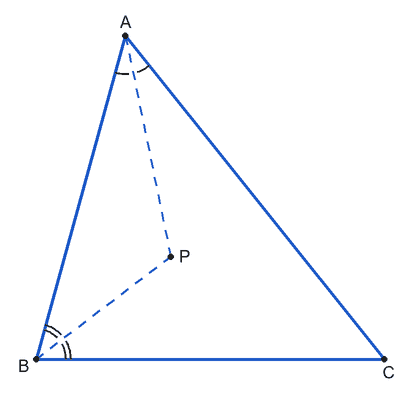
In triangle ABC, bisectors of angles A and B meet at point P.
Assertion (A) : PC bisects angle C.
Reason (R) : Bisectors of angles of a triangle are concurrent.
 Solve with AI
Answer
(A) A is true, R is false.
(B) A is false, R is true.
- Correct
(C) Both A and R are true and R is the correct reason for A.
(D) Both A and R are true and R is the incorrect reason for A.
Answer: (C) Both A and R are true and R is the correct reason for A.
Concept: The bisectors of the three angles of a triangle are concurrent: they all pass through one point, the incentre.
Step 1 — Judge the Reason.
The Reason says the angle bisectors of a triangle are concurrent. This is a standard theorem (their common point is the incentre), so R is true.
Step 2 — Judge the Assertion.
The bisectors of ∠A and ∠B meet at P. By the theorem in R, the bisector of ∠C must pass through the same point P. So the line PC is the bisector of ∠C, and A is true.
Step 3 — Decide whether R explains A.
We proved A directly from R: P is the common point of all three bisectors because the bisectors are concurrent. So R is the correct reason for A.
Watch out: Two bisectors meeting at P do not by themselves prove anything about C. It is the concurrency theorem (R) that brings the third bisector through P.
Why the other options are wrong:
- (A) A is true, R is false: R is a true theorem: the three angle bisectors always meet at one point.
- (B) A is false, R is true: A is true: PC passes through the common point of the bisectors, so it bisects ∠C.
- (D) Both A and R are true and R is the incorrect reason for A: R is exactly the fact that proves A, so it is the correct reason, not an incorrect one.
Therefore, both A and R are true and R is the correct reason for A, option (C).
- 61 mark
Question 6
In triangle ABC, ∠A = 35° and ∠C = 55°.
Assertion (A) : Circle with AC as diameter will pass through the vertex B.
Reason (R) : ∠ABC = 180° – (35° + 55°) = 90° = angle of semi-circle
 Solve with AI
Answer
(A) A is true, R is false.
(B) A is false, R is true.
- Correct
(C) Both A and R are true and R is the correct reason for A.
(D) Both A and R are true and R is the incorrect reason for A.
Answer: (C) Both A and R are true and R is the correct reason for A.
Concept: The angle in a semicircle is 90°. Conversely, if a segment AC subtends 90° at a point B, then B lies on the circle with AC as diameter.
Step 1 — Find ∠ABC.
The angles of a triangle add up to 180°, so we subtract the two given angles from 180°.
Step 2 — Judge the Assertion.
AC subtends a right angle at B. By the converse of the angle-in-a-semicircle theorem, B lies on the circle with AC as diameter. So A is true.
Step 3 — Judge the Reason and the link.
The Reason works out ∠ABC = 90° correctly and names it as the angle of a semicircle. This is true, and it is exactly why the circle on AC passes through B. So R is the correct reason for A.
Watch out: The right angle is at B, the vertex opposite AC, so it is AC (the side facing the right angle) that is the diameter.
Why the other options are wrong:
- (A) A is true, R is false: R is true: 180° − (35° + 55°) = 90°, and a 90° angle on AC is an angle in a semicircle.
- (B) A is false, R is true: A is true, because ∠ABC = 90° puts B on the circle with AC as diameter.
- (D) Both A and R are true and R is the incorrect reason for A: R gives precisely the reason (∠B = 90°, angle in a semicircle), so it is the correct reason.
Therefore, both A and R are true and R is the correct reason for A, option (C).
- 71 mark
Question 7
In ΔABC, PQ is perpendicular bisector of side AB and PR is perpendicular bisector of side BC.
Statement (1) : Perpendicular bisector of side AC will pass through point P.
Statement (2) : Perpendicular bisectors of the sides of a triangle are concurrent.
 Solve with AI
Answer
- Correct
(A) Both the statements are true.
(B) Both the statements are false.
(C) Statement 1 is true, and statement 2 is false.
(D) Statement 1 is false, and statement 2 is true.
Answer: (A) Both the statements are true.
Concept: The perpendicular bisectors of the three sides of a triangle are concurrent: they meet at one point, the circumcentre, which is equally far from all three vertices.
Step 1 — Judge statement 2.
Statement 2 is the standard theorem that the perpendicular bisectors of the sides of a triangle meet at one point. So statement 2 is true.
Step 2 — Judge statement 1.
P is on the perpendicular bisector of AB, so PA = PB.
P is also on the perpendicular bisector of BC, so PB = PC.
Hence PA and PC are both equal to PB, so P is equally far from A and C and lies on the perpendicular bisector of AC. So statement 1 is true.
Watch out: You can prove statement 1 either from the theorem in statement 2 or directly from the equal distances PA, PB and PC; both routes agree.
Why the other options are wrong:
- (B) Both the statements are false: both statements are true (Steps 1 and 2).
- (C) Statement 1 is true, and statement 2 is false: statement 2 is a true theorem, not false.
- (D) Statement 1 is false, and statement 2 is true: statement 1 is true, since P is equally far from A, B and C, which puts it on the perpendicular bisector of AC.
Therefore, both the statements are true, option (A).
- 81 mark
Question 8
Pentagon ABCDE is inscribed in a circle with centre O.
Statement (1) : ∠AOB =
Statement (2) : If pentagon is regular, ∠AOB =
Solve with AIAnswer
(A) Both the statements are true.
(B) Both the statements are false.
(C) Statement 1 is true, and statement 2 is false.
- Correct
(D) Statement 1 is false, and statement 2 is true.
Answer: (D) Statement 1 is false, and statement 2 is true.
Concept: Equal chords of a circle subtend equal angles at the centre. In a regular pentagon all five sides (chords) are equal, so the five angles at the centre are equal and together make 360°.
Step 1 — Judge statement 2.
If the pentagon is regular, its five sides are equal chords, so they subtend five equal angles at O. These five angles fill the full turn of 360°.
So statement 2 is true.
Step 2 — Judge statement 1.
Statement 1 says the same for any pentagon inscribed in the circle. If the pentagon is not regular, its sides can have different lengths: a longer side AB subtends a bigger angle at O. So ∠AOB need not be 72°, and statement 1 is false in general.
Watch out: "inscribed in a circle" only means the vertices lie on the circle. It does not make the sides equal.
Why the other options are wrong:
- (A) Both the statements are true: statement 1 is false for a pentagon that is not regular.
- (B) Both the statements are false: statement 2 is true: a regular pentagon's sides are equal chords, each subtending 72° at the centre.
- (C) Statement 1 is true, and statement 2 is false: this has the two statements the wrong way round.
Therefore, statement 1 is false and statement 2 is true, option (D).
- 93 marks
Question 9
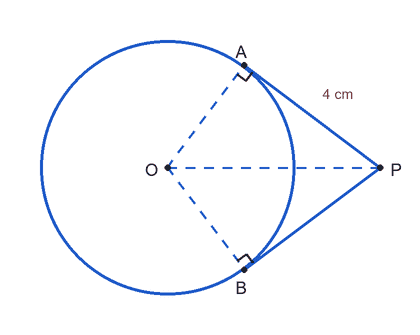
Draw a circle of radius 3 cm. Mark a point P at a distance of 5 cm from the centre of the circle drawn. Draw two tangents PA and PB to the given circle and measure the length of each tangent.
Solve with AIWritten solution
Solution:
Concept: A tangent to a circle is perpendicular to the radius at the point of contact. If P is outside the circle and PA touches it at A, then ∠OAP = 90°, so A lies on the circle with OP as diameter (the angle in a semicircle is 90°). That circle cuts the given circle at the two points of contact.
Step 1 — Draw the circle and mark P.
Draw a circle with centre O and radius 3 cm. Draw a line from O and mark P on it so that OP = 5 cm. P is outside the circle, because 5 cm is more than the radius.
Step 2 — Bisect OP.
Draw the perpendicular bisector of OP (arcs of equal radius, more than half of OP, from O and from P). It cuts OP at its mid-point M, which is 2·5 cm from both O and P.
Step 3 — Draw the circle on OP as diameter.
With M as centre and MO as radius, draw a circle. It cuts the given circle at two points; name them A and B.
Step 4 — Draw the tangents.
Join PA and PB. These are the required tangents: A lies on the circle with diameter OP, so ∠OAP = 90° (angle in a semicircle), and a line perpendicular to the radius at its end is a tangent. The same holds for B.
Step 5 — Measure and check the tangents.
Measuring with a ruler gives 4 cm for each of PA and PB. We can check this by calculation: triangle OAP is right-angled at A, so by Pythagoras' theorem
and therefore
Watch out: M must be the exact mid-point of OP. If the second circle is not centred at the mid-point, ∠OAP will not be 90° and PA will not be a tangent.
Therefore, each tangent is 4 cm long: PA = 4 cm and PB = 4 cm.
- 103 marks
Question 10
Draw a circle of radius 5 cm. Draw two tangents to this circle so that the angle between the tangents is 45°.
Solve with AIWritten solution
Solution:
Concept: A tangent is perpendicular to the radius at the point of contact. So if tangents at A and B meet at P, the quadrilateral OAPB has right angles at A and B, and its four angles add up to 360°.
Step 1 — Find the angle between the radii.
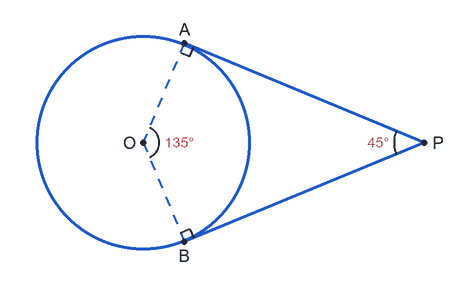
In quadrilateral OAPB, ∠OAP and ∠OBP are both 90° (tangent ⊥ radius), and ∠APB must be 45°. The angles of a quadrilateral add up to 360°, so
So the two radii OA and OB must make an angle of 135° at the centre.
Step 2 — Draw the circle and the two radii.
Draw a circle with centre O and radius 5 cm, and draw any radius OA. At O, construct ∠AOB = 135° with compasses (a 90° angle plus half of the next 90°, which is 45°), and let its arm meet the circle at B.
Step 3 — Draw the tangents at A and B.
At A, construct a line perpendicular to OA, and at B, a line perpendicular to OB. These are tangents, because each is perpendicular to a radius at its end. Let them meet at P.
Step 4 — Check the angle.
Measuring ∠APB with a protractor gives 45°, as required by Step 1.
Watch out: The angle at the centre is not 45°. It is the supplement, 180° − 45° = 135°, because the two right angles at A and B take up 180° of the quadrilateral.
Therefore, PA and PB are the required tangents, with ∠AOB = 135° and ∠APB = 45°.
- 113 marks
Question 11
Using ruler and compasses only, draw an equilateral triangle of side 4·5 cm and draw its circumscribed circle. Measure the radius of the circle.
Solve with AIWritten solution
Solution:
Concept: The circumcentre of a triangle is the point where the perpendicular bisectors of its sides meet. Every point on the perpendicular bisector of a side is equally far from the two ends of that side, so the circumcentre is equally far from all three vertices. A circle with this centre and that distance as radius passes through all three vertices: it is the circumscribed circle (circumcircle).
Step 1 — Construct the equilateral triangle.
Draw AB = 4·5 cm. With A as centre and radius 4·5 cm, draw an arc; with B as centre and the same radius, draw a second arc cutting the first at C. Join AC and BC. All three sides are 4·5 cm.
Step 2 — Draw two perpendicular bisectors.
Draw the perpendicular bisectors of AB and BC. They meet at O, the circumcentre, which is equally far from A, B and C.
Step 3 — Draw the circumscribed circle.
With O as centre and OA as radius, draw the circle. It passes through A, B and C.
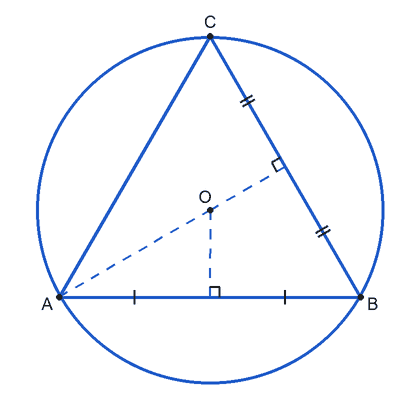
Step 4 — Measure and check the radius.
Measuring OA gives about 2·6 cm. We can check this: in an equilateral triangle the circumradius is , so
Watch out: Bisect two angles (or two sides) neatly with compass arcs; the third bisector is not needed, because all three meet at the same point.
Therefore, the radius of the circumscribed circle is about 2·6 cm.
- 123 marks
Question 12
Using ruler and compasses only,
(i) Construct triangle ABC, having given BC = 7 cm, AB – AC = 1 cm and ∠ABC = 45°.
(ii) Inscribe a circle in the Δ ABC constructed in (i) above.
Solve with AIWritten solution
Solution:
Concept: When the difference of two sides is given, cut that difference off the longer side. A point on the perpendicular bisector of a segment is equally far from its two ends, which turns the difference into a length we can draw. The incentre of a triangle is the point where the bisectors of its angles meet.
(i)
Step 1 — Draw the base and the given angle.
Draw BC = 7 cm. At B, construct ∠CBX = 45° (bisect a right angle), so that A will lie somewhere on the ray BX.
Step 2 — Cut off the difference.
AB is longer than AC by 1 cm, so from B cut off BD = 1 cm along BX. Join DC.
Step 3 — Locate A.
Draw the perpendicular bisector of DC. It meets BX at A. Join AC. ABC is the required triangle.
Step 4 — See why it works.
A lies on the perpendicular bisector of DC, so AD = AC. Then
as required.
(ii)
Step 5 — Find the incentre.
Draw the bisectors of any two angles of the triangle, say ∠B and ∠C. They meet at I, the incentre.
Step 6 — Draw the incircle.
From I, draw IF perpendicular to one side (in the figure, to AC). With I as centre and IF as radius, draw the circle; it touches all three sides.
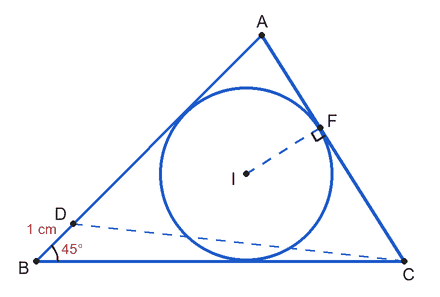
For reference, measuring gives AB ≈ 6·1 cm, AC ≈ 5·1 cm and the inradius ≈ 1·7 cm (calculation: AB = 6·08 cm, AC = 5·08 cm, r = 1·66 cm).
Watch out: Cut the 1 cm off the longer side AB (on the ray BX through the given angle), not off BC. And always take the radius of the incircle as the perpendicular distance from I to a side.
Therefore, ΔABC (BC = 7 cm, ∠B = 45°, AB − AC = 1 cm) is constructed and its incircle drawn, with radius about 1·7 cm.
- 133 marks
Question 13
Using ruler and compasses only,
(i) Construct a triangle ABC with the following data : Base AB = 6 cm, BC = 7·5 cm and angle CAB = 60°.
(ii) In the same diagram, draw a circle which passes through the points A, B and C and mark its centre O.
(iii) Draw a perpendicular from O to AB which meets AB in D.
(iv) Prove that : AD = BD.
Solve with AIWritten solution
Solution:
Concept: The circumcentre of a triangle is the point where the perpendicular bisectors of its sides meet. Every point on the perpendicular bisector of a side is equally far from the two ends of that side, so the circumcentre is equally far from all three vertices. A circle with this centre and that distance as radius passes through all three vertices: it is the circumscribed circle (circumcircle). In a circle, the perpendicular from the centre to a chord bisects the chord.
(i)
Step 1 — Construct the triangle.
Draw AB = 6 cm. At A, construct ∠BAX = 60° with compasses. With B as centre and radius 7·5 cm, draw an arc cutting AX at C. Join BC. ABC is the required triangle.
(ii)
Step 2 — Find the centre of the circle through A, B and C.
Draw the perpendicular bisectors of AB and AC. They meet at O, the circumcentre, which is equally far from A, B and C.
Step 3 — Draw the circle.
With O as centre and OA as radius, draw the circle. It passes through A, B and C.
(iii)
Step 4 — Draw the perpendicular to AB.
From O, draw OD perpendicular to AB, meeting AB at D. Join OA and OB.
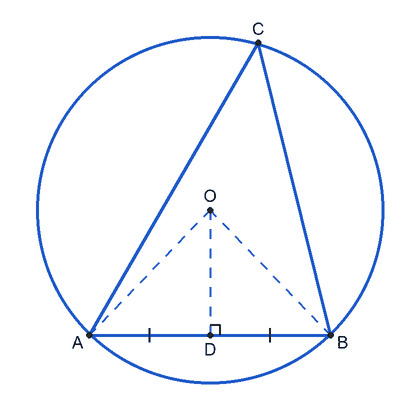
(iv)
Step 5 — Prove AD = BD.
We compare triangles OAD and OBD, which share the side OD.
In ΔOAD and ΔOBD:
- OA = OB (radii of the same circle)
- ∠ODA and ∠ODB are both 90° (OD ⊥ AB)
- OD = OD (common side)
So ΔOAD ≅ ΔOBD by the RHS rule, and the corresponding sides AD and BD are equal.
For reference, the circumradius measures about 4·3 cm (calculation: R = ≈ 4·33 cm).
Watch out: RHS needs the right angle, the hypotenuse and one other side. Here the hypotenuses are OA and OB (equal radii) and the other side is OD.
Therefore, AD = BD: the perpendicular from the centre O bisects the chord AB. Hence proved.
- 143 marks
Question 14
Using ruler and compasses only construct a triangle ABC in which BC = 4 cm, ∠ACB = 45° and perpendicular from A on BC is 2·5 cm. Draw a circle circumscribing the triangle ABC.
Solve with AIWritten solution
Solution:
Concept: All points at a fixed distance from a line lie on a line parallel to it. So the vertex A, which is 2·5 cm from BC, lies on the line parallel to BC at a distance of 2·5 cm. The circumcentre of a triangle is the point where the perpendicular bisectors of its sides meet.
Step 1 — Draw the base and the angle at C.
Draw BC = 4 cm. At C, construct ∠BCX = 45° (bisect a right angle).
Step 2 — Draw the line for the height.
At any point of BC (or of BC produced), draw a perpendicular and mark on it a point 2·5 cm from BC. Through that point, draw a line parallel to BC, on the same side as CX. Every point of this line is 2·5 cm from BC.
Step 3 — Locate A.
The parallel line meets CX at A. Join AB. In ΔABC, the perpendicular AD from A to BC is 2·5 cm and ∠ACB = 45°.
Step 4 — Find the circumcentre.
Draw the perpendicular bisectors of two sides, say BC and AC. They meet at O, the circumcentre.
Step 5 — Draw the circumcircle.
With O as centre and OA as radius, draw the circle. It passes through A, B and C.
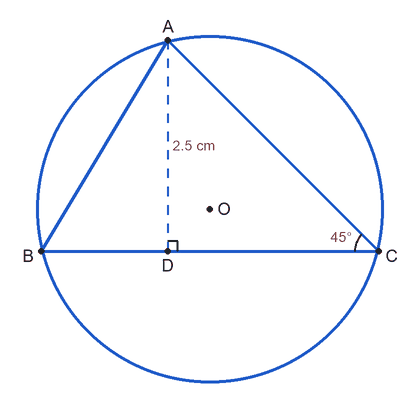
For reference, the circumradius measures about 2·1 cm (calculation: R = 2·06 cm).
Watch out: The 2·5 cm is the height of the triangle (the perpendicular from A), not the length of a side. Do not cut 2·5 cm off CX.
Therefore, ΔABC is constructed and its circumcircle drawn, with radius about 2·1 cm.
- 153 marks
Question 15
Perpendicular bisectors of the sides AB and AC of a triangle ABC meet at O.
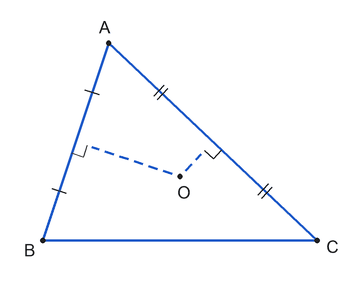
(i) What do you call the point O ?
(ii) What is the relation between the distances OA, OB and OC ?
(iii) Does the perpendicular bisector of BC pass through O ?
Solve with AIWritten solution
Solution:
Concept: Every point on the perpendicular bisector of a segment is equally far from the two ends of the segment, and every point equally far from the two ends lies on it.
(i)
Step 1 — Name the point.
O is the meeting point of the perpendicular bisectors of two sides of the triangle, so O is the circumcentre of ΔABC.
(ii)
Step 2 — Compare the distances.
O lies on the perpendicular bisector of AB, so OA = OB.
O also lies on the perpendicular bisector of AC, so OA = OC.
Putting these together, OB and OC are both equal to OA: the three distances OA, OB and OC are all equal.
(iii)
Step 3 — Decide about the third bisector.
From (ii), OB = OC, so O is equally far from B and C. Every point equally far from B and C lies on the perpendicular bisector of BC. So yes, the perpendicular bisector of BC passes through O.
Watch out: The perpendicular bisectors give equal distances from the vertices (OA, OB, OC), not from the sides.
Therefore, (i) O is the circumcentre; (ii) OA, OB and OC are all equal; (iii) yes, the perpendicular bisector of BC passes through O.
- 163 marks
Question 16
The bisectors of angles A and B of a scalene triangle ABC meet at O.
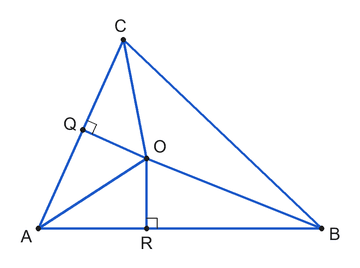
(i) What is the point O called ?
(ii) OR and OQ are perpendiculars drawn to AB and CA respectively. What is the relation between OR and OQ ?
(iii) What is the relation between angle ACO and angle BCO ?
Solve with AIWritten solution
Solution:
Concept: Every point on the bisector of an angle is equally far from the two arms of the angle, and every point inside the angle that is equally far from its arms lies on the bisector.
(i)
Step 1 — Name the point.
O is the meeting point of the bisectors of two angles of the triangle, so O is the incentre of ΔABC.
(ii)
Step 2 — Compare OR and OQ.
OR and OQ are the perpendicular distances from O to AB and to CA. These are the two arms of ∠A, and O lies on the bisector of ∠A, so O is equally far from them: OR = OQ.
(iii)
Step 3 — Compare ∠ACO and ∠BCO.
O is also on the bisector of ∠B, so its distances to BA and BC are equal. Hence O is equally far from CA and CB, so it lies on the bisector of ∠C. Therefore CO bisects ∠C, and ∠ACO = ∠BCO.
Watch out: The triangle is scalene, so OA, OB and OC are not equal. It is the perpendicular distances to the sides that are equal.
Therefore, (i) O is the incentre; (ii) OR = OQ; (iii) ∠ACO = ∠BCO.
- 173 marks
Question 17
(i) Using ruler and compasses only, construct a triangle ABC in which AB = 8 cm, BC = 6 cm and CA = 5 cm.
(ii) Find its incentre and mark it I.
(iii) With I as centre, draw a circle which will cut off 2 cm chords from each side of the triangle.
Solve with AIWritten solution
Solution:
Concept: The incentre of a triangle is the point where the bisectors of its angles meet. Every point on the bisector of an angle is equally far from the two arms of that angle, so the incentre is equally far from all three sides. The perpendicular from the centre of a circle to a chord bisects the chord, so a chord of 2 cm has 1 cm on each side of the foot of that perpendicular.
(i)
Step 1 — Construct the triangle.
Draw AB = 8 cm. With A as centre and radius 5 cm, draw an arc; with B as centre and radius 6 cm, draw another arc cutting it at C. Join AC and BC.
(ii)
Step 2 — Find the incentre.
Draw the bisectors of ∠A and ∠B. They meet at the incentre; mark it I.
(iii)
Step 3 — Find a point of the required circle.
Draw IF perpendicular to AB. Since the required circle cuts a 2 cm chord off AB and IF ⊥ AB, F is the mid-point of that chord. So mark the points 1 cm from F on either side along AB; they are the ends of the chord.
Step 4 — Draw the circle.
With I as centre and the distance from I to either of these points as radius, draw the circle.
Step 5 — See why it cuts 2 cm chords off all three sides.
I is equally far (distance , the inradius) from all three sides. A circle of radius centred at I therefore cuts a chord of the same length off every side. By Pythagoras' theorem in the right triangle with legs and 1 cm,
and on AB this chord is 2 cm by construction, so it is 2 cm on BC and CA as well.
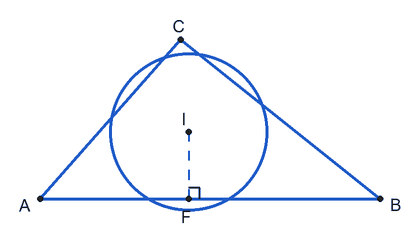
For reference: r ≈ 1·58 cm, so the radius of the circle is about 1·87 cm.
Watch out: The circle is not the incircle. The incircle touches the sides (chord 0 cm); this circle is a little larger, so that it cuts a 2 cm chord off each side.
Therefore, the circle with centre I and radius about 1·87 cm cuts a 2 cm chord off each side of ΔABC.
- 183 marks
Question 18
Draw a circle circumscribing a regular hexagon with side 5 cm.
Solve with AIWritten solution
Solution:
Concept: Each interior angle of a regular hexagon is = 120°. Its three main diagonals meet at the centre, which is equally far from all six vertices, and that distance equals the side.
Step 1 — Construct the regular hexagon.
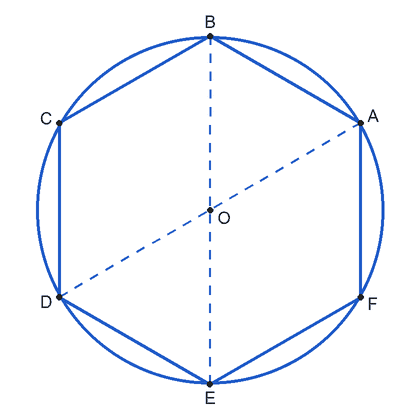
Draw AB = 5 cm. At B, construct an angle of 120° and cut BC = 5 cm on its arm. Continue in the same way at C, D and E (each angle 120°, each side 5 cm) to complete the regular hexagon ABCDEF.
Step 2 — Find the centre.
Join two main diagonals, AD and BE. They meet at O, the centre of the hexagon.
Step 3 — Draw the circumscribing circle.
With O as centre and OA as radius, draw the circle. It passes through all six vertices.
Step 4 — Measure the radius.
Measuring OA gives 5 cm. This agrees with theory: the six triangles OAB, OBC, … are equilateral, so the radius equals the side.
Watch out: A regular hexagon can also be drawn quickly by stepping the radius six times round a circle; but here the side is given, so build the hexagon first and then find its centre.
Therefore, the circle with centre O and radius 5 cm (equal to the side) circumscribes the regular hexagon.
- 193 marks
Question 19
Draw an inscribing circle of a regular hexagon of side 5·8 cm.
Solve with AIWritten solution
Solution:
Concept: The bisectors of the interior angles of a regular hexagon all meet at its centre, which is equally far from all six sides. A circle with this centre and that distance as radius touches every side: it is the inscribed circle.
Step 1 — Construct the regular hexagon.
Draw one side of 5·8 cm and, at each vertex, construct an angle of 120° and cut 5·8 cm on its arm, until the regular hexagon ABCDEF is complete.
Step 2 — Find the centre.
Draw the bisectors of two interior angles, say at A and B. They meet at I, the centre of the hexagon.
Step 3 — Find the radius.
Draw IP perpendicular to one side (here AF). IP is the distance from I to the sides; any side will do, because I is equally far from all six.
Step 4 — Draw the inscribed circle.
With I as centre and IP as radius, draw the circle. It touches all six sides.

Step 5 — Check the radius.
IP is the height of the equilateral triangle IAF of side 5·8 cm, so
which agrees with the measured value of about 5 cm.
Watch out: The radius of the inscribed circle is the perpendicular distance IP, not the distance IA to a vertex (which is the side, 5·8 cm).
Therefore, the inscribed circle has centre I and radius about 5·0 cm.
- 203 marks
Question 20
Construct a triangle ABC in which base BC = 5·5 cm, AB = 6 cm and ∠ABC = 120°.
(i) Construct a circle circumscribing the triangle ABC.
(ii) Draw a cyclic quadrilateral ABCD so that D is equidistant from B and C.
Solve with AIWritten solution
Solution:
Concept: The circumcentre of a triangle is the point where the perpendicular bisectors of its sides meet. Every point on the perpendicular bisector of a side is equally far from the two ends of that side, so the circumcentre is equally far from all three vertices. A circle with this centre and that distance as radius passes through all three vertices: it is the circumscribed circle (circumcircle). A point equidistant from B and C lies on the perpendicular bisector of BC. A quadrilateral is cyclic when all four vertices lie on one circle.
Step 1 — Construct ΔABC.
Draw BC = 5·5 cm. At B, construct ∠CBX = 120° and cut BA = 6 cm on BX. Join AC.
(i)
Step 2 — Find the circumcentre.
Draw the perpendicular bisectors of BC and AB. They meet at O.
Step 3 — Draw the circumcircle.
With O as centre and OA as radius, draw the circle through A, B and C. (Its radius measures about 5·75 cm.)
(ii)
Step 4 — Locate D.
D must be equally far from B and C, so it lies on the perpendicular bisector of BC. Produce this bisector (through its foot M on BC and through O) to meet the circle again at D on the arc CA, the arc that does not contain B.
Step 5 — Complete the quadrilateral.
Join CD and DA. ABCD is cyclic because all four vertices lie on the circle, and DB = DC because D lies on the perpendicular bisector of BC.
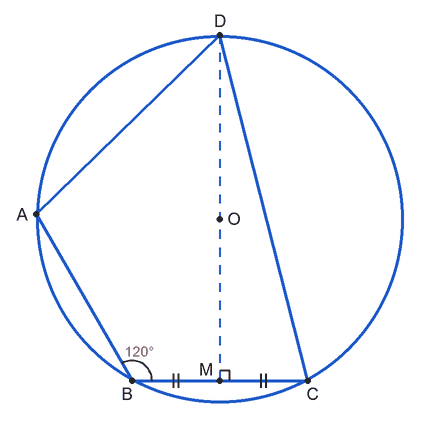
Watch out: The perpendicular bisector of BC meets the circle at two points. The one on the small arc BC (below BC) would give the order A, B, D, C, not ABCD; take the point on arc CA.
Therefore, ABCD is the required cyclic quadrilateral, with D on the circumcircle and DB = DC.
- 213 marks
Question 21
Using a ruler and compasses only :
(i) Construct a triangle ABC with the following data : AB = 3·5 cm, BC = 6 cm and ∠ABC = 120°.
(ii) In the same diagram, draw a circle with BC as diameter. Find a point P on the circumference of the circle which is equidistant from AB and BC.
(iii) Measure ∠BCP.
Solve with AIWritten solution
Solution:
Concept: Points equidistant from two lines that meet lie on the bisector of the angle between them. The angle in a semicircle is 90°.
(i)
Step 1 — Construct the triangle.
Draw BC = 6 cm. At B, construct ∠CBX = 120° and cut BA = 3·5 cm on BX. Join AC.
(ii)
Step 2 — Draw the circle on BC as diameter.
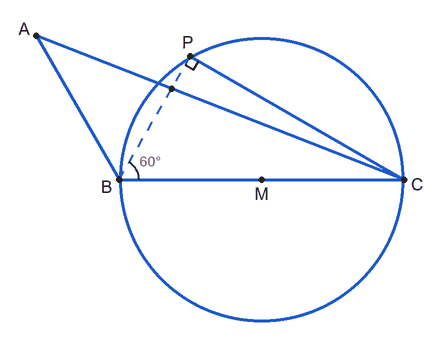
Bisect BC at M. With M as centre and MB (3 cm) as radius, draw the circle; BC is its diameter.
Step 3 — Locate P.
A point equidistant from AB and BC lies on the bisector of ∠ABC. Bisect ∠ABC; the bisector meets the circle at P. Join PC.
(iii)
Step 4 — Measure ∠BCP and check it.
Measuring with a protractor gives ∠BCP = 30°. To check, BP bisects the 120° angle, so ∠PBC = 60°, and ∠BPC = 90° (angle in a semicircle). The angles of ΔBPC add up to 180°, so
Watch out: ∠PBC is half of 120°, that is 60°, because BP is the bisector; do not use 120° in triangle BPC.
Therefore, ∠BCP = 30°.
- 223 marks
Question 22
Draw a line AB = 5 cm. Mark a point C on AB such that AC = 3 cm. Using a ruler and a compass only, construct :
(i) a circle of radius 2·5 cm, passing through A and C.
(ii) construct two tangents to the circle from the external point B. Measure and record the length of the tangents.
Solve with AIWritten solution
Solution:
Concept: The centre of a circle through two points is equally far from both, so it lies on the perpendicular bisector of their join. A tangent to a circle is perpendicular to the radius at the point of contact. If P is outside the circle and PA touches it at A, then ∠OAP = 90°, so A lies on the circle with OP as diameter (the angle in a semicircle is 90°). That circle cuts the given circle at the two points of contact.
(i)
Step 1 — Draw AB and mark C.
Draw AB = 5 cm and mark C on it with AC = 3 cm, so CB = 2 cm.
Step 2 — Locate the centre.
Draw the perpendicular bisector of AC. With A as centre and radius 2·5 cm, draw an arc cutting it at O. Then OA = 2·5 cm. As O is on the perpendicular bisector of AC, OC is equal to OA, so OC is 2·5 cm too.
Step 3 — Draw the circle.
With O as centre and radius 2·5 cm, draw the circle. It passes through A and C.
(ii)
Step 4 — Draw the tangents from B.
Join OB and bisect it at M. With M as centre and MO as radius, draw a circle cutting the given circle at T and S. Join BT and BS: these are the tangents, because ∠OTB and ∠OSB are both 90° (angles in a semicircle).

Step 5 — Measure and check the tangents.
Measuring gives BT = BS ≈ 3·2 cm. To check, use the tangent–secant theorem: the square of the tangent from B equals the product of the parts of the secant BCA, so
and therefore
Watch out: The circle through A and C has radius 2·5 cm, more than half of AC (1·5 cm), so there are two possible centres, one on each side of AB. Either one gives the same tangent length.
Therefore, the tangents BT and BS are each about 3·2 cm long.
- 233 marks
Question 23
Using a ruler and a compass, construct a triangle ABC in which AB = 7 cm, ∠CAB = 60° and AC = 5 cm. Construct the locus of :
(i) points equidistant from AB and AC.
(ii) points equidistant from BA and BC.
Hence construct a circle touching the three sides of the triangle internally.
Solve with AIWritten solution
Solution:
Concept: The locus of points equidistant from two intersecting lines is the bisector of the angle between them. The incentre of a triangle is the point where the bisectors of its angles meet. Every point on the bisector of an angle is equally far from the two arms of that angle, so the incentre is equally far from all three sides. A circle with this centre and that distance as radius touches all three sides: it is the inscribed circle (incircle).
Step 1 — Construct the triangle.
Draw AB = 7 cm. At A, construct ∠BAX = 60° and cut AC = 5 cm on AX. Join BC.
(i)
Step 2 — Points equidistant from AB and AC.
AB and AC meet at A, so the locus is the bisector of ∠A (∠CAB = 60°, so each half is 30°). Construct it.
(ii)
Step 3 — Points equidistant from BA and BC.
BA and BC meet at B, so the locus is the bisector of ∠B. Construct it.
Step 4 — Draw the circle touching the three sides.
The two bisectors meet at I. I is equally far from AB and AC (on the first locus) and from BA and BC (on the second), so it is equally far from all three sides. Draw IF perpendicular to AB; with I as centre and IF as radius, draw the circle. It touches all three sides internally.
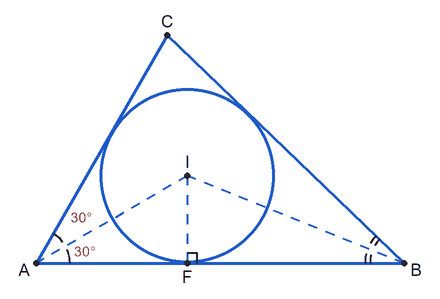
For reference, the radius measures about 1·7 cm (calculation: r = 1·66 cm).
Watch out: The locus of points equidistant from two lines is an angle bisector; the locus of points equidistant from two points is a perpendicular bisector. Here we want lines.
Therefore, the circle with centre I (where the two bisectors meet) and radius IF ≈ 1·7 cm is the required incircle.
- 243 marks
Question 24
Construct a triangle ABC in which AB = 5 cm, BC = 6·8 cm and median AD = 4·4 cm. Draw incircle of this triangle.
Solve with AIWritten solution
Solution:
Concept: A median joins a vertex to the mid-point of the opposite side. So D is the mid-point of BC, and ΔABD can be constructed first from its three sides. The incentre of a triangle is the point where the bisectors of its angles meet.
Step 1 — Find BD.
D is the mid-point of BC, so BD is half of BC.
Step 2 — Construct ΔABD.
Draw BD = 3·4 cm. With B as centre and radius 5 cm, and with D as centre and radius 4·4 cm, draw arcs cutting at A. Join AB and AD.
Step 3 — Complete ΔABC.
Produce BD to C so that DC = 3·4 cm; then BC = 6·8 cm and AD is the median. Join AC.
Step 4 — Find the incentre.
Draw the bisectors of two angles, say ∠B and ∠C. They meet at I, the incentre.
Step 5 — Draw the incircle.
Draw IF perpendicular to BC. With I as centre and IF as radius, draw the circle; it touches all three sides.
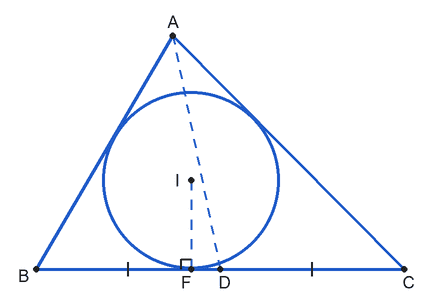
For reference: AC measures about 6·1 cm and the inradius about 1·6 cm (calculation: AC = 6·07 cm, r = 1·64 cm).
Watch out: The median is AD = 4·4 cm, from A to the mid-point of BC; it is not a perpendicular or an angle bisector.
Therefore, ΔABC is constructed and its incircle drawn, with radius about 1·6 cm.
- 253 marks
Question 25
Draw two concentric circles with radii 4 cm and 6 cm. Taking a point on the outer circle, construct a pair of tangents to inner circle. By measuring the lengths of both the tangents, show that they are equal to each other.
Solve with AIWritten solution
Solution:
Concept: A tangent to a circle is perpendicular to the radius at the point of contact. If P is outside the circle and PA touches it at A, then ∠OAP = 90°, so A lies on the circle with OP as diameter (the angle in a semicircle is 90°). That circle cuts the given circle at the two points of contact. Here the given circle is the inner one, and P is outside it.
Step 1 — Draw the two circles and mark P.
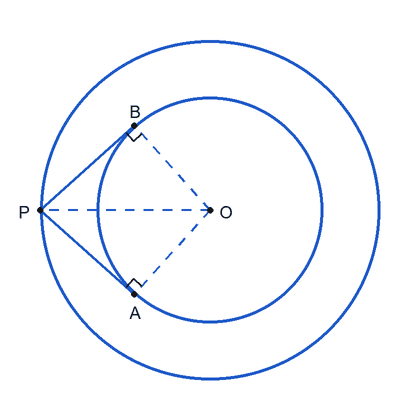
With centre O, draw circles of radii 4 cm and 6 cm. Mark any point P on the outer circle, so OP = 6 cm.
Step 2 — Draw the circle on OP as diameter.
Join OP and bisect it at M. With M as centre and MO as radius, draw a circle cutting the inner circle at A and B.
Step 3 — Draw the tangents.
Join PA and PB. These are tangents to the inner circle, because ∠OAP and ∠OBP are both 90° (angles in a semicircle).
Step 4 — Measure and compare.
Measuring gives PA ≈ 4·5 cm and PB ≈ 4·5 cm, so the two tangents are equal. To check, triangle OAP is right-angled at A, so
and therefore
Triangle OBP gives exactly the same working, so PB is the same length.
Watch out: The radius in Pythagoras is the radius of the inner circle (4 cm), the one the tangents touch; OP is the outer radius (6 cm).
Therefore, PA = PB ≈ 4·5 cm, so the two tangents are equal.
- 263 marks
Question 26
In triangle ABC, ∠ABC = 90°, side AB = 6 cm, side BC = 7·2 cm and BD is perpendicular to side AC. Draw circumcircle of triangle BDC and then state the length of the radius of this circumcircle drawn.
Solve with AIWritten solution
Solution:
Concept: If a segment subtends a right angle at a point, that point lies on the circle with the segment as diameter (the angle in a semicircle is 90°).
Step 1 — Construct ΔABC.
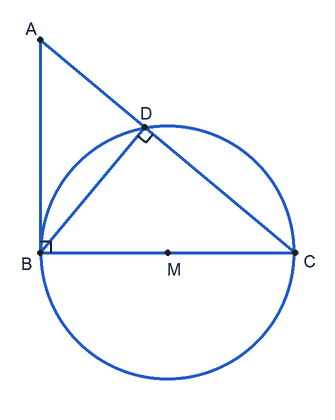
Draw BC = 7·2 cm. At B, construct ∠CBX = 90° and cut BA = 6 cm on BX. Join AC.
Step 2 — Draw BD.
From B, draw BD perpendicular to AC, meeting it at D.
Step 3 — Spot the diameter.
∠BDC = 90°, so the side BC subtends a right angle at D. Therefore the circumcircle of ΔBDC has BC as its diameter, and its centre is the mid-point of BC.
Step 4 — Draw the circumcircle.
Bisect BC at M. With M as centre and MB as radius, draw the circle; it passes through B, D and C.
Step 5 — State the radius.
The radius is half the diameter BC.
Watch out: You do not need to bisect two sides of ΔBDC here. The right angle at D tells you at once that BC is a diameter.
Therefore, the radius of the circumcircle of ΔBDC is 3·6 cm.
What Class 10 Maths Ch 19 covers
The sections of the chapter, in the order the book takes them. Every question above comes from one of these.
- 01Construction of Tangents to a Given Circle
- 02Circumscribed and Inscribed Circles of a Triangle
- 03Circumscribing and Inscribing a Circle on a Regular Hexagon
More ways to study this chapter
The same chapter asked three other ways. Practise it, revise it, and see what the board has set on Ch 19 before.
- Competency-Based Questions (CBQ)Case study questions: a situation, and the part of the chapter that answers it.40questionsOpen
- Previous Year QuestionsQuestions that have actually appeared in board papers, each tagged with its year.12questionsOpen
- Practice QuestionsExtra questions per chapter, for when one attempt at a method is not enough.40questionsOpen
Ch 19 in past ICSE papers
The same chapter as the board has actually asked it. These are worded differently from the textbook exercise, which is the point of reading them.
- 13 marks
Board paper question 1
Construct a regular hexagon of side 5 cm. Hence construct all its lines of symmetry and name them.
Solve with AIWritten solution
Solution:
Concept: These facts are used here.
- Regular hexagon: a regular hexagon is made of six equilateral triangles meeting at its centre, so each side equals the distance from the centre to a vertex.
- Lines of symmetry of a regular hexagon: there are six, three joining opposite vertices and three joining the mid-points of opposite sides.
Step 1 — Draw the circle.
A regular hexagon of side 5 cm fits in a circle of radius 5 cm (its six triangles are equilateral). So draw a circle with centre O and radius 5 cm.
Step 2 — Mark the vertices.
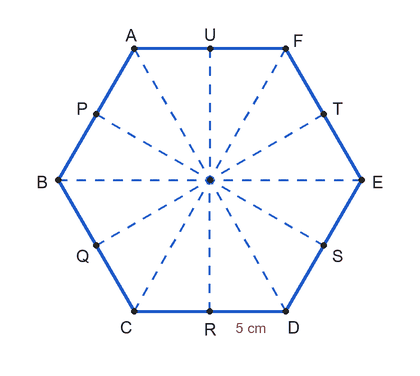
Take any point A on the circle. With the compass still open at 5 cm, cut the circle at B from A, at C from B, and so on, to get the six vertices A, B, C, D, E and F. Join them in order; every side is 5 cm.
Step 3 — Draw the diagonal lines of symmetry.
Join each vertex to the opposite vertex: AD, BE and CF. Each passes through O and folds the hexagon onto itself.
Step 4 — Draw the side lines of symmetry.
Bisect three sides with the compass (perpendicular bisectors) and mark the mid-points P, Q, R, S, T and U of AB, BC, CD, DE, EF and FA. Join the opposite mid-points: PS, QT and RU. Each also passes through O.
Step 5 — Look at the finished figure.
The six dashed lines are the lines of symmetry.
Watch out: A regular hexagon has SIX lines of symmetry, not three; the lines through the mid-points of opposite sides count too.
Therefore, the six lines of symmetry are AD, BE, CF, PS, QT and RU.
- 24 marks
Board paper question 2
Draw a line AB = 5 cm. Mark a point C on AB such that AC = 3 cm. Using a ruler and a compass only, construct:
(i) A circle of radius 2.5 cm, passing through A and C.
(ii) Construct two tangents to the circle from the external point B. Measure and record the length of the tangents.
Solve with AIWritten solution
Solution:
Concept: These facts are used here.
- Perpendicular bisector: every point on the perpendicular bisector of a segment is equidistant from its two ends, so the centre of a circle through two points lies on the perpendicular bisector of the segment joining them.
- Tangents from an outside point: a tangent is perpendicular to the radius at its point of contact; the angle in a semicircle is , so the circle on OP as diameter cuts the given circle at the two points of contact.
Step 1 — Draw AB and mark C.
Draw AB of length 5 cm and mark C on it with AC = 3 cm, so that CB = 2 cm.
Step 2 — Find the centre of the circle (part i).
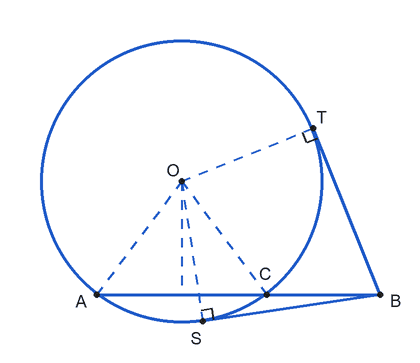
The circle passes through A and C. So its centre lies on the perpendicular bisector of AC. Draw that bisector. With A as centre and radius 2.5 cm, cut the bisector at O (on either side of AB; the figure takes the point above AB). Then OA and OC are both 2.5 cm.
Step 3 — Draw the circle.
With O as centre and radius 2.5 cm, draw the circle. It passes through A and C.
Step 4 — Construct the tangents from B (part ii).
Join OB and bisect it at L. With L as centre and LO as radius, draw a circle. It cuts the first circle at T and S. Join BT and BS; these are the tangents, because and are angles in a semicircle, that is, .
Step 5 — Measure and check.
On measuring, BT and BS are both 3.2 cm. To check, the foot of O on AB is the mid-point of AC, 1.5 cm from A, and O is 2 cm above AB, because:
So, with B 3.5 cm along AB from that foot:
Watch out: The circle's radius is 2.5 cm, not half of AC; its centre is NOT the mid-point of AC.
Therefore, each tangent from B is about cm long.
- 34 marks
Board paper question 3
Using a ruler and a compass construct a triangle ABC in which AB = 7cm, and AC = 5cm. Construct the locus of:
(i) points equidistant from AB and AC.
(ii) points equidistant from BA and BC.
Hence construct a circle touching the three sides of the triangle internally.
Solve with AIWritten solution
Solution:
Concept: These facts are used here.
- Angle bisector: every point on the bisector of an angle is equidistant from its two arms, so the locus of points equidistant from two intersecting lines is the bisector of the angle between them.
- Incentre: the point where the angle bisectors meet is equidistant from all three sides, so it is the centre of the circle touching the three sides (the incircle).
Step 1 — Construct the triangle.
Draw AB of length 7 cm. At A, construct with the compass. Cut AC of length 5 cm on AX and join BC.
Step 2 — Locus (i).
The points equidistant from AB and AC lie on the bisector of . Bisect .
Step 3 — Locus (ii).
The points equidistant from BA and BC lie on the bisector of . Bisect . The two bisectors meet at I.
Step 4 — Draw the incircle.
I is equidistant from all three sides. Draw IF perpendicular to AB. With I as centre and IF as radius, draw the circle; it touches all three sides.
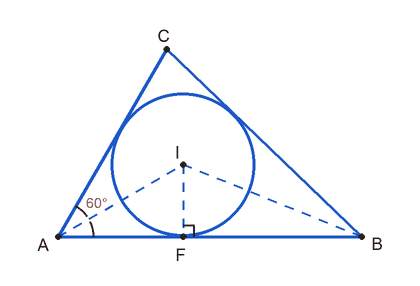
Step 5 — Measure and check.
On measuring, cm. To check, find BC by the cosine rule, then .
Watch out: The locus of points equidistant from two LINES is an angle bisector; the perpendicular bisector is for points equidistant from two POINTS.
Therefore, the loci are the bisectors of and , and the incircle has radius about cm.
- 44 marks
Board paper question 4
Using ruler and compass only, construct a such that BC = 5 cm and AB = 6.5 cm and .
(i) Construct a circum-circle of .
(ii) Construct a cyclic quadrilateral ABCD, such that D is equidistant from AB and BC.
Solve with AIWritten solution
Solution:
Concept: These facts are used here.
- Perpendicular bisector: every point on the perpendicular bisector of a segment is equidistant from its two ends, so the centre of a circle through two points lies on the perpendicular bisector of the segment joining them.
- Angle bisector: every point on the bisector of an angle is equidistant from its two arms, so the locus of points equidistant from two intersecting lines is the bisector of the angle between them.
- Cyclic quadrilateral: a quadrilateral whose four vertices lie on one circle.
Step 1 — Construct the triangle.
Draw BC of length 5 cm. At B, construct (two arcs). Cut BA of length 6.5 cm on BX and join AC.
Step 2 — Draw the circumcircle (part i).
Draw the perpendicular bisectors of AB and BC. They meet at O, which is equidistant from A, B and C. With O as centre and OB as radius, draw the circle through A, B and C.
Step 3 — Locate D (part ii).
D must be equidistant from AB and BC, so it lies on the bisector of . Bisect ; each half is . Produce the bisector to meet the circle again at D, on the arc AC away from B.
Step 4 — Complete the quadrilateral.
Join AD and CD. A, B, C and D all lie on the circle, so ABCD is the required cyclic quadrilateral, with and both .
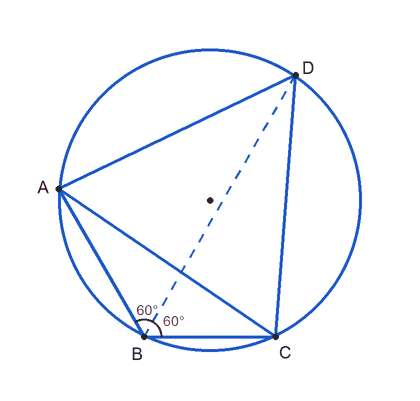
Step 5 — Check the size of the circle.
The cosine rule gives AC, and then .
Watch out: D is on the bisector of (equidistant from the two LINES AB and BC), not on the perpendicular bisector of AC.
Therefore, the circumcircle has radius about cm, and D is where the bisector of meets it again.
- 54 marks
Board paper question 5
Use ruler and compass only for answering this question.
Draw a circle of radius 4 cm. Mark the centre as O. Mark a point P outside the circle at a distance of 7 cm from the centre. Construct two tangents to the circle from the external point P.
Measure and write down the length of any one tangent.
Solve with AIWritten solution
Solution:
Concept: Tangents from an outside point: a tangent is perpendicular to the radius at its point of contact; the angle in a semicircle is , so the circle on OP as diameter cuts the given circle at the two points of contact.
Step 1 — Draw the circle and P.
Draw a circle with centre O and radius 4 cm. Mark P with OP = 7 cm.
Step 2 — Bisect OP.
Draw the perpendicular bisector of OP to find its mid-point M.
Step 3 — Draw the circle on OP.
With M as centre and MO as radius, draw a circle. It cuts the first circle at A and B.
Step 4 — Draw the tangents.
Join PA and PB. These are the tangents, because and are angles in a semicircle (on the diameter OP), so they are .
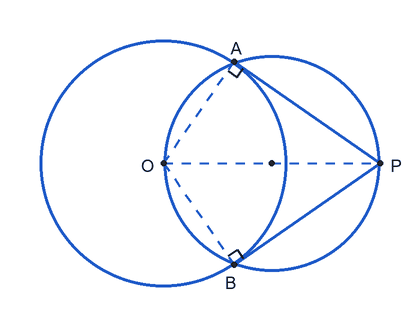
Step 5 — Measure and check.
On measuring, cm. In right :
Watch out: The radius OA is perpendicular to the tangent, so OP is the hypotenuse; PA is NOT cm.
Therefore, each tangent is about cm long.
- 64 marks
Board paper question 6
Using ruler and a compass only construct a semi-circle with diameter BC = 7 cm. Locate a point A on the circumference of the semicircle such that A is equidistant from B and C. Complete the cyclic quadrilateral ABCD, such that D is equidistant from AB and BC. Measure and write it down.
Solve with AIWritten solution
Solution:
Concept: These facts are used here.
- Perpendicular bisector: every point on the perpendicular bisector of a segment is equidistant from its two ends, so the centre of a circle through two points lies on the perpendicular bisector of the segment joining them.
- Angle bisector: every point on the bisector of an angle is equidistant from its two arms, so the locus of points equidistant from two intersecting lines is the bisector of the angle between them.
- Cyclic quadrilateral: opposite angles add up to .
- Angle in a semicircle: the angle on a diameter at any point of the circle is .
Step 1 — Draw the semicircle.
Draw BC of length 7 cm, bisect it at M, and with M as centre and radius 3.5 cm draw a semicircle on BC.
Step 2 — Locate A.
A is equidistant from B and C, so it lies on the perpendicular bisector of BC. That bisector passes through M; it meets the semicircle at A. Join AB and AC; then .
Step 3 — Locate D.
D is equidistant from AB and BC, so it lies on the bisector of . Bisect and let the bisector meet the semicircle at D (on the arc AC). Join AD and DC to complete ABCD.
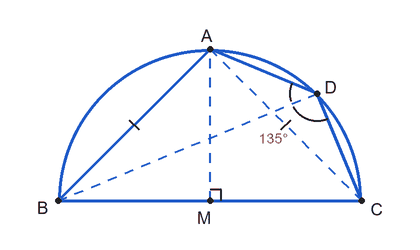
Step 4 — Measure and check.
On measuring, . To check, note that is (angle in a semicircle) and that AB equals AC. So is . ABCD is cyclic, so the angle at D is the supplement of the angle at B.
Watch out: The angle at D is opposite the angle at B (), not opposite the angle at A.
Therefore, .
All 12 board paper questions for this chapter, solved the same way.
Class 10 Maths Ch 19 questions students ask
How many questions are there in Class 10 Maths Ch 19?
26 questions. Every one is solved step by step on this page.
Are these Class 10 Maths solutions free?
Yes. Every question and its full working is free to read, with no account needed.
Can I download the Class 10 Maths Ch 19 solutions as a PDF?
There is no PDF to download. Every solution is on this page instead, which means it is searchable, always the current syllabus, and readable on a phone. Use your browser's print option if you want it on paper.