
Opening your dashboard
Class 10 Maths Chapter 19 Constructions: Competency-Based Questions (CBQ)
40 questions on Chapter 19, each worked through on its own page with the AI tutor. Class 10 Maths, ICSE 2026-27.
40 questions
1–5 marks · Mixed difficulty
- 11 mark
Question 1
Competency: Understanding
A carpenter has a triangular piece of plywood. He wants to cut out the largest possible round table top from it. To find the centre of the circle, he should construct :
- 21 mark
Question 2
Competency: Understanding
Sana draws a circle of radius 3·5 cm. Without changing the opening of her compasses, she starts from a point A on the circle and marks off equal arcs round the circle, one after another. She comes back exactly to A after marking :
- 31 mark
Question 3
Competency: Application
A circle has centre O and radius 6 cm. P is a point 10 cm from O. To construct the tangents from P, a second circle is drawn on OP as diameter.
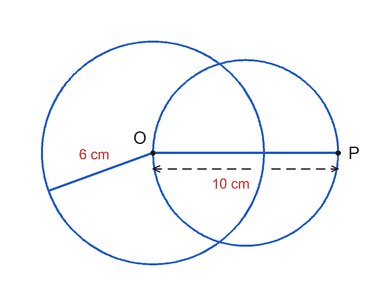
The radius of this second circle is :
- 41 mark
Question 4
Competency: Analysis
Four construction tasks are set in a class test. Which one is impossible?
- 51 mark
Question 5
Competency: Application & Analysis
A triangular lawn has sides 30 m, 40 m and 50 m. A round flower bed is to touch all three sides.
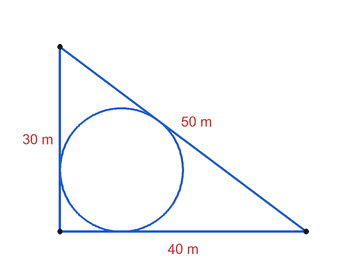
A plan is drawn to the scale 1 cm = 5 m. On the plan, the radius of the circle for the flower bed should measure :
- 61 mark
Question 6
Competency: Application & Evaluation
A baker has a round cake of diameter 21 cm. She wants to place it flat in a box whose base is a regular hexagon of side 12 cm. Will the cake fit? (Take .)
- 72 marks
Question 7
Competency: Analysis & Evaluation
Nikita draws a circle of radius 2 cm with centre O and marks a point P with OP = 5·2 cm. She constructs two lines from P which she calls tangents. On measuring, she finds PA = 4·8 cm and PB = 5·1 cm, where A and B are the points she has marked on the circle.
(a) Calculate the length which each tangent should have.
(b) What do her two measurements tell her about her construction?
- 82 marks
Question 8
Competency: Application
A tinsmith has a round tin lid. Its centre is not marked. Describe a ruler-and-compasses construction to find the centre, and explain why it works.
- 92 marks
Question 9
Competency: Analysis
Ishaan constructed a regular hexagon and then its inscribed circle. He remembers that the radius of the inscribed circle measured about 4·3 cm, but he has forgotten the side of the hexagon. It was 4 cm, 5 cm or 6 cm. Which was it? Justify your answer. (Take .)
- 102 marks
Question 10
Competency: Analysis & Evaluation
Dev says, "The inscribed circle of a triangle always touches each side at its mid-point." Test his claim on a triangle ABC with AB = 5 cm, BC = 6 cm and CA = 7 cm, without drawing it. For which triangles is the claim true?
- 113 marks
Question 11
Competency: Application
A triangular plot of land has sides 50 m, 60 m and 70 m. A circular boundary road is to pass through its three corners. Using ruler and compasses, make a scale drawing with 1 cm = 10 m and construct the circle for the road. Measure its radius and write the radius of the actual road.
- 123 marks
Question 12
Competency: Application & Creativity
A club wants a logo : a regular hexagon with its circumscribed circle and its inscribed circle. The whole logo must fit on a square card of side 10 cm. The gap between the two circles, measured along a line from the centre through the mid-point of a side, must be at least 0·5 cm.
(a) Choose a suitable side for the hexagon. Show that your choice meets both conditions. (Take .)
(b) Write the steps to construct your logo.
- 133 marks
Question 13
Competency: Analysis & Evaluation
A lawn has the shape of a triangle ABC with AB = AC = 10 m and BC = 12 m.
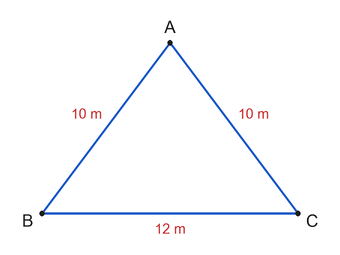
One water sprinkler is to be fixed. It wets a circle round itself.
Option 1 : Fix it at the incentre, so that the wet circle just touches all three sides.
Option 2 : Fix it at the circumcentre, so that the wet circle just reaches all three corners.
(a) Find the radius of the wet circle in Option 1.
(b) Find the radius of the wet circle in Option 2.
(c) Which option waters the whole lawn? State one drawback of that option, using the areas. (Take .)
- 145 marks
Question 14
Competency: Analysis & Evaluation
Case study: Each student of a class draws a circle of radius 3 cm with centre O, marks a point P, constructs the tangents from P and measures one of them. Four students record their results in this table.
Student Distance OP (cm) Measured length of tangent (cm) Asha 5 4·0 Bilal 6 5·2 Charu 7·5 7·2 Dev 3·4 1·6 (a) Check the measurements of Asha and Dev by calculation.
(b) One of the other two measurements is careless. Whose is it? Give the value it should be, correct to one decimal place.
(c) Esha marks her point P at 3 cm from O, and Farid marks his at 2 cm from O. How many tangents can each of them draw through P? Give reasons.
- 154 marks
Question 15
Competency: Application & Analysis
Case study: Two straight roads meet at P at an angle of . A roundabout, a circle with centre O and radius 15 m, is to be built so that it touches both roads, at A and B. Later, a third straight road QR will be built. It will touch the roundabout at N, the point farthest from P, and will be perpendicular to PO.
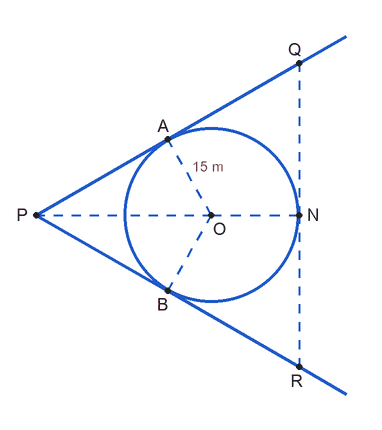
(a) Explain why the centre O must lie on the bisector of the angle between the two roads.
(b) Find OP and PA. (Take .)
(c) Show that the three roads form an equilateral triangle PQR, and find its side. What is the roundabout called for this triangle?
- 161 mark
Question 16
Competency: Analysis
A circle has centre O. A point P outside it is moved straight towards O, so that P comes closer and closer to the circle. All the time, the two tangents from P to the circle are drawn. What happens to the two tangents at the moment P reaches the circle?
- 171 mark
Question 17
Competency: Application
A signboard is in the shape of an equilateral triangle whose altitude is 18 cm. A circular logo, as large as possible, is to be painted on it so that the circle touches all three sides. The diameter of the logo is :
- 181 mark
Question 18
Competency: Application & Analysis
A regular hexagon is drawn inside a circle of radius 8 cm, with all six corners on the circle. A thread is stretched straight from to . The length of the thread is :
- 191 mark
Question 19
Competency: Evaluation & Analysis
Assertion (A) : A circle can be drawn touching all three sides of every triangle, but a circle through all three corners can be drawn only for some triangles.
Reason (R) : The bisectors of the angles of a triangle always meet inside it, but the perpendicular bisectors of its sides may meet outside it.
- 201 mark
Question 20
Competency: Evaluation
Assertion (A) : In a regular hexagon, the radius of the circle through all six corners is equal to the side of the hexagon.
Reason (R) : Each side of a regular hexagon makes an angle of at the centre of this circle.
- 211 mark
Question 21
Competency: Analysis
Three lamp posts , and stand along a straight road, with m. A circular path through all three posts is to be drawn by constructing the perpendicular bisectors of and . This cannot be done because :
- 221 mark
Question 22
Competency: Application & Analysis
A triangular farm has longer than . A signal tower is to stand at a point inside (it may be beyond , outside the farm). It must be equally far from the roads along and , and also equally far from the gates at the corners and . Which two lines should be constructed to find the point?
- 231 mark
Question 23
Competency: Application
To draw the tangents from a point P to a circle with centre O, Imran draws a second circle on OP as diameter. He finds that this second circle has radius 6·5 cm and that each tangent from P measures 12 cm. The radius of the given circle is :
- 241 mark
Question 24
Competency: Analysis
A well is dug at the point that is equally far from the three corners of a triangular plot . The surveyor finds that the well lies exactly on the boundary wall , between and . Which of the following must be true?
- 251 mark
Question 25
Competency: Evaluation
Meera constructs the circumcircle of triangle . She draws the perpendicular bisectors of and , which meet at . She then measures cm, cm and cm. What can she conclude?
- 262 marks
Question 26
Competency: Application & Analysis
A circular park has radius 7 m. Six lamp posts stand on its edge, equally spaced. Rani wants to hang a light cable from post to post, in straight pieces, round the park, instead of along the curved edge. (Take .)
(a) What is the total length of the cable?
(b) How much shorter is the cable than the curved edge of the park?
- 272 marks
Question 27
Competency: Analysis & Evaluation
Asha draws a circle with centre and radius 4 cm. She marks a point on the circle and then tries the usual method for drawing tangents from a point: she bisects at and draws a second circle with centre and radius .
(a) Find and , and show that the second circle meets the first circle only at .
(b) What does your answer to part (a) tell Asha about the tangents from ? Say how she should construct the tangent at instead.
- 282 marks
Question 28
Competency: Application & Understanding
In a triangular garden , and m. A sprinkler is fixed at the circumcentre of the garden, and the hose from it to the corner is 12·5 m long.
(a) Where is the circumcentre of the garden?
(b) Find the length of .
- 292 marks
Question 29
Competency: Analysis & Application
A regular hexagon is drawn in a circle with centre and radius 6 cm, with its six corners on the circle. The tangents to the circle at and at are constructed, and they meet at . (Take .)
(a) Find and the length .
(b) The tangents at all six corners form a bigger regular hexagon round the circle. Find the side of this bigger hexagon.
- 302 marks
Question 30
Competency: Creativity & Application
A gardener wants a triangular flower bed in which the incentre lies inside the bed but the circumcentre lies outside it. Design such a triangle. Give enough data (two lengths and an angle) for it to be constructed with ruler and compasses, and explain why your triangle works.
- 312 marks
Question 31
Competency: Understanding & Analysis
is a regular hexagon whose six corners lie on a circle with centre .
(a) Show that is a diameter of the circle.
(b) Find and give a reason.
- 323 marks
Question 32
Competency: Understanding & Application
A student makes a scale drawing of a village pond, using the scale cm m. He draws the pond as a circle with centre and marks the temple at a point outside it. From he draws a tangent to the pond. On the drawing, cm and cm.
(a) Find the radius of the circle on the drawing.
(b) Find the real radius of the pond and the real length of the tangent .
(c) How far is the temple from the nearest point of the pond?
- 333 marks
Question 33
Competency: Analysis & Evaluation
A circle has centre and radius 4·5 cm. Kavya wants to mark every point from which the tangent to this circle is exactly 6 cm long.
(a) Show that all such points are the same distance from , and find this distance.
(b) Hence describe the locus of all such points, and say how Kavya can construct it with compasses.
(c) Pooja says that the locus is the circle with centre and radius 6 cm. Take a point on Pooja's circle, find the length of the tangent from to the given circle, correct to one decimal place, and say whether she is right.
- 343 marks
Question 34
Competency: Analysis & Application
A triangular garden has the wall m, and . A circular hedge is to pass through the three corners, so its centre is the circumcentre of the triangle. (The angle which an arc subtends at the centre of a circle is double the angle which it subtends at any point on the remaining part of the circle.)
(a) Find .
(b) Show that triangle is equilateral, and hence find the radius of the hedge.
(c) Find , and .
- 353 marks
Question 35
Competency: Analysis & Evaluation
Seven identical coins, each of radius 1·25 cm, are laid flat as shown : one coin in the middle and six coins round it. Each outer coin touches the middle coin and its two neighbours.

The coins are to be put into a circular tray that has the same centre as the middle coin.
(a) Show that the centres of the six outer coins are the corners of a regular hexagon, and find its side.
(b) Find the radius of the smallest circular tray in which all seven coins fit.
(c) A tray of radius 3·5 cm is available. Will it do? Give a reason.
- 363 marks
Question 36
Competency: Analysis
In triangle , the bisectors of and meet at the incentre . It is given that and . Find
(a) ,
(b) ,
(c) .
- 375 marks
Question 37
Competency: Analysis & Evaluation
Case study: A triangular plot has m and m. The owner wants a lamp post at the point that is equally far from the three corners , and . His helper says, "Put it at , the mid-point of . It is right in the middle, so it must be equally far from all three corners."
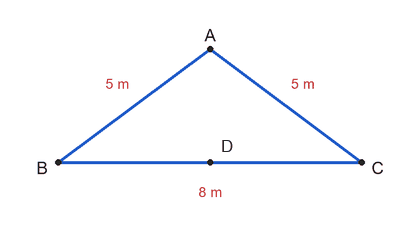
(a) Show that is obtuse. What does this tell you about where the lamp post must stand?
(b) Find and . Is the helper right? Give a reason.
(c) Find how far beyond the correct point lies, and its distance from each corner.
- 384 marks
Question 38
Competency: Analysis & Evaluation
Case study: Two circular ponds in a park have centres A and B. Their radii are 5 m and 9 m, and AB = 28 m. A lamp post P is to stand on the line AB, between the two ponds. From P, a straight fence PT is to touch the first pond at T, and another straight fence PS is to touch the second pond at S. The two fences must be of equal length. (Hypothetical data.)
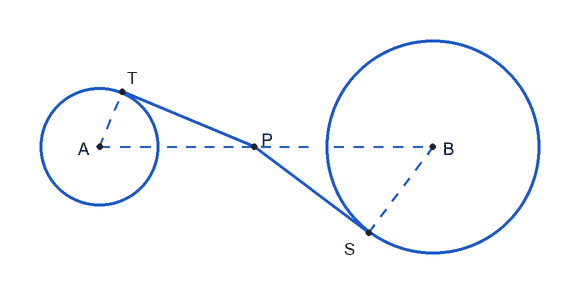
(a) Raju says that P should be the mid-point of AB. Find PT and PS for his choice, correct to one decimal place, and say whether he is right.
(b) Let AP = metres. Form an equation in , find where P must stand and find the length of each fence.
(c) Meena wants a point Q on AB, between the ponds, from which both fences would be 15 m long. Show that no such point exists.
- 395 marks
Question 39
Competency: Evaluation & Analysis
Case study: A school has three triangular plots. A rain-water tank is to be placed on each plot at the point that is equally far from its three corners. The sides of the plots are given below. (Hypothetical data.)
Plot Sides (m) X 13, 14, 15 Y 6, 8, 10 Z 4, 5, 8 (a) For each plot, compare the square of the longest side with the sum of the squares of the other two sides.
(b) Hence say, for each plot, whether the tank lies inside the plot, on a side of it or outside it.
(c) The area of plot X is 84 m. Find the radius of the largest circular pond that can be made in plot X, touching all three sides. Can a pond of radius 4·2 m be made there?
- 404 marks
Question 40
Competency: Analysis & Evaluation
Case study: A workshop cuts the largest possible regular hexagonal tile from a round metal disc. The six corners of the tile lie on the edge of the disc. The area of a regular hexagon of side is , as it is made of six equilateral triangles. Take and . (Hypothetical data.)
Disc P Q R Radius (cm) 5 6 8 (a) Find the side of the tile, the area of the tile and the area of the metal wasted for each disc.
(b) Find the wasted area as a percentage of the disc for each disc, correct to one decimal place. What do you notice?
(c) Predict the percentage wasted for a disc of radius 10 cm, and give a reason.