
Opening your dashboard
Class 10 Maths Chapter 19 Constructions: Previous Year Questions
12 questions on Chapter 19, each solved step by step. Class 10 Maths, ICSE 2026-27.
12 questions with solutions
3–5 marks · Mixed difficulty
- 13 marks
Question 1
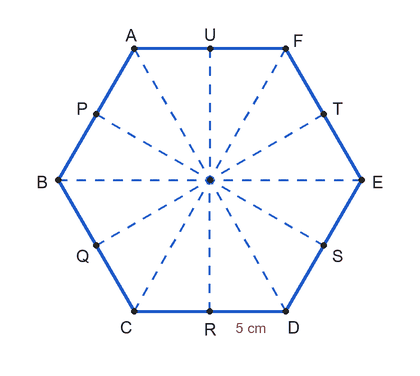
Construct a regular hexagon of side 5 cm. Hence construct all its lines of symmetry and name them.
Solve with AIWritten solution
Solution:
Concept: These facts are used here.
- Regular hexagon: a regular hexagon is made of six equilateral triangles meeting at its centre, so each side equals the distance from the centre to a vertex.
- Lines of symmetry of a regular hexagon: there are six, three joining opposite vertices and three joining the mid-points of opposite sides.
Step 1 — Draw the circle.
A regular hexagon of side 5 cm fits in a circle of radius 5 cm (its six triangles are equilateral). So draw a circle with centre O and radius 5 cm.
Step 2 — Mark the vertices.
Take any point A on the circle. With the compass still open at 5 cm, cut the circle at B from A, at C from B, and so on, to get the six vertices A, B, C, D, E and F. Join them in order; every side is 5 cm.
Step 3 — Draw the diagonal lines of symmetry.
Join each vertex to the opposite vertex: AD, BE and CF. Each passes through O and folds the hexagon onto itself.
Step 4 — Draw the side lines of symmetry.
Bisect three sides with the compass (perpendicular bisectors) and mark the mid-points P, Q, R, S, T and U of AB, BC, CD, DE, EF and FA. Join the opposite mid-points: PS, QT and RU. Each also passes through O.
Step 5 — Look at the finished figure.
The six dashed lines are the lines of symmetry.
Watch out: A regular hexagon has SIX lines of symmetry, not three; the lines through the mid-points of opposite sides count too.
Therefore, the six lines of symmetry are AD, BE, CF, PS, QT and RU.
- 24 marks
Question 2
Draw a line AB = 5 cm. Mark a point C on AB such that AC = 3 cm. Using a ruler and a compass only, construct:
(i) A circle of radius 2.5 cm, passing through A and C.
(ii) Construct two tangents to the circle from the external point B. Measure and record the length of the tangents.
Solve with AIWritten solution
Solution:
Concept: These facts are used here.
- Perpendicular bisector: every point on the perpendicular bisector of a segment is equidistant from its two ends, so the centre of a circle through two points lies on the perpendicular bisector of the segment joining them.
- Tangents from an outside point: a tangent is perpendicular to the radius at its point of contact; the angle in a semicircle is , so the circle on OP as diameter cuts the given circle at the two points of contact.
Step 1 — Draw AB and mark C.
Draw AB of length 5 cm and mark C on it with AC = 3 cm, so that CB = 2 cm.
Step 2 — Find the centre of the circle (part i).
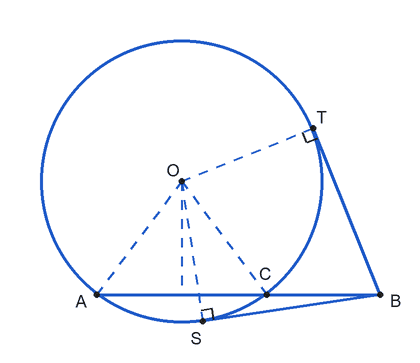
The circle passes through A and C. So its centre lies on the perpendicular bisector of AC. Draw that bisector. With A as centre and radius 2.5 cm, cut the bisector at O (on either side of AB; the figure takes the point above AB). Then OA and OC are both 2.5 cm.
Step 3 — Draw the circle.
With O as centre and radius 2.5 cm, draw the circle. It passes through A and C.
Step 4 — Construct the tangents from B (part ii).
Join OB and bisect it at L. With L as centre and LO as radius, draw a circle. It cuts the first circle at T and S. Join BT and BS; these are the tangents, because and are angles in a semicircle, that is, .
Step 5 — Measure and check.
On measuring, BT and BS are both 3.2 cm. To check, the foot of O on AB is the mid-point of AC, 1.5 cm from A, and O is 2 cm above AB, because:
So, with B 3.5 cm along AB from that foot:
Watch out: The circle's radius is 2.5 cm, not half of AC; its centre is NOT the mid-point of AC.
Therefore, each tangent from B is about cm long.
- 34 marks
Question 3
Using a ruler and a compass construct a triangle ABC in which AB = 7cm, and AC = 5cm. Construct the locus of:
(i) points equidistant from AB and AC.
(ii) points equidistant from BA and BC.
Hence construct a circle touching the three sides of the triangle internally.
Solve with AIWritten solution
Solution:
Concept: These facts are used here.
- Angle bisector: every point on the bisector of an angle is equidistant from its two arms, so the locus of points equidistant from two intersecting lines is the bisector of the angle between them.
- Incentre: the point where the angle bisectors meet is equidistant from all three sides, so it is the centre of the circle touching the three sides (the incircle).
Step 1 — Construct the triangle.
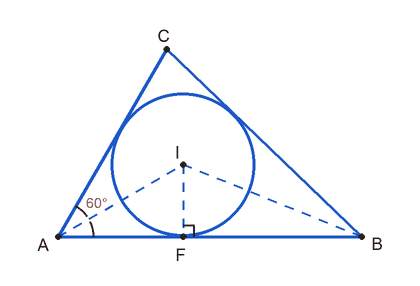
Draw AB of length 7 cm. At A, construct with the compass. Cut AC of length 5 cm on AX and join BC.
Step 2 — Locus (i).
The points equidistant from AB and AC lie on the bisector of . Bisect .
Step 3 — Locus (ii).
The points equidistant from BA and BC lie on the bisector of . Bisect . The two bisectors meet at I.
Step 4 — Draw the incircle.
I is equidistant from all three sides. Draw IF perpendicular to AB. With I as centre and IF as radius, draw the circle; it touches all three sides.
Step 5 — Measure and check.
On measuring, cm. To check, find BC by the cosine rule, then .
Watch out: The locus of points equidistant from two LINES is an angle bisector; the perpendicular bisector is for points equidistant from two POINTS.
Therefore, the loci are the bisectors of and , and the incircle has radius about cm.
- 44 marks
Question 4
Using ruler and compass only, construct a such that BC = 5 cm and AB = 6.5 cm and .
(i) Construct a circum-circle of .
(ii) Construct a cyclic quadrilateral ABCD, such that D is equidistant from AB and BC.
Solve with AIWritten solution
Solution:
Concept: These facts are used here.
- Perpendicular bisector: every point on the perpendicular bisector of a segment is equidistant from its two ends, so the centre of a circle through two points lies on the perpendicular bisector of the segment joining them.
- Angle bisector: every point on the bisector of an angle is equidistant from its two arms, so the locus of points equidistant from two intersecting lines is the bisector of the angle between them.
- Cyclic quadrilateral: a quadrilateral whose four vertices lie on one circle.
Step 1 — Construct the triangle.
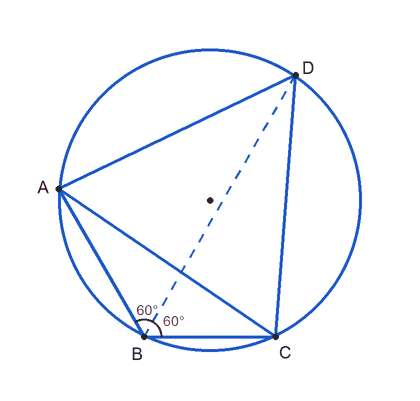
Draw BC of length 5 cm. At B, construct (two arcs). Cut BA of length 6.5 cm on BX and join AC.
Step 2 — Draw the circumcircle (part i).
Draw the perpendicular bisectors of AB and BC. They meet at O, which is equidistant from A, B and C. With O as centre and OB as radius, draw the circle through A, B and C.
Step 3 — Locate D (part ii).
D must be equidistant from AB and BC, so it lies on the bisector of . Bisect ; each half is . Produce the bisector to meet the circle again at D, on the arc AC away from B.
Step 4 — Complete the quadrilateral.
Join AD and CD. A, B, C and D all lie on the circle, so ABCD is the required cyclic quadrilateral, with and both .
Step 5 — Check the size of the circle.
The cosine rule gives AC, and then .
Watch out: D is on the bisector of (equidistant from the two LINES AB and BC), not on the perpendicular bisector of AC.
Therefore, the circumcircle has radius about cm, and D is where the bisector of meets it again.
- 54 marks
Question 5
Use ruler and compass only for answering this question.
Draw a circle of radius 4 cm. Mark the centre as O. Mark a point P outside the circle at a distance of 7 cm from the centre. Construct two tangents to the circle from the external point P.
Measure and write down the length of any one tangent.
Solve with AIWritten solution
Solution:
Concept: Tangents from an outside point: a tangent is perpendicular to the radius at its point of contact; the angle in a semicircle is , so the circle on OP as diameter cuts the given circle at the two points of contact.
Step 1 — Draw the circle and P.
Draw a circle with centre O and radius 4 cm. Mark P with OP = 7 cm.
Step 2 — Bisect OP.
Draw the perpendicular bisector of OP to find its mid-point M.
Step 3 — Draw the circle on OP.
With M as centre and MO as radius, draw a circle. It cuts the first circle at A and B.
Step 4 — Draw the tangents.
Join PA and PB. These are the tangents, because and are angles in a semicircle (on the diameter OP), so they are .
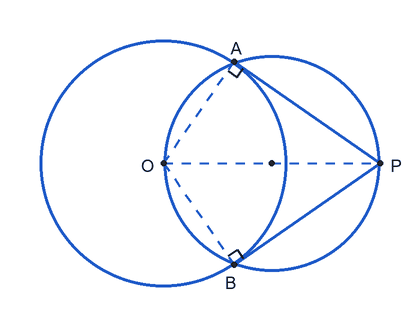
Step 5 — Measure and check.
On measuring, cm. In right :
Watch out: The radius OA is perpendicular to the tangent, so OP is the hypotenuse; PA is NOT cm.
Therefore, each tangent is about cm long.
- 64 marks
Question 6
Using ruler and a compass only construct a semi-circle with diameter BC = 7 cm. Locate a point A on the circumference of the semicircle such that A is equidistant from B and C. Complete the cyclic quadrilateral ABCD, such that D is equidistant from AB and BC. Measure and write it down.
Solve with AIWritten solution
Solution:
Concept: These facts are used here.
- Perpendicular bisector: every point on the perpendicular bisector of a segment is equidistant from its two ends, so the centre of a circle through two points lies on the perpendicular bisector of the segment joining them.
- Angle bisector: every point on the bisector of an angle is equidistant from its two arms, so the locus of points equidistant from two intersecting lines is the bisector of the angle between them.
- Cyclic quadrilateral: opposite angles add up to .
- Angle in a semicircle: the angle on a diameter at any point of the circle is .
Step 1 — Draw the semicircle.
Draw BC of length 7 cm, bisect it at M, and with M as centre and radius 3.5 cm draw a semicircle on BC.
Step 2 — Locate A.
A is equidistant from B and C, so it lies on the perpendicular bisector of BC. That bisector passes through M; it meets the semicircle at A. Join AB and AC; then .
Step 3 — Locate D.
D is equidistant from AB and BC, so it lies on the bisector of . Bisect and let the bisector meet the semicircle at D (on the arc AC). Join AD and DC to complete ABCD.
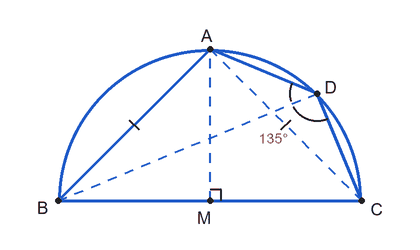
Step 4 — Measure and check.
On measuring, . To check, note that is (angle in a semicircle) and that AB equals AC. So is . ABCD is cyclic, so the angle at D is the supplement of the angle at B.
Watch out: The angle at D is opposite the angle at B (), not opposite the angle at A.
Therefore, .
- 74 marks
Question 7
Using ruler and compass construct a triangle where cm, cm and . Hence construct a circle circumscribing triangle . Measure and write down the radius of the circle.
Solve with AIWritten solution
Solution:
Concept: These facts are used here.
- Perpendicular bisector: every point on the perpendicular bisector of a segment is equidistant from its two ends, so the centre of a circle through two points lies on the perpendicular bisector of the segment joining them.
- Right-angled triangle: the circumcentre of a right-angled triangle is the mid-point of the hypotenuse.
Step 1 — Construct the triangle.
Draw BC of length 4 cm. At B, construct and cut BA of length 3 cm on BX. Join AC.
Step 2 — Find the circumcentre.
Draw the perpendicular bisectors of AB and BC. They meet at O, which turns out to be the mid-point of AC.
Step 3 — Draw the circle.
With O as centre and OA as radius, draw the circle; it passes through A, B and C.
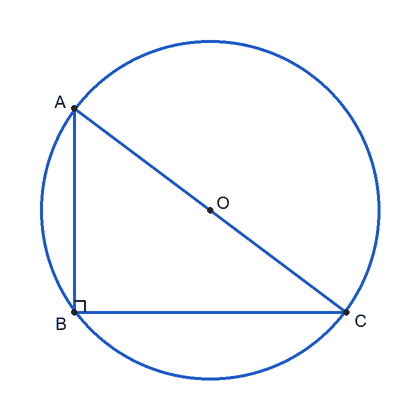
Step 4 — Measure and check.
On measuring, OA is 2.5 cm. Since is a right angle, AC is a diameter.
Watch out: The radius is half the hypotenuse AC, not half of AB or BC.
Therefore, the radius of the circumcircle is cm.
- 84 marks
Question 8
Using ruler and compass construct a triangle ABC in which cm, and cm. Construct a circle passing through A, B and C. Measure and write down the radius of the circle.
Solve with AIWritten solution
Solution:
Concept: These facts are used here.
- Perpendicular bisector: every point on the perpendicular bisector of a segment is equidistant from its two ends, so the centre of a circle through two points lies on the perpendicular bisector of the segment joining them.
- Cosine rule: in , .
- Circumradius: in any triangle, , where a is the side opposite the angle A.
Step 1 — Construct the triangle.
Draw AB of length 6 cm. At A, construct (two arcs). Cut AC of length 5 cm on AX and join BC.
Step 2 — Find the circumcentre.
Draw the perpendicular bisectors of AB and BC. They meet at O. Because is obtuse, O lies outside the triangle, on the far side of BC.
Step 3 — Draw the circle.
With O as centre and OB as radius, draw the circle through A, B and C.
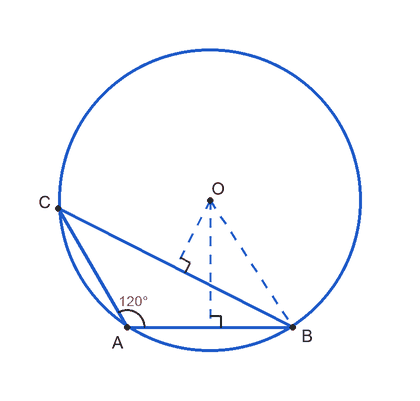
Step 4 — Measure and check.
On measuring, cm. The cosine rule gives BC, and then R.
Watch out: is negative (), so the last term ADDS 30.
Therefore, the radius of the circle is about cm.
- 94 marks
Question 9
Use ruler and compass for the following construction. Construct a , where cm, cm and . Construct a circle circumscribing the . Measure and write down the length of the radius of the circle.
Solve with AIWritten solution
Solution:
Concept: These facts are used here.
- Perpendicular bisector: every point on the perpendicular bisector of a segment is equidistant from its two ends, so the centre of a circle through two points lies on the perpendicular bisector of the segment joining them.
- Cosine rule: in , .
- Circumradius: in any triangle, , where a is the side opposite the angle A.
Step 1 — Construct the triangle.
Draw AB of length 6 cm. At A, construct . Cut AC of length 4.5 cm on AX and join BC.
Step 2 — Find the circumcentre.
Draw the perpendicular bisectors of AB and BC. They meet at O, outside the triangle because is obtuse.
Step 3 — Draw the circle.
With O as centre and OB as radius, draw the circle through A, B and C.

Step 4 — Measure and check.
On measuring, cm. The cosine rule gives BC, and then R.
Watch out: , so the last term adds 27 instead of subtracting it.
Therefore, the radius of the circumcircle is about cm.
- 104 marks
Question 10
Construct a regular hexagon of side 4.5 cm. Hence, construct a circle circumscribing the regular hexagon. Use ruler and compass for the construction. Measure and write down the radius of the circle.
Solve with AIWritten solution
Solution:
Concept: Regular hexagon: a regular hexagon is made of six equilateral triangles meeting at its centre, so each side equals the distance from the centre to a vertex.
Step 1 — Construct the hexagon.
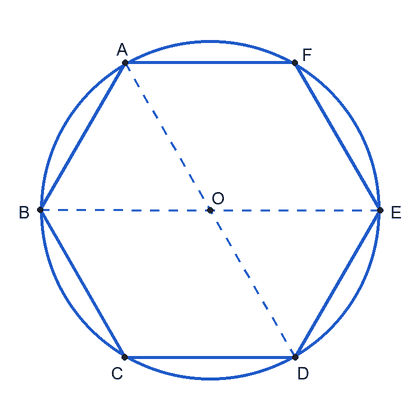
Draw a circle with centre O and radius 4.5 cm. From any point A on it, step off the radius six times round the circle to get B, C, D, E and F. Join them in order; every side is 4.5 cm.
Step 2 — Construct the circumcircle.
Join two pairs of opposite vertices, AD and BE. They meet at the centre O of the hexagon, which is equidistant from all six vertices. With O as centre and OA as radius, draw the circle through all six vertices.
Step 3 — Measure and check.
On measuring, cm. This is expected: the six triangles OAB, OBC, … are equilateral, so each radius equals a side of the hexagon.
Watch out: The circumradius of a regular hexagon equals its SIDE; it is not half the side or half a diagonal.
Therefore, the radius of the circumcircle is cm.
- 115 marks
Question 11
Use ruler and compass for the following construction:
(a) construct an equilateral triangle ABC of side 5 cm.
(b) construct the circumcircle of .
(c) construct the locus of points which are equidistant from AB and BC. Mark the point where the circumcircle and locus meet, as D.
(d) give the geometrical name of quadrilateral ABCD.
Solve with AIWritten solution
Solution:
Concept: These facts are used here.
- Perpendicular bisector: every point on the perpendicular bisector of a segment is equidistant from its two ends, so the centre of a circle through two points lies on the perpendicular bisector of the segment joining them.
- Angle bisector: every point on the bisector of an angle is equidistant from its two arms, so the locus of points equidistant from two intersecting lines is the bisector of the angle between them.
- Kite: a quadrilateral with two pairs of equal adjacent sides.
Step 1 — Construct the triangle (part a).
Draw BC of length 5 cm. With B and C as centres and radius 5 cm, draw arcs meeting at A. Join AB and AC.
Step 2 — Construct the circumcircle (part b).
Draw the perpendicular bisectors of AB and BC; they meet at O. With O as centre and OA as radius, draw the circle through A, B and C.
Step 3 — Construct the locus and D (part c).
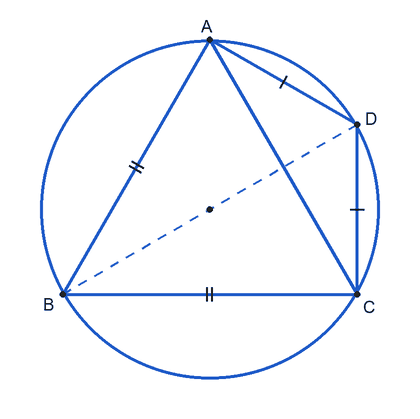
The points equidistant from AB and BC lie on the bisector of . Bisect . In an equilateral triangle this bisector is also the perpendicular bisector of AC, so it passes through O. Produce it to meet the circumcircle at D, and join AD and DC.
Step 4 — Name the quadrilateral (part d).
D lies on the perpendicular bisector of AC, so DA equals DC. Also BA and BC are both 5 cm. So ABCD has two pairs of equal adjacent sides. BD passes through O, so it is a diameter, and and are right angles (angles in a semicircle).
Watch out: ABCD is not a rhombus: the equal sides DA and DC (about 2.89 cm each) are shorter than BA and BC (5 cm each).
Therefore, the locus is the bisector of , and ABCD is a kite (a cyclic kite, with right angles at A and C).
- 124 marks
Question 12
Using a ruler and compass only, construct:
(a) such that cm, cm and .
(b) the circumcircle of .
(c) the locus of points which are equidistant from AB and BC.
Solve with AIWritten solution
Solution:
Concept: These facts are used here.
- Perpendicular bisector: every point on the perpendicular bisector of a segment is equidistant from its two ends, so the centre of a circle through two points lies on the perpendicular bisector of the segment joining them.
- Angle bisector: every point on the bisector of an angle is equidistant from its two arms, so the locus of points equidistant from two intersecting lines is the bisector of the angle between them.
- Circumradius: in any triangle, , where a is the side opposite the angle A.
Step 1 — Construct the triangle (part a).
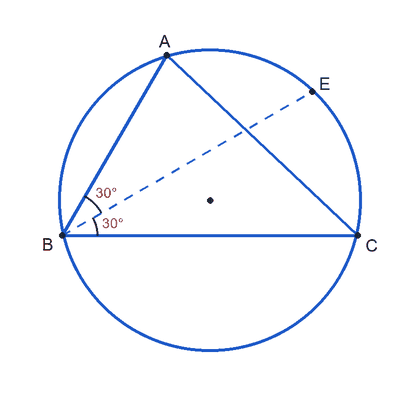
Draw AB of length 5 cm. At B, construct . With A as centre and radius 6.3 cm, cut BX at C. Join AC.
Step 2 — Construct the circumcircle (part b).
Draw the perpendicular bisectors of AB and BC; they meet at O. With O as centre and OA as radius, draw the circle through A, B and C.
Step 3 — Construct the locus (part c).
The points equidistant from AB and BC lie on the bisector of . Bisect , so that each half is ; the dashed line BE is the locus.
Step 4 — Check the measurements.
From the cosine rule, BC satisfies the equation below, and its positive root is the length.
The radius of the circle is
Watch out: The arc of radius 6.3 cm is drawn from A (C is 6.3 cm from A), not from B.
Therefore, the triangle has cm, its circumcircle has radius about cm, and the locus is the bisector BE of .