
Question 44 marksAsked 2018Medium
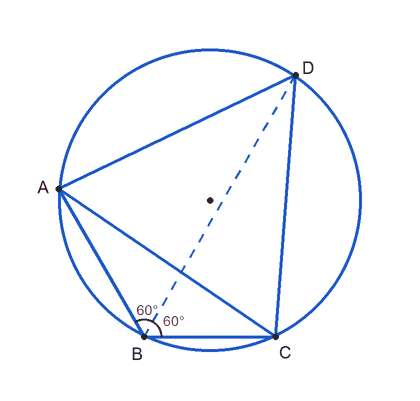
Using ruler and compass only, construct a such that BC = 5 cm and AB = 6.5 cm and .
(i) Construct a circum-circle of .
(ii) Construct a cyclic quadrilateral ABCD, such that D is equidistant from AB and BC.
Confirming your payment
Sign up now and get 250 free tokens.
Previous Year Questions · Question 4 of 12
Using ruler and compass only, construct a such that BC = 5 cm and AB = 6.5 cm and .
(i) Construct a circum-circle of .
(ii) Construct a cyclic quadrilateral ABCD, such that D is equidistant from AB and BC.
Solution:
Concept: These facts are used here.
Step 1 — Construct the triangle.
Draw BC of length 5 cm. At B, construct (two arcs). Cut BA of length 6.5 cm on BX and join AC.
Step 2 — Draw the circumcircle (part i).
Draw the perpendicular bisectors of AB and BC. They meet at O, which is equidistant from A, B and C. With O as centre and OB as radius, draw the circle through A, B and C.
Step 3 — Locate D (part ii).
D must be equidistant from AB and BC, so it lies on the bisector of . Bisect ; each half is . Produce the bisector to meet the circle again at D, on the arc AC away from B.
Step 4 — Complete the quadrilateral.
Join AD and CD. A, B, C and D all lie on the circle, so ABCD is the required cyclic quadrilateral, with and both .
Step 5 — Check the size of the circle.
The cosine rule gives AC, and then .
Watch out: D is on the bisector of (equidistant from the two LINES AB and BC), not on the perpendicular bisector of AC.
Therefore, the circumcircle has radius about cm, and D is where the bisector of meets it again.