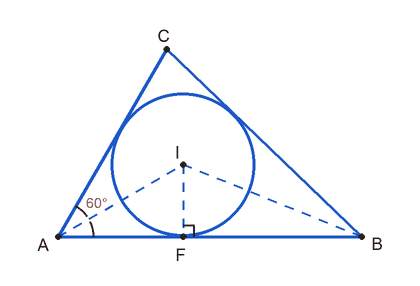
Using a ruler and a compass construct a triangle ABC in which AB = 7cm, ∠ CAB = 60^° and AC = 5cm.
Question 34 marksAsked 2017Medium
Using a ruler and a compass construct a triangle ABC in which AB = 7cm, ∠CAB=60∘ and AC = 5cm. Construct the locus of:
(i) points equidistant from AB and AC.
(ii) points equidistant from BA and BC.
Hence construct a circle touching the three sides of the triangle internally.
Solution:
Concept: These facts are used here.
Angle bisector: every point on the bisector of an angle is equidistant from its two arms, so the locus of points equidistant from two intersecting lines is the bisector of the angle between them.
Incentre: the point where the angle bisectors meet is equidistant from all three sides, so it is the centre of the circle touching the three sides (the incircle).
Step 1 — Construct the triangle.
Draw AB of length 7 cm. At A, construct ∠BAX=60∘ with the compass. Cut AC of length 5 cm on AX and join BC.
Step 2 — Locus (i).
The points equidistant from AB and AC lie on the bisector of ∠A. Bisect ∠CAB.
Step 3 — Locus (ii).
The points equidistant from BA and BC lie on the bisector of ∠B. Bisect ∠ABC. The two bisectors meet at I.
Step 4 — Draw the incircle.
I is equidistant from all three sides. Draw IF perpendicular to AB. With I as centre and IF as radius, draw the circle; it touches all three sides.
Step 5 — Measure and check.
On measuring, IF≈1.7 cm. To check, find BC by the cosine rule, then r=sarea.