Solution:
Concept: These facts are used here.
- Perpendicular bisector: every point on the perpendicular bisector of a segment is equidistant from its two ends, so the centre of a circle through two points lies on the perpendicular bisector of the segment joining them.
- Angle bisector: every point on the bisector of an angle is equidistant from its two arms, so the locus of points equidistant from two intersecting lines is the bisector of the angle between them.
- Cyclic quadrilateral: opposite angles add up to 180∘.
- Angle in a semicircle: the angle on a diameter at any point of the circle is 90∘.
Step 1 — Draw the semicircle.
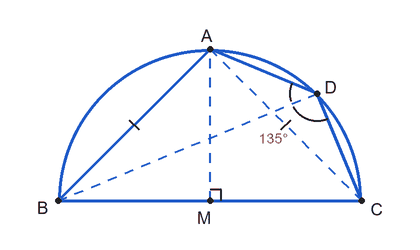
Draw BC of length 7 cm, bisect it at M, and with M as centre and radius 3.5 cm draw a semicircle on BC.
Step 2 — Locate A.
A is equidistant from B and C, so it lies on the perpendicular bisector of BC. That bisector passes through M; it meets the semicircle at A. Join AB and AC; then AB=AC.
Step 3 — Locate D.
D is equidistant from AB and BC, so it lies on the bisector of ∠ABC. Bisect ∠ABC and let the bisector meet the semicircle at D (on the arc AC). Join AD and DC to complete ABCD.
Step 4 — Measure and check.
On measuring, ∠ADC=135∘. To check, note that ∠BAC is 90∘ (angle in a semicircle) and that AB equals AC. So ∠ABC is 45∘. ABCD is cyclic, so the angle at D is the supplement of the angle at B.
∠ADC=180∘−45∘=135∘
Watch out: The angle at D is opposite the angle at B (45∘), not opposite the angle at A.
Therefore, ∠ADC=135∘.
