Solution:
Concept: These facts are used here.
- Perpendicular bisector: every point on the perpendicular bisector of a segment is equidistant from its two ends, so the centre of a circle through two points lies on the perpendicular bisector of the segment joining them.
- Angle bisector: every point on the bisector of an angle is equidistant from its two arms, so the locus of points equidistant from two intersecting lines is the bisector of the angle between them.
- Kite: a quadrilateral with two pairs of equal adjacent sides.
Step 1 — Construct the triangle (part a).
Draw BC of length 5 cm. With B and C as centres and radius 5 cm, draw arcs meeting at A. Join AB and AC.
Step 2 — Construct the circumcircle (part b).
Draw the perpendicular bisectors of AB and BC; they meet at O. With O as centre and OA as radius, draw the circle through A, B and C.
Step 3 — Construct the locus and D (part c).
The points equidistant from AB and BC lie on the bisector of ∠ABC. Bisect ∠ABC. In an equilateral triangle this bisector is also the perpendicular bisector of AC, so it passes through O. Produce it to meet the circumcircle at D, and join AD and DC.
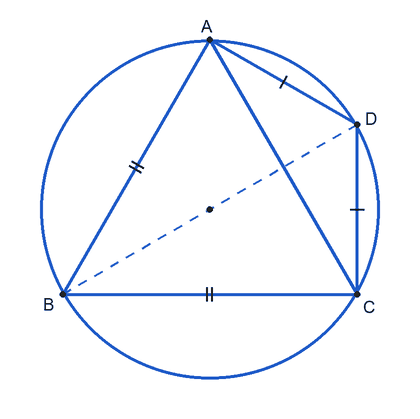
Step 4 — Name the quadrilateral (part d).
D lies on the perpendicular bisector of AC, so DA equals DC. Also BA and BC are both 5 cm. So ABCD has two pairs of equal adjacent sides. BD passes through O, so it is a diameter, and ∠BAD and ∠BCD are right angles (angles in a semicircle).
Watch out: ABCD is not a rhombus: the equal sides DA and DC (about 2.89 cm each) are shorter than BA and BC (5 cm each).
Therefore, the locus is the bisector of ∠ABC, and ABCD is a kite (a cyclic kite, with right angles at A and C).
