
Question 84 marksAsked 2023Medium
Using ruler and compass construct a triangle ABC in which cm, and cm. Construct a circle passing through A, B and C. Measure and write down the radius of the circle.
Confirming your payment
Sign up now and get 250 free tokens.
Previous Year Questions · Question 8 of 12
Using ruler and compass construct a triangle ABC in which cm, and cm. Construct a circle passing through A, B and C. Measure and write down the radius of the circle.
Solution:
Concept: These facts are used here.
Step 1 — Construct the triangle.
Draw AB of length 6 cm. At A, construct (two arcs). Cut AC of length 5 cm on AX and join BC.
Step 2 — Find the circumcentre.
Draw the perpendicular bisectors of AB and BC. They meet at O. Because is obtuse, O lies outside the triangle, on the far side of BC.
Step 3 — Draw the circle.
With O as centre and OB as radius, draw the circle through A, B and C.
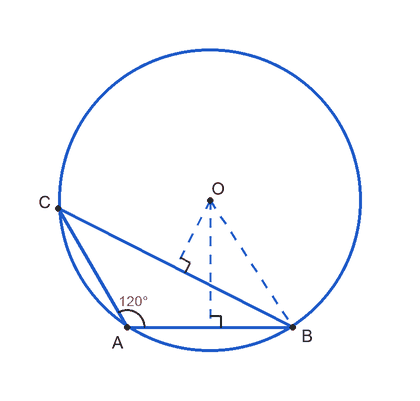
Step 4 — Measure and check.
On measuring, cm. The cosine rule gives BC, and then R.
Watch out: is negative (), so the last term ADDS 30.
Therefore, the radius of the circle is about cm.