
Question 263 marksMedium
In triangle ABC, ∠ABC = 90°, side AB = 6 cm, side BC = 7·2 cm and BD is perpendicular to side AC. Draw circumcircle of triangle BDC and then state the length of the radius of this circumcircle drawn.
Confirming your payment
Sign up now and get 250 free tokens.
Constructions · Question 26 of 26
In triangle ABC, ∠ABC = 90°, side AB = 6 cm, side BC = 7·2 cm and BD is perpendicular to side AC. Draw circumcircle of triangle BDC and then state the length of the radius of this circumcircle drawn.
Solution:
Concept: If a segment subtends a right angle at a point, that point lies on the circle with the segment as diameter (the angle in a semicircle is 90°).
Step 1 — Construct ΔABC.
Draw BC = 7·2 cm. At B, construct ∠CBX = 90° and cut BA = 6 cm on BX. Join AC.
Step 2 — Draw BD.
From B, draw BD perpendicular to AC, meeting it at D.
Step 3 — Spot the diameter.
∠BDC = 90°, so the side BC subtends a right angle at D. Therefore the circumcircle of ΔBDC has BC as its diameter, and its centre is the mid-point of BC.
Step 4 — Draw the circumcircle.
Bisect BC at M. With M as centre and MB as radius, draw the circle; it passes through B, D and C.
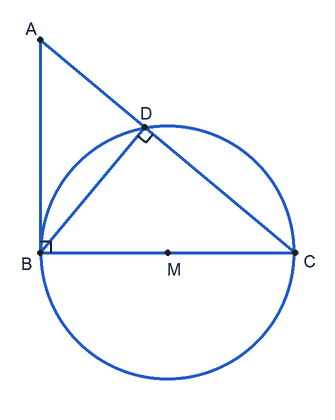
Step 5 — State the radius.
The radius is half the diameter BC.
Watch out: You do not need to bisect two sides of ΔBDC here. The right angle at D tells you at once that BC is a diameter.
Therefore, the radius of the circumcircle of ΔBDC is 3·6 cm.