
Question 253 marksMedium
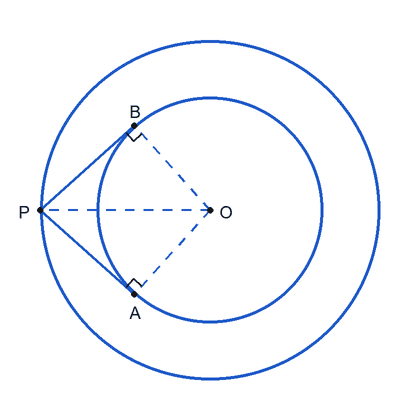
Draw two concentric circles with radii 4 cm and 6 cm. Taking a point on the outer circle, construct a pair of tangents to inner circle. By measuring the lengths of both the tangents, show that they are equal to each other.
Confirming your payment
Sign up now and get 250 free tokens.
Constructions · Question 25 of 26
Draw two concentric circles with radii 4 cm and 6 cm. Taking a point on the outer circle, construct a pair of tangents to inner circle. By measuring the lengths of both the tangents, show that they are equal to each other.
Solution:
Concept: A tangent to a circle is perpendicular to the radius at the point of contact. If P is outside the circle and PA touches it at A, then ∠OAP = 90°, so A lies on the circle with OP as diameter (the angle in a semicircle is 90°). That circle cuts the given circle at the two points of contact. Here the given circle is the inner one, and P is outside it.
Step 1 — Draw the two circles and mark P.
With centre O, draw circles of radii 4 cm and 6 cm. Mark any point P on the outer circle, so OP = 6 cm.
Step 2 — Draw the circle on OP as diameter.
Join OP and bisect it at M. With M as centre and MO as radius, draw a circle cutting the inner circle at A and B.
Step 3 — Draw the tangents.
Join PA and PB. These are tangents to the inner circle, because ∠OAP and ∠OBP are both 90° (angles in a semicircle).
Step 4 — Measure and compare.
Measuring gives PA ≈ 4·5 cm and PB ≈ 4·5 cm, so the two tangents are equal. To check, triangle OAP is right-angled at A, so
and therefore
Triangle OBP gives exactly the same working, so PB is the same length.
Watch out: The radius in Pythagoras is the radius of the inner circle (4 cm), the one the tangents touch; OP is the outer radius (6 cm).
Therefore, PA = PB ≈ 4·5 cm, so the two tangents are equal.