
Question 93 marksMedium
Draw a circle of radius 3 cm. Mark a point P at a distance of 5 cm from the centre of the circle drawn. Draw two tangents PA and PB to the given circle and measure the length of each tangent.
Confirming your payment
Sign up now and get 250 free tokens.
Constructions · Question 9 of 26
Draw a circle of radius 3 cm. Mark a point P at a distance of 5 cm from the centre of the circle drawn. Draw two tangents PA and PB to the given circle and measure the length of each tangent.
Solution:
Concept: A tangent to a circle is perpendicular to the radius at the point of contact. If P is outside the circle and PA touches it at A, then ∠OAP = 90°, so A lies on the circle with OP as diameter (the angle in a semicircle is 90°). That circle cuts the given circle at the two points of contact.
Step 1 — Draw the circle and mark P.
Draw a circle with centre O and radius 3 cm. Draw a line from O and mark P on it so that OP = 5 cm. P is outside the circle, because 5 cm is more than the radius.
Step 2 — Bisect OP.
Draw the perpendicular bisector of OP (arcs of equal radius, more than half of OP, from O and from P). It cuts OP at its mid-point M, which is 2·5 cm from both O and P.
Step 3 — Draw the circle on OP as diameter.
With M as centre and MO as radius, draw a circle. It cuts the given circle at two points; name them A and B.
Step 4 — Draw the tangents.
Join PA and PB. These are the required tangents: A lies on the circle with diameter OP, so ∠OAP = 90° (angle in a semicircle), and a line perpendicular to the radius at its end is a tangent. The same holds for B.
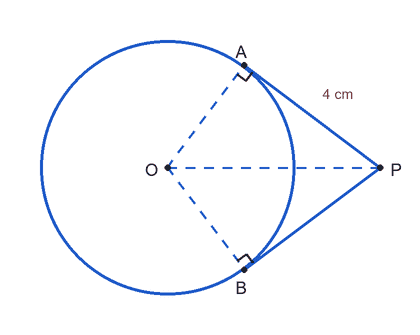
Step 5 — Measure and check the tangents.
Measuring with a ruler gives 4 cm for each of PA and PB. We can check this by calculation: triangle OAP is right-angled at A, so by Pythagoras' theorem
and therefore
Watch out: M must be the exact mid-point of OP. If the second circle is not centred at the mid-point, ∠OAP will not be 90° and PA will not be a tangent.
Therefore, each tangent is 4 cm long: PA = 4 cm and PB = 4 cm.