
Question 203 marksMedium
Construct a triangle ABC in which base BC = 5·5 cm, AB = 6 cm and ∠ABC = 120°.
(i) Construct a circle circumscribing the triangle ABC.
(ii) Draw a cyclic quadrilateral ABCD so that D is equidistant from B and C.
Confirming your payment
Sign up now and get 250 free tokens.
Constructions · Question 20 of 26
Construct a triangle ABC in which base BC = 5·5 cm, AB = 6 cm and ∠ABC = 120°.
(i) Construct a circle circumscribing the triangle ABC.
(ii) Draw a cyclic quadrilateral ABCD so that D is equidistant from B and C.
Solution:
Concept: The circumcentre of a triangle is the point where the perpendicular bisectors of its sides meet. Every point on the perpendicular bisector of a side is equally far from the two ends of that side, so the circumcentre is equally far from all three vertices. A circle with this centre and that distance as radius passes through all three vertices: it is the circumscribed circle (circumcircle). A point equidistant from B and C lies on the perpendicular bisector of BC. A quadrilateral is cyclic when all four vertices lie on one circle.
Step 1 — Construct ΔABC.
Draw BC = 5·5 cm. At B, construct ∠CBX = 120° and cut BA = 6 cm on BX. Join AC.
(i)
Step 2 — Find the circumcentre.
Draw the perpendicular bisectors of BC and AB. They meet at O.
Step 3 — Draw the circumcircle.
With O as centre and OA as radius, draw the circle through A, B and C. (Its radius measures about 5·75 cm.)
(ii)
Step 4 — Locate D.
D must be equally far from B and C, so it lies on the perpendicular bisector of BC. Produce this bisector (through its foot M on BC and through O) to meet the circle again at D on the arc CA, the arc that does not contain B.
Step 5 — Complete the quadrilateral.
Join CD and DA. ABCD is cyclic because all four vertices lie on the circle, and DB = DC because D lies on the perpendicular bisector of BC.
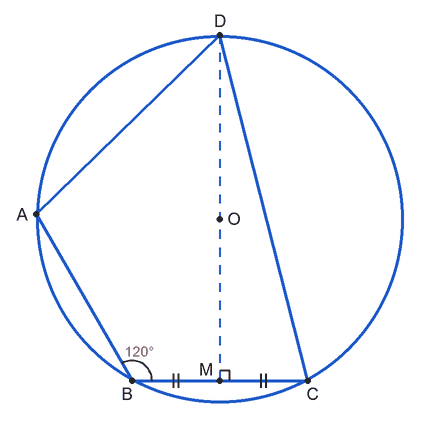
Watch out: The perpendicular bisector of BC meets the circle at two points. The one on the small arc BC (below BC) would give the order A, B, D, C, not ABCD; take the point on arc CA.
Therefore, ABCD is the required cyclic quadrilateral, with D on the circumcircle and DB = DC.