Solution:
Concept: Points equidistant from two lines that meet lie on the bisector of the angle between them. The angle in a semicircle is 90°.
(i)
Step 1 — Construct the triangle.
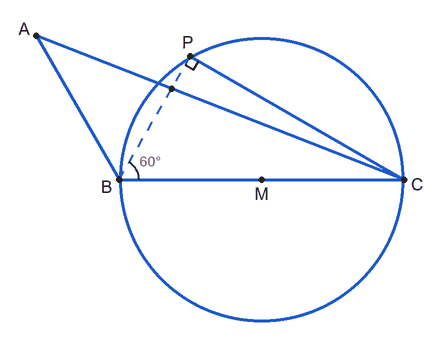
Draw BC = 6 cm. At B, construct ∠CBX = 120° and cut BA = 3·5 cm on BX. Join AC.
(ii)
Step 2 — Draw the circle on BC as diameter.
Bisect BC at M. With M as centre and MB (3 cm) as radius, draw the circle; BC is its diameter.
Step 3 — Locate P.
A point equidistant from AB and BC lies on the bisector of ∠ABC. Bisect ∠ABC; the bisector meets the circle at P. Join PC.
(iii)
Step 4 — Measure ∠BCP and check it.
Measuring with a protractor gives ∠BCP = 30°. To check, BP bisects the 120° angle, so ∠PBC = 60°, and ∠BPC = 90° (angle in a semicircle). The angles of ΔBPC add up to 180°, so
∠BCP=180∘−90∘−60∘=30∘
Watch out: ∠PBC is half of 120°, that is 60°, because BP is the bisector; do not use 120° in triangle BPC.
Therefore, ∠BCP = 30°.
