
Question 143 marksMedium
Using ruler and compasses only construct a triangle ABC in which BC = 4 cm, ∠ACB = 45° and perpendicular from A on BC is 2·5 cm. Draw a circle circumscribing the triangle ABC.
Confirming your payment
Sign up now and get 250 free tokens.
Constructions · Question 14 of 26
Using ruler and compasses only construct a triangle ABC in which BC = 4 cm, ∠ACB = 45° and perpendicular from A on BC is 2·5 cm. Draw a circle circumscribing the triangle ABC.
Solution:
Concept: All points at a fixed distance from a line lie on a line parallel to it. So the vertex A, which is 2·5 cm from BC, lies on the line parallel to BC at a distance of 2·5 cm. The circumcentre of a triangle is the point where the perpendicular bisectors of its sides meet.
Step 1 — Draw the base and the angle at C.
Draw BC = 4 cm. At C, construct ∠BCX = 45° (bisect a right angle).
Step 2 — Draw the line for the height.
At any point of BC (or of BC produced), draw a perpendicular and mark on it a point 2·5 cm from BC. Through that point, draw a line parallel to BC, on the same side as CX. Every point of this line is 2·5 cm from BC.
Step 3 — Locate A.
The parallel line meets CX at A. Join AB. In ΔABC, the perpendicular AD from A to BC is 2·5 cm and ∠ACB = 45°.
Step 4 — Find the circumcentre.
Draw the perpendicular bisectors of two sides, say BC and AC. They meet at O, the circumcentre.
Step 5 — Draw the circumcircle.
With O as centre and OA as radius, draw the circle. It passes through A, B and C.
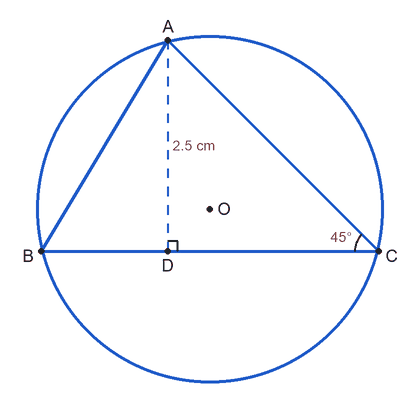
For reference, the circumradius measures about 2·1 cm (calculation: R = 2·06 cm).
Watch out: The 2·5 cm is the height of the triangle (the perpendicular from A), not the length of a side. Do not cut 2·5 cm off CX.
Therefore, ΔABC is constructed and its circumcircle drawn, with radius about 2·1 cm.