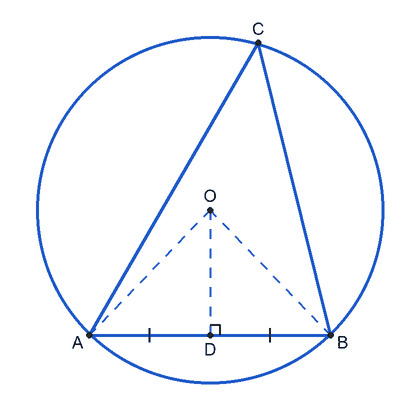
(i) Construct a triangle ABC with the following data : Base AB = 6 cm, BC = 7·5 cm and angle CAB = 60°.
(ii) In the same diagram, draw a circle which passes through the points A, B and C and mark its centre O.
(iii) Draw a perpendicular from O to AB which meets AB in D.
(iv) Prove that : AD = BD.
Solution:
Concept: The circumcentre of a triangle is the point where the perpendicular bisectors of its sides meet. Every point on the perpendicular bisector of a side is equally far from the two ends of that side, so the circumcentre is equally far from all three vertices. A circle with this centre and that distance as radius passes through all three vertices: it is the circumscribed circle (circumcircle). In a circle, the perpendicular from the centre to a chord bisects the chord.
(i)
Step 1 — Construct the triangle.
Draw AB = 6 cm. At A, construct ∠BAX = 60° with compasses. With B as centre and radius 7·5 cm, draw an arc cutting AX at C. Join BC. ABC is the required triangle.
(ii)
Step 2 — Find the centre of the circle through A, B and C.
Draw the perpendicular bisectors of AB and AC. They meet at O, the circumcentre, which is equally far from A, B and C.
Step 3 — Draw the circle.
With O as centre and OA as radius, draw the circle. It passes through A, B and C.
(iii)
Step 4 — Draw the perpendicular to AB.
From O, draw OD perpendicular to AB, meeting AB at D. Join OA and OB.
(iv)
Step 5 — Prove AD = BD.
We compare triangles OAD and OBD, which share the side OD.
In ΔOAD and ΔOBD:
OA = OB (radii of the same circle)
∠ODA and ∠ODB are both 90° (OD ⊥ AB)
OD = OD (common side)
So ΔOAD ≅ ΔOBD by the RHS rule, and the corresponding sides AD and BD are equal.
For reference, the circumradius measures about 4·3 cm (calculation: R = 37.5 ≈ 4·33 cm).
Watch out: RHS needs the right angle, the hypotenuse and one other side. Here the hypotenuses are OA and OB (equal radii) and the other side is OD.
Therefore, AD = BD: the perpendicular from the centre O bisects the chord AB. Hence proved.