
Question 123 marksHard
Using ruler and compasses only,
(i) Construct triangle ABC, having given BC = 7 cm, AB – AC = 1 cm and ∠ABC = 45°.
(ii) Inscribe a circle in the Δ ABC constructed in (i) above.
Confirming your payment
Sign up now and get 250 free tokens.
Constructions · Question 12 of 26
Using ruler and compasses only,
(i) Construct triangle ABC, having given BC = 7 cm, AB – AC = 1 cm and ∠ABC = 45°.
(ii) Inscribe a circle in the Δ ABC constructed in (i) above.
Solution:
Concept: When the difference of two sides is given, cut that difference off the longer side. A point on the perpendicular bisector of a segment is equally far from its two ends, which turns the difference into a length we can draw. The incentre of a triangle is the point where the bisectors of its angles meet.
(i)
Step 1 — Draw the base and the given angle.
Draw BC = 7 cm. At B, construct ∠CBX = 45° (bisect a right angle), so that A will lie somewhere on the ray BX.
Step 2 — Cut off the difference.
AB is longer than AC by 1 cm, so from B cut off BD = 1 cm along BX. Join DC.
Step 3 — Locate A.
Draw the perpendicular bisector of DC. It meets BX at A. Join AC. ABC is the required triangle.
Step 4 — See why it works.
A lies on the perpendicular bisector of DC, so AD = AC. Then
as required.
(ii)
Step 5 — Find the incentre.
Draw the bisectors of any two angles of the triangle, say ∠B and ∠C. They meet at I, the incentre.
Step 6 — Draw the incircle.
From I, draw IF perpendicular to one side (in the figure, to AC). With I as centre and IF as radius, draw the circle; it touches all three sides.
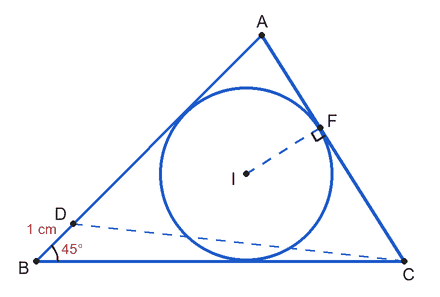
For reference, measuring gives AB ≈ 6·1 cm, AC ≈ 5·1 cm and the inradius ≈ 1·7 cm (calculation: AB = 6·08 cm, AC = 5·08 cm, r = 1·66 cm).
Watch out: Cut the 1 cm off the longer side AB (on the ray BX through the given angle), not off BC. And always take the radius of the incircle as the perpendicular distance from I to a side.
Therefore, ΔABC (BC = 7 cm, ∠B = 45°, AB − AC = 1 cm) is constructed and its incircle drawn, with radius about 1·7 cm.