
Question 113 marksEasy
Using ruler and compasses only, draw an equilateral triangle of side 4·5 cm and draw its circumscribed circle. Measure the radius of the circle.
Confirming your payment
Sign up now and get 250 free tokens.
Constructions · Question 11 of 26
Using ruler and compasses only, draw an equilateral triangle of side 4·5 cm and draw its circumscribed circle. Measure the radius of the circle.
Solution:
Concept: The circumcentre of a triangle is the point where the perpendicular bisectors of its sides meet. Every point on the perpendicular bisector of a side is equally far from the two ends of that side, so the circumcentre is equally far from all three vertices. A circle with this centre and that distance as radius passes through all three vertices: it is the circumscribed circle (circumcircle).
Step 1 — Construct the equilateral triangle.
Draw AB = 4·5 cm. With A as centre and radius 4·5 cm, draw an arc; with B as centre and the same radius, draw a second arc cutting the first at C. Join AC and BC. All three sides are 4·5 cm.
Step 2 — Draw two perpendicular bisectors.
Draw the perpendicular bisectors of AB and BC. They meet at O, the circumcentre, which is equally far from A, B and C.
Step 3 — Draw the circumscribed circle.
With O as centre and OA as radius, draw the circle. It passes through A, B and C.
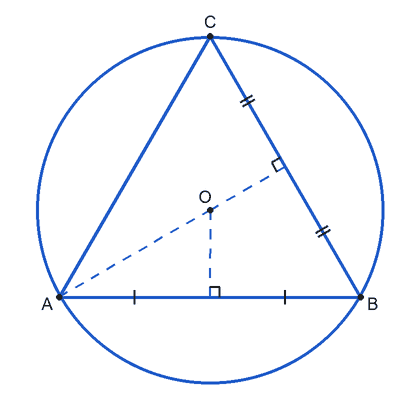
Step 4 — Measure and check the radius.
Measuring OA gives about 2·6 cm. We can check this: in an equilateral triangle the circumradius is , so
Watch out: Bisect two angles (or two sides) neatly with compass arcs; the third bisector is not needed, because all three meet at the same point.
Therefore, the radius of the circumscribed circle is about 2·6 cm.