
Question 11 markMCQMedium
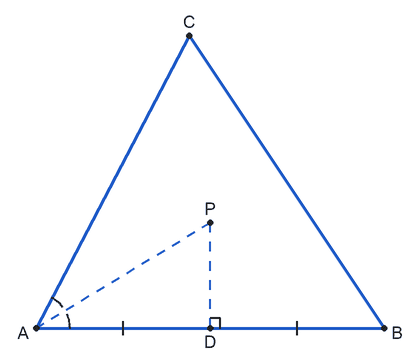
In the given figure, AP is bisector of angle A of ΔABC and DP is perpendicular bisector of side AB, then :
Confirming your payment
Sign up now and get 250 free tokens.
Constructions · Question 1 of 26
In the given figure, AP is bisector of angle A of ΔABC and DP is perpendicular bisector of side AB, then :
(A) P is incentre of ΔABC.
(B) P is circumcentre of ΔABC.
(C) PB bisects angle B.
(D) none of these
Answer: (D) none of these
Concept: A point on the bisector of an angle is equally far from the two arms of the angle. A point on the perpendicular bisector of a segment is equally far from the two ends of the segment. The incentre needs two angle bisectors, and the circumcentre needs two perpendicular bisectors.
Step 1 — Read what each line tells us about P.
P lies on the bisector of ∠A, so P is equally far from the sides AB and AC. P also lies on the perpendicular bisector DP of AB, so PA = PB.
Step 2 — Test whether P is the incentre.
To be the incentre, P would also have to lie on the bisector of ∠B or ∠C. We are told only about ∠A, and an angle bisector together with a perpendicular bisector does not, in general, meet at the incentre.
Step 3 — Test whether P is the circumcentre.
To be the circumcentre, P would also have to be equally far from C (PC = PA). Nothing in the question gives this, and in general PC is not equal to PA.
Step 4 — Test whether PB bisects ∠B.
Since PA = PB, triangle PAB is isosceles, so its base angles are equal:
and ∠PAB is half of ∠A, because AP bisects ∠A. So ∠PBA is half of ∠A. PB would bisect ∠B only if half of ∠B were the same as half of ∠A, that is only when ∠A = ∠B, which is not given.
Watch out: Do not mix up the two kinds of bisector. An angle bisector leads to the incentre; a perpendicular bisector of a side leads to the circumcentre. One of each gives neither.
Why the other options are wrong:
Therefore, none of the statements (A), (B), (C) must be true, option (D).