Solution:
Concept: The locus of points equidistant from two intersecting lines is the bisector of the angle between them. The incentre of a triangle is the point where the bisectors of its angles meet. Every point on the bisector of an angle is equally far from the two arms of that angle, so the incentre is equally far from all three sides. A circle with this centre and that distance as radius touches all three sides: it is the inscribed circle (incircle).
Step 1 — Construct the triangle.
Draw AB = 7 cm. At A, construct ∠BAX = 60° and cut AC = 5 cm on AX. Join BC.
(i)
Step 2 — Points equidistant from AB and AC.
AB and AC meet at A, so the locus is the bisector of ∠A (∠CAB = 60°, so each half is 30°). Construct it.
(ii)
Step 3 — Points equidistant from BA and BC.
BA and BC meet at B, so the locus is the bisector of ∠B. Construct it.
Step 4 — Draw the circle touching the three sides.
The two bisectors meet at I. I is equally far from AB and AC (on the first locus) and from BA and BC (on the second), so it is equally far from all three sides. Draw IF perpendicular to AB; with I as centre and IF as radius, draw the circle. It touches all three sides internally.
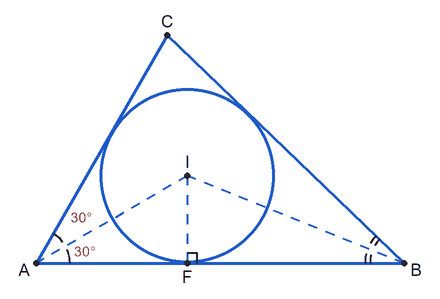
For reference, the radius measures about 1·7 cm (calculation: r = 1·66 cm).
Watch out: The locus of points equidistant from two lines is an angle bisector; the locus of points equidistant from two points is a perpendicular bisector. Here we want lines.
Therefore, the circle with centre I (where the two bisectors meet) and radius IF ≈ 1·7 cm is the required incircle.
