
Opening your dashboard
Class 9 Maths Chapter 10: Isosceles Triangles Solutions
58 textbook questions with step-by-step answers, free to read, for ICSE 2026-27.
Get talked through Ch 10, not just shown the answer
Reading a finished solution is not the same as being able to do it. The AI tutor takes one question at a time and works it with you, in your own words, until you can.
- Ask it out loud, in your own words
- It gives you the next step, not the answer
- Stuck on part (ii)? Start there
58 questions with solutions
1–3 marks · Mixed difficulty
- 11 mark
Question 1
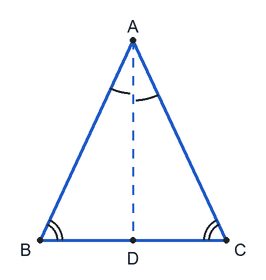
In the given figure, ∠B = ∠C and ∠BAD = ∠CAD, then :
 Solve with AI
Answer
- Correct
(A) AB = AC
(B) AB ≠ AC
(C) ∠ADB ≠ ∠ADC
(D) ∠ADB ≠ 90°
Answer: (A) AB = AC
Concept: Sides opposite equal angles of a triangle are equal.
Step 1 — Use ∠B = ∠C in ΔABC.
In ΔABC the angles at B and C are given equal. The side opposite ∠C is AB and the side opposite ∠B is AC.
Step 2 — Apply the converse of the isosceles theorem.
Sides opposite equal angles are equal, so AB = AC.
Watch out: Only the equal angles at B and C are needed to get AB = AC; the equal angles at A are not used.
Why the other options are wrong:
- (B): This contradicts Step 2, which proves AB = AC.
- (C): In ΔABD and ΔACD the angles at B and C are equal and the angles at A are equal, so the third angles ∠ADB and ∠ADC are equal too (each is 180° minus the same two angles).
- (D): ∠ADB and ∠ADC are equal (see the last bullet) and they form a linear pair on BC, so each of them is 90°.
Therefore, AB = AC, option (A).
- 21 mark
Question 2
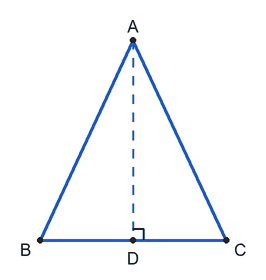
In the given figure, AD ⊥ BC and AB = AC, then :
 Solve with AI
Answer
(A) ΔABD ≇ ΔACD
- Correct
(B) BD = CD
(C) ∠BAC = 90°
(D) ∠CAD = 45°
Answer: (B) BD = CD
Concept: Two triangles are congruent by S.S.S., S.A.S., A.S.A. (or A.A.S.) or R.H.S., and then their corresponding parts are equal (C.P.C.T.C.).
Step 1 — Look at the two right triangles.
AD ⊥ BC, so ΔABD and ΔACD both have a right angle at D.
Step 2 — List the equal parts.
Hypotenuse AB = hypotenuse AC (given)
AD is common to both triangles.
Step 3 — Apply R.H.S.
Right angle, equal hypotenuses and one equal side give ΔABD ≅ ΔACD (R.H.S.). The corresponding sides BD and CD are therefore equal.
Watch out: In R.H.S. the equal sides must include the hypotenuses (the sides opposite the right angles).
Why the other options are wrong:
- (A): Step 3 shows that the triangles ARE congruent.
- (C): Nothing fixes the size of ∠BAC; it would be 90° only for one special triangle.
- (D): ∠CAD is half of ∠BAC, and nothing fixes ∠BAC, so ∠CAD need not be 45°.
Therefore, BD = CD, option (B).
- 31 mark
Question 3
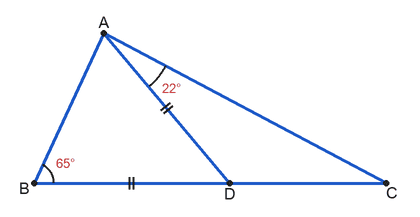
In the given figure, AD = BD, then angle ACD is :
 Solve with AI
Answer
(A) 43°
(B) 22°
(C) 65°
- Correct
(D) 28°
Answer: (D) 28°
Concept: Angles opposite equal sides of a triangle are equal. The angles of a triangle add up to 180°, and two angles on a straight line (a linear pair) also add up to 180°.
Step 1 — Use AD = BD.
The figure marks AD = BD, so the angles opposite these sides in ΔABD are equal. ∠BAD is opposite BD and ∠B is opposite AD, so ∠BAD equals ∠B, which is 65°.
Step 2 — Find ∠ADB and ∠ADC.
The angles of ΔABD add up to 180°.
B, D and C are on one straight line, so ∠ADC is the linear pair of ∠ADB.
Step 3 — Find ∠ACD.
In ΔADC the angles at D and A are 130° and 22°.
Watch out: The equal angles are the ones OPPOSITE the equal sides, not the angles between them.
Why the other options are wrong:
- (A): 43° is 65° − 22°, a difference of two marked angles; it is not an angle of the figure.
- (B): 22° is ∠DAC, the angle at A, not the angle at C.
- (C): 65° is ∠B (and ∠BAD), not ∠ACD.
Therefore, ∠ACD = 28°, option (D).
- 41 mark
Question 4
In the given figure; BE = DC, then :
 Solve with AI
Answer
(A) AD = DC
(B) AE = BE
- Correct
(C) AD = AE
(D) ∠ABE = ∠DAC
Answer: (C) AD = AE
Concept: Angles opposite equal sides of a triangle are equal. Two triangles are congruent by S.S.S., S.A.S., A.S.A. (or A.A.S.) or R.H.S., and then their corresponding parts are equal (C.P.C.T.C.).
Step 1 — Read the figure.
The figure marks AB = AC, so the angles opposite them are equal:
∠B = ∠C.
We are also given BE = DC.
Step 2 — Compare ΔABE and ΔACD.
AB = AC (marked)
∠ABE = ∠ACD (the base angles ∠B and ∠C)
BE = CD (given)
So ΔABE ≅ ΔACD by S.A.S. (the angle at B lies between AB and BE; the angle at C between AC and CD).
Step 3 — Read off the result.
The corresponding sides AE and AD are equal (C.P.C.T.C.).
Watch out: Match the triangles in order: A ↔ A, B ↔ C, E ↔ D, so AE corresponds to AD.
Why the other options are wrong:
- (A): Equal sides AD and DC would need equal opposite angles ∠C and ∠DAC in ΔADC; nothing in the data gives this.
- (B): Equal sides AE and BE would need equal opposite angles ∠B and ∠BAE in ΔABE; nothing in the data gives this.
- (D): ∠ABE is the base angle at B, while ∠DAC is a part of the angle at A; nothing in the data makes them equal.
Therefore, AD = AE, option (C).
- 51 mark
Question 5
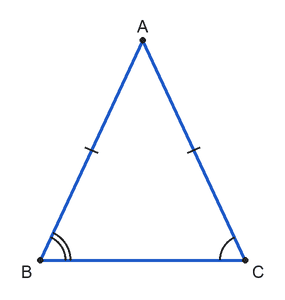
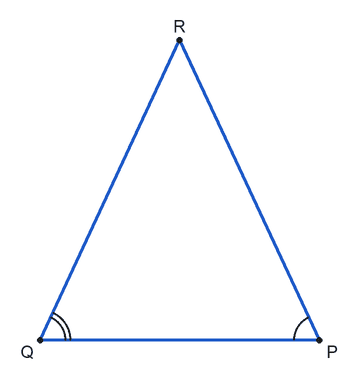
In ΔABC and ΔPQR, AB = AC, ∠C = ∠P and ∠B = ∠Q; then triangles are :
 Solve with AI
Answer
- Correct
(A) isosceles but not congruent
(B) isosceles and congruent
(C) congruent but not isosceles
(D) neither isosceles nor congruent.
Answer: (A) isosceles but not congruent
Concept: Angles opposite equal sides of a triangle are equal. Sides opposite equal angles of a triangle are equal. Equal angles alone (A.A.A.) do not prove two triangles congruent.
Step 1 — ΔABC is isosceles.
AB = AC is given, so ΔABC is isosceles. The angles opposite the equal sides are equal: ∠B = ∠C.
Step 2 — ΔPQR is isosceles.
∠P = ∠C and ∠Q = ∠B, and ∠B = ∠C, so ∠P and ∠Q are equal. The sides opposite them, QR and PR, are therefore equal, so ΔPQR is isosceles too.
Step 3 — Are they congruent?
All three angles of ΔPQR equal those of ΔABC, but no side of ΔPQR is given equal to a side of ΔABC. Triangles with equal angles can differ in size (one can be an enlargement of the other), so they need not be congruent.
Watch out: A.A.A. is not a congruence rule; at least one pair of corresponding sides must be equal.
Why the other options are wrong:
- (B): The triangles are isosceles, but equal angles alone do not make them congruent.
- (C): Both triangles are isosceles (Steps 1 and 2), so “not isosceles” is false.
- (D): Both triangles are isosceles, so “neither isosceles” is false.
Therefore, the triangles are isosceles but not (necessarily) congruent, option (A).
- 63 marks
Question 6
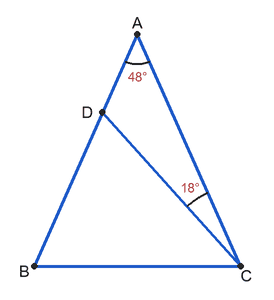
In the figure alongside,
AB = AC
∠A = 48° and
∠ACD = 18°.
Show that : BC = CD.
 Solve with AI
Written solution
Solution:
Concept: Angles opposite equal sides of a triangle are equal. Sides opposite equal angles of a triangle are equal. An exterior angle of a triangle equals the sum of the two interior opposite angles.
Given: AB = AC, ∠A = 48°, ∠ACD = 18°, D on AB.
Step 1 — Base angles of ΔABC.
AB = AC, so ∠B = ∠ACB.
They share what is left of 180° after ∠A = 48°.
Step 2 — Find ∠BDC.
D lies on AB, so ∠BDC is an exterior angle of ΔADC. It equals the sum of the interior opposite angles ∠A and ∠ACD.
Step 3 — Compare the angles of ΔBCD.
In ΔBCD, ∠CBD = 66° and ∠CDB = 66°, so these angles are equal. The side opposite ∠CDB is BC and the side opposite ∠CBD is CD, so BC = CD.
Watch out: ∠BDC is an exterior angle of ΔADC (not of ΔBDC); that is why it equals 48° + 18°.
Therefore, BC = CD. Hence shown.
- 73 marks
Question 7
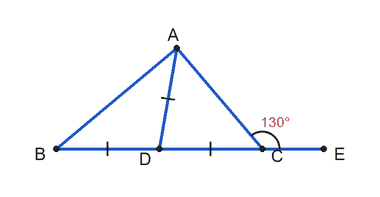
Calculate :
(i) ∠ADC
(ii) ∠ABC
(iii) ∠BAC
 Solve with AI
Written solution
Solution:
Concept: Angles opposite equal sides of a triangle are equal. The angles of a triangle add up to 180°, and two angles on a straight line (a linear pair) also add up to 180°.
Given: BD, DC and AD are equal (marked), ∠ACE = 130°, and B, C, E are on a straight line.
Step 1 — Find ∠ACB.
The figure marks BD, DC and AD as equal, and B, C, E lie on one straight line. ∠ACB is the linear pair of ∠ACE = 130°.
Step 2 — Part (i): ∠ADC.
AD = DC, so in ΔADC the angles opposite them are equal: ∠DAC equals ∠DCA, which is 50°.
Step 3 — Part (ii): ∠ABC.
B, D, C are on one line, so ∠ADB is the linear pair of ∠ADC.
AD = BD, so in ΔADB the base angles ∠ABD and ∠BAD are equal and share what is left of 180°.
Step 4 — Part (iii): ∠BAC.
∠BAC is made of ∠BAD = 40° and ∠DAC = 50°.
Watch out: The equal angles are the ones OPPOSITE the equal sides, not the angles between them.
Therefore, (i) ∠ADC = 80°, (ii) ∠ABC = 40° and (iii) ∠BAC = 90°.
- 83 marks
Question 8
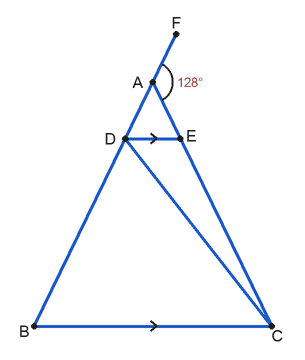
In the following figure, AB = AC; BC = CD and DE is parallel to BC. Calculate :
(i) ∠CDE
(ii) ∠DCE
 Solve with AI
Written solution
Solution:
Concept: Angles opposite equal sides of a triangle are equal. The angles of a triangle add up to 180°, and two angles on a straight line (a linear pair) also add up to 180°. When a line crosses two parallel lines, alternate angles are equal and corresponding angles are equal.
Given: AB = AC, BC = CD, DE ∥ BC and ∠FAC = 128°.
Step 1 — Find ∠BAC.
F lies on BA produced, so ∠BAC is the linear pair of ∠FAC = 128°.
Step 2 — Base angles of ΔABC.
AB = AC, so ∠B = ∠ACB. They share what is left of 180°.
Step 3 — Angles of ΔBCD.
BC = CD, so in ΔBCD the angles opposite these sides are equal: ∠CDB equals ∠B, which is 64°.
Step 4 — Part (i): ∠CDE.
DE ∥ BC and DC is a transversal, so the alternate angles ∠CDE and ∠BCD are equal. So ∠CDE = 52°.
Step 5 — Part (ii): ∠DCE.
E lies on AC, so ∠DCE is the part of ∠ACB left after taking away ∠BCD.
Watch out: In ΔBCD the equal sides are BC and CD, so the equal angles are at B and D (opposite them), not at C.
Therefore, (i) ∠CDE = 52° and (ii) ∠DCE = 12°.
- 93 marks
Question 9
Calculate :
(i)
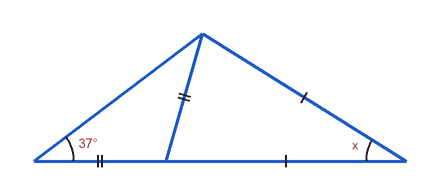
(ii)
 Solve with AI
Written solution
Solution:
Concept: Angles opposite equal sides of a triangle are equal. An exterior angle of a triangle equals the sum of the two interior opposite angles.
Step 1 — Name the points.
In each figure call the left vertex P, the top vertex Q, the right vertex R and the point where the inner line meets the base S. The angle x is ∠R.
Step 2 — Figure (i): left triangle.
PS and SQ carry the same (double) marks, so in ΔPSQ the angles opposite them are equal: ∠PQS equals ∠P, which is 37°. ∠QSR is the exterior angle of ΔPSQ at S.
Step 3 — Figure (i): right triangle.
SR and QR carry the same (single) marks, so in ΔQSR the angles opposite them are equal: ∠SQR equals ∠QSR, which is 74°. The angle sum of ΔQSR gives x.
Step 4 — Figure (ii): left triangle.
PS, SQ and SR all carry the same mark. In ΔPSQ, PS = SQ, so ∠PQS equals ∠P, which is 50°. The exterior angle of ΔPSQ at S is the sum of these two angles.
Step 5 — Figure (ii): right triangle.
In ΔQSR, SQ = SR, so the angles opposite them, ∠R and ∠SQR, are equal. They share what is left of 180°.
Watch out: The equal angles are the ones OPPOSITE the equal sides, not the angles between them.
Therefore, (i) x = 32° and (ii) x = 40°.
- 103 marks
Question 10
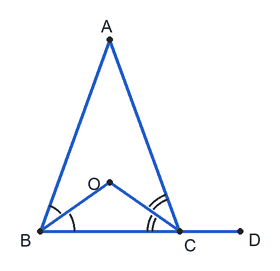
In the figure, given below, AB = AC.
Prove that : ∠BOC = ∠ACD.
 Solve with AI
Written solution
Solution:
Concept: Angles opposite equal sides of a triangle are equal. The angles of a triangle add up to 180°, and two angles on a straight line (a linear pair) also add up to 180°.
Given: AB = AC; OB and OC bisect ∠B and ∠C (marked); BCD is a straight line.
Step 1 — Name the base angles.
AB = AC, so ∠ABC = ∠ACB. Call each of them 2x. The figure marks OB and OC as the bisectors of these angles, so each half is x: ∠OBC and ∠OCB are both x.
Step 2 — Find ∠BOC.
The angles of ΔOBC add up to 180°.
Step 3 — Find ∠ACD.
B, C and D are on one straight line, so ∠ACD is the linear pair of ∠ACB.
Step 4 — Compare.
Both angles equal 180° − 2x, so ∠BOC = ∠ACD.
Watch out: Calling the base angle 2x (not x) keeps the halves free of fractions.
Therefore, ∠BOC = ∠ACD. Hence proved.
- 113 marks
Question 11
In the figure given below, LM = LN; angle PLN = 110°. Calculate :
(i) ∠LMN
(ii) ∠MLN
 Solve with AI
Written solution
Solution:
Concept: When a line crosses two parallel lines, alternate angles are equal and corresponding angles are equal. Angles opposite equal sides of a triangle are equal.
Given: LM = LN, ∠PLN = 110°, PS ⊥ PQ and QR ⊥ PQ (marked).
Step 1 — PS is parallel to QR.
The figure marks right angles at P and Q, so PS ⊥ PQ and QR ⊥ PQ. Two lines perpendicular to the same line are parallel, so PS ∥ QR.
Step 2 — Find ∠SLN.
P, L and S are on one straight line, so ∠SLN is the linear pair of ∠PLN = 110°.
Step 3 — Part (i): ∠LMN.
LN crosses the parallel lines PS and QR, so the alternate angles ∠LNM and ∠SLN are equal:
∠LNM = 70°.
LM = LN, so the angles opposite them in ΔLMN are equal.
Hence ∠LMN equals ∠LNM, which is 70°.
Step 4 — Part (ii): ∠MLN.
The angles of ΔLMN add up to 180°.
Watch out: ∠LNM sits on the other side of LN from ∠SLN; that is what makes them alternate angles.
Therefore, (i) ∠LMN = 70° and (ii) ∠MLN = 40°.
- 123 marks
Question 12
An isosceles triangle ABC has AC = BC. CD bisects AB at D and ∠CAB = 55°.

Find : (i) ∠DCB (ii) ∠CBD.
Solve with AIWritten solution
Solution:
Concept: Angles opposite equal sides of a triangle are equal. Two triangles are congruent by S.S.S., S.A.S., A.S.A. (or A.A.S.) or R.H.S., and then their corresponding parts are equal (C.P.C.T.C.).
Given: AC = BC, D is the mid-point of AB and ∠CAB = 55°.
Step 1 — Part (ii) first: ∠CBD.
AC = BC, so the angles opposite them in ΔABC are equal: ∠CBA equals ∠CAB, which is 55°. D lies on AB, so ∠CBD is the same angle: ∠CBD = 55°.
Step 2 — Show CD ⊥ AB.
Compare ΔACD and ΔBCD.
AC = BC (given)
AD = BD (CD bisects AB)
CD is common to both triangles.
So ΔACD ≅ ΔBCD (S.S.S.), and ∠CDA = ∠CDB. They form a linear pair, so each is 90°.
Step 3 — Part (i): ∠DCB.
The angles of ΔCDB add up to 180°.
Watch out: “Bisects AB” means D is the mid-point of AB; the right angle at D has to be proved, not assumed.
Therefore, (i) ∠DCB = 35° and (ii) ∠CBD = 55°.
- 133 marks
Question 13
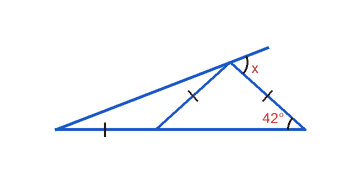
Find :
 Solve with AI
Written solution
Solution:
Concept: Angles opposite equal sides of a triangle are equal. An exterior angle of a triangle equals the sum of the two interior opposite angles. The angles of a triangle add up to 180°, and two angles on a straight line (a linear pair) also add up to 180°.
Step 1 — Name the points.
Call the left vertex P, the top vertex Q, the right vertex R and the point where the inner line meets the base S. The figure marks PS, SQ and QR equal, and ∠R = 42°. The angle x lies at Q, between PQ produced and QR.
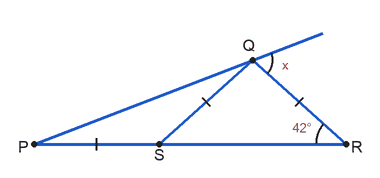
Step 2 — Right triangle QSR.
SQ = QR, so the angles opposite them in ΔQSR are equal: ∠QSR equals ∠R, which is 42°.
Step 3 — Angle PSQ.
P, S and R are on one straight line, so ∠PSQ is the linear pair of ∠QSR.
Step 4 — Left triangle PSQ.
PS = SQ, so ∠P and ∠PQS are equal and share what is left of 180°.
Step 5 — Find x.
The angle x is the exterior angle of the big ΔPQR at Q, so it equals the sum of the interior opposite angles ∠P and ∠R.
Watch out: The equal angles are the ones OPPOSITE the equal sides, not the angles between them.
Therefore, x = 63°.
- 143 marks
Question 14
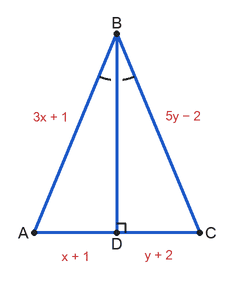
In the triangle ABC, BD bisects angle B and is perpendicular to AC. If the lengths of the sides of the triangle are expressed in terms of and as shown, find the values of and .
 Solve with AI
Written solution
Solution:
Concept: Two triangles are congruent by S.S.S., S.A.S., A.S.A. (or A.A.S.) or R.H.S., and then their corresponding parts are equal (C.P.C.T.C.).
Given: BD bisects ∠B and BD ⊥ AC; AB = 3x + 1, BC = 5y − 2, AD = x + 1, DC = y + 2.
Step 1 — Show ΔABD ≅ ΔCBD.
BD bisects ∠B and is perpendicular to AC.
∠ABD = ∠CBD (BD bisects ∠B)
BD is common to both triangles.
∠ADB = ∠CDB, since both are 90°.
So ΔABD ≅ ΔCBD (A.S.A.), and the corresponding sides give AD = CD and AB = CB.
Step 2 — Use AD = CD.
Write the two lengths from the figure and simplify.
Step 3 — Use AB = CB.
Write the two lengths from the figure, then put x = y + 1.
Step 4 — Find x.
Put y = 3 into the result of Step 2.
Step 5 — Check.
With x = 4 and y = 3, AB and CB are both 13, and AD and CD are both 5, so both pairs are equal.
Watch out: Both pairs of equal sides are needed: AD = CD gives one equation and AB = CB the other.
Therefore, x = 4 and y = 3.
- 153 marks
Question 15
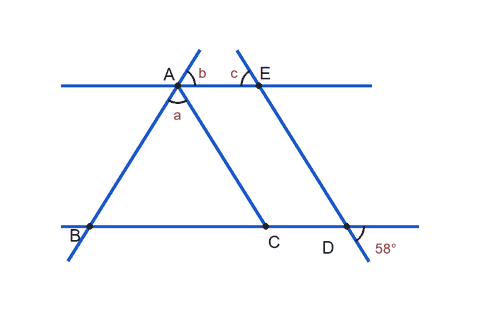
In the given figure ; AE // BD, AC // ED and AB = AC. Find ∠a, ∠b and ∠c.
 Solve with AI
Written solution
Solution:
Concept: When a line crosses two parallel lines, alternate angles are equal and corresponding angles are equal. Angles opposite equal sides of a triangle are equal. Vertically opposite angles are equal.
Given: AE ∥ BD, AC ∥ ED, AB = AC; the angle at D is 58°.
Step 1 — Read the figure.
B, C and D lie on one line, and the line through A and E is parallel to it (AE ∥ BD). Also AC ∥ ED and AB = AC. The 58° angle at D is vertically opposite ∠EDB, so ∠EDB = 58°.
Step 2 — Find ∠ACB.
AC ∥ ED and BD is a transversal, so the corresponding angles ∠ACB and ∠EDB are equal: ∠ACB = 58°.
Step 3 — Find a.
AB = AC, so ∠ABC equals ∠ACB, which is 58°. ∠a is ∠BAC, the third angle of ΔABC.
Step 4 — Find b.
∠b lies at A between AE and BA produced. AE ∥ BD with BA produced as a transversal, so ∠b and ∠ABC are corresponding angles: ∠b = 58°.
Step 5 — Find c.
∠c lies at E between EA and DE produced. AE ∥ BD with DE produced as a transversal, so ∠c and ∠EDB are corresponding angles: ∠c = 58°.
Watch out: Name the transversal each time; the same 58° travels across both pairs of parallel lines.
Therefore, ∠a = 64°, ∠b = 58° and ∠c = 58°.
- 163 marks
Question 16
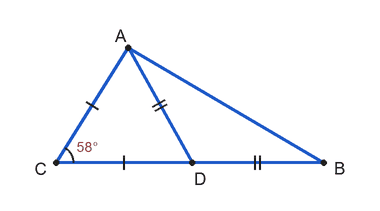
In the following figure; AC = CD, AD = BD and ∠C = 58°.
Find angle CAB.
 Solve with AI
Written solution
Solution:
Concept: Angles opposite equal sides of a triangle are equal. The angles of a triangle add up to 180°, and two angles on a straight line (a linear pair) also add up to 180°.
Given: AC = CD, AD = BD and ∠C = 58°.
Step 1 — Triangle ACD.
AC = CD, so ∠CAD and ∠CDA are equal and share what is left of 180° after ∠C = 58°.
Step 2 — Angle ADB.
C, D and B are on one straight line, so ∠ADB is the linear pair of ∠CDA = 61°.
Step 3 — Triangle ADB.
AD = BD, so ∠DAB and ∠DBA are equal and share what is left of 180°.
Step 4 — Angle CAB.
∠CAB is made of ∠CAD and ∠DAB.
Since 0.5° = 30′, this is 91°30′.
Watch out: The equal angles are the ones OPPOSITE the equal sides, not the angles between them.
Therefore, ∠CAB = 91.5°, that is 91°30′.
- 173 marks
Question 17
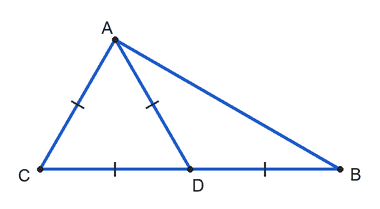
In the figure of Q. no. 12, given above, if AC = AD = CD = BD; find angle ABC.
 Solve with AI
Written solution
Solution:
Concept: Each angle of an equilateral triangle is 60°. Angles opposite equal sides of a triangle are equal.
Given: AC, AD, CD and BD are all equal (figure of Q12).
Step 1 — Triangle ACD is equilateral.
AC, AD and CD are equal, so ΔACD is equilateral and each of its angles is 60°. In particular ∠ADC = 60°.
Step 2 — Angle ADB.
C, D and B are on one straight line, so ∠ADB is the linear pair of ∠ADC.
Step 3 — Triangle ADB.
AD = BD, so ∠ABD and ∠BAD are equal and share what is left of 180°.
D lies on BC, so ∠ABC is the same angle as ∠ABD.
Watch out: The equal angles are the ones OPPOSITE the equal sides, not the angles between them.
Therefore, ∠ABC = 30°.
- 183 marks
Question 18
In triangle ABC; AB = AC and ∠A : ∠B = 8 : 5; find angle A.
 Solve with AI
Written solution
Solution:
Concept: Angles opposite equal sides of a triangle are equal. The angles of a triangle add up to 180°.
Given: AB = AC and ∠A : ∠B = 8 : 5.
Step 1 — Write the angles in one unknown.
AB = AC, so ∠B = ∠C.
As ∠A :
∠B = 8 : 5, let ∠A = 8k and ∠B = 5k; then ∠C = 5k too.
Step 2 — Use the angle sum.
The three angles add up to 180°.
Step 3 — Find ∠A.
∠A is 8k.
Step 4 — Check.
∠B and ∠C are each 50°, and 80° + 50° + 50° = 180°.
Also 80 : 50 = 8 : 5.
Watch out: ∠C is also 5k (it equals ∠B), so the sum is 18k, not 13k.
Therefore, ∠A = 80°.
- 193 marks
Question 19
In triangle ABC; ∠A = 60°, ∠C = 40° and bisector of angle ABC meets side AC at point P.

Show that BP = CP.
Solve with AIWritten solution
Solution:
Concept: Sides opposite equal angles of a triangle are equal.
Given: In ΔABC, ∠A = 60°, ∠C = 40°, and the bisector of ∠ABC meets AC at P.
Step 1 — Find ∠ABC.
The angles of ΔABC add up to 180°.
Step 2 — Halve it.
BP bisects ∠ABC, so ∠PBC is half of 80°.
Step 3 — Compare in ΔPBC.
P lies on AC, so ∠PCB is ∠C = 40°. In ΔPBC the angles at B and C are both 40°. The side opposite ∠PCB is BP and the side opposite ∠PBC is CP, so BP = CP.
Watch out: Sides opposite equal angles are equal: here the equal angles are at B and C of ΔPBC, so the equal sides are CP and BP.
Therefore, BP = CP. Hence shown.
- 201 mark
Question 20
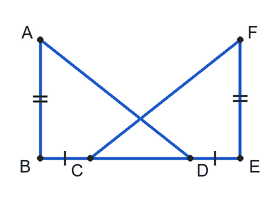
In the given figure, AB ⊥ BE, EF ⊥ BE, AB = EF and BC = DE, then :
 Solve with AI
Answer
(A) ΔABD ≅ ΔEFC
- Correct
(B) ΔABD ≅ ΔFEC
(C) ΔABD ≅ ΔECF
(D) ΔABD ≅ ΔCEF
Answer: (B) ΔABD ≅ ΔFEC
Concept: Two triangles are congruent by S.S.S., S.A.S., A.S.A. (or A.A.S.) or R.H.S., and then their corresponding parts are equal (C.P.C.T.C.). The letters must be written in matching order.
Step 1 — Make BD equal to EC.
BC = DE.
Adding the common part CD to both gives BC + CD = DE + CD, that is BD = EC.
Step 2 — Find the congruence.
AB = FE (given)
∠ABD = ∠FEC, since both are 90° (AB ⊥ BE and EF ⊥ BE)
BD = EC (Step 1)
So the triangles are congruent by S.A.S.
Step 3 — Match the vertices in order.
The right angles match, so B ↔ E. The equal sides AB and FE then give A ↔ F, and BD, EC give D ↔ C. So ΔABD ≅ ΔFEC.
Watch out: A correct congruence statement lists matching vertices in the same positions.
Why the other options are wrong:
- (A): ΔEFC puts E in the place of A, but A must match F.
- (C): ΔECF puts E in the place of A and C in the place of B; the right angle at B must match the right angle at E.
- (D): ΔCEF puts C in the place of A; but A must match F.
Therefore, ΔABD ≅ ΔFEC, option (B).
- 211 mark
Question 21
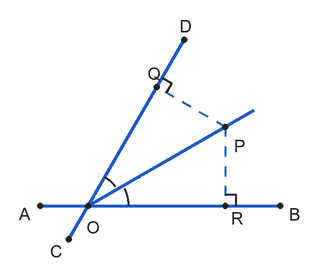
From the adjoining figure, we find :
 Solve with AI
Answer
(A) OP = OR
(B) OP = OQ
- Correct
(C) PQ = PR
(D) PR ≠ PQ
Answer: (C) PQ = PR
Concept: A point on the bisector of an angle is equally far from its two arms. Two triangles are congruent by S.S.S., S.A.S., A.S.A. (or A.A.S.) or R.H.S., and then their corresponding parts are equal (C.P.C.T.C.).
Step 1 — Read the figure.
The figure marks OP as the bisector of ∠DOB, with PQ ⊥ OD and PR ⊥ OB.
Step 2 — Compare ΔOQP and ΔORP.
∠QOP = ∠ROP (OP bisects the angle)
∠OQP = ∠ORP, since both are 90°
OP is common to both triangles.
So ΔOQP ≅ ΔORP (A.A.S.), and the corresponding sides PQ and PR are equal.
Watch out: The distance from P to an arm is the perpendicular PQ or PR, not the slanting OP.
Why the other options are wrong:
- (A): OP is the hypotenuse of right ΔORP, so OP > OR; they are not equal.
- (B): OP is the hypotenuse of right ΔOQP, so OP > OQ; they are not equal.
- (D): The congruence gives PR = PQ, so they are not unequal.
Therefore, PQ = PR, option (C).
- 221 mark
Question 22
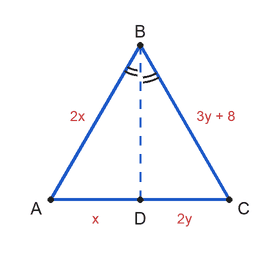
From the given figure, if ∠A = ∠C, we get :
 Solve with AI
Answer
(A) ,
(B) ,
(C) ,
- Correct
(D) ,
Answer: (D) ,
Concept: Sides opposite equal angles of a triangle are equal. Two triangles are congruent by S.S.S., S.A.S., A.S.A. (or A.A.S.) or R.H.S., and then their corresponding parts are equal (C.P.C.T.C.).
Step 1 — Use ∠A = ∠C.
In ΔABC, ∠A = ∠C, so the sides opposite them are equal: BC = BA. From the figure this gives the first equation.
Step 2 — Use the bisector BD.
The figure marks BD as the bisector of ∠B. In ΔABD and ΔCBD: AB = CB (Step 1), ∠ABD = ∠CBD, and BD is common. So ΔABD ≅ ΔCBD (S.A.S.), and AD = CD.
Step 3 — Solve.
Put x = 2y into the first equation.
Then x is twice 8, so x = 16.
Step 4 — Check.
AB = 2 × 16, which is 32.
BC = 3 × 8 + 8, which is 32.
AD = 16 and DC = 2 × 8, which is 16. Both pairs are equal.
Watch out: Two equations are needed for two unknowns; use both pairs of equal sides.
Why the other options are wrong:
- (A): If x were 8 and y were 16, AD would be 8 but DC would be 32, so AD and DC would not be equal.
- (B): A negative x makes AD (= x) a negative length, which is impossible.
- (C): A negative y makes DC (= 2y) a negative length, which is impossible.
Therefore, x = 16 and y = 8, option (D).
- 231 mark
Question 23
ABCD is a rectangle. X and Y are points on sides AD and BC respectively such that AX = BY, then :
 Solve with AI
Answer
(A) AY ≠ BX
(B) ΔABX ≅ ΔBYA
(C) ΔABX ≅ ΔAYB
- Correct
(D) ΔABX ≅ ΔBAY
Answer: (D) ΔABX ≅ ΔBAY
Concept: Two triangles are congruent by S.S.S., S.A.S., A.S.A. (or A.A.S.) or R.H.S., and then their corresponding parts are equal (C.P.C.T.C.). The letters must be written in matching order.
Step 1 — List the equal parts.
In a rectangle every angle is 90°.
AB = BA (common side)
∠BAX = ∠ABY, since both are 90°
AX = BY (given)
Step 2 — Match the vertices.
The common side AB matches BA, so A ↔ B and B ↔ A. Then AX matches BY, so X ↔ Y. By S.A.S., ΔABX ≅ ΔBAY.
Watch out: AB is used twice, once as AB and once as BA; the order of letters shows which vertex matches which.
Why the other options are wrong:
- (A): The congruence gives BX = AY, so they are not unequal.
- (B): ΔBYA would match B with Y; but B must match A.
- (C): ΔAYB would match B with Y and X with B; the matching order is wrong.
Therefore, ΔABX ≅ ΔBAY, option (D).
- 241 mark
Question 24
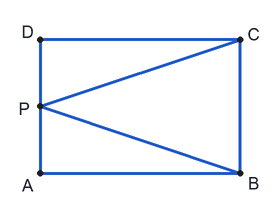
In the adjoining figure, P is mid-point of side AD; then :
 Solve with AI
Answer
(A) ∠PBC = ∠PBA
- Correct
(B) ∠PBC = ∠PCB
(C) ∠BPA = ∠BPC
(D) ∠PBC = ∠BPA
Answer: (B) ∠PBC = ∠PCB
Concept: Two triangles are congruent by S.S.S., S.A.S., A.S.A. (or A.A.S.) or R.H.S., and then their corresponding parts are equal (C.P.C.T.C.). Angles opposite equal sides of a triangle are equal.
Step 1 — Read the figure.
The figure shows ABCD as a rectangle: every angle is 90°, AB = DC and AD ∥ BC. P is the mid-point of AD, so PA = PD.
Step 2 — Show PB = PC.
Compare ΔPAB and ΔPDC.
PA = PD (P is the mid-point)
∠PAB = ∠PDC, since both are 90°
AB = DC (opposite sides of the rectangle)
So ΔPAB ≅ ΔPDC (S.A.S.) and PB = PC.
Step 3 — Use the isosceles triangle PBC.
PB = PC, so the angles opposite them in ΔPBC are equal: ∠PBC = ∠PCB.
Watch out: This rests on the figure being a rectangle (right angles at A and D, AB = DC).
Note: Both (B) and (D) are true statements for this figure; the printed key (B) is kept because it is the result this exercise on isosceles triangles is testing.
Why the other options are wrong:
- (A): ∠PBA and ∠PBC are the two parts of the right angle at B; they are equal only when each is 45°, that is when AP = AB (AD twice AB), which is not given.
- (C): ∠BPA and ∠BPC are not equal in general (∠BPC is the apex angle of ΔPBC).
- (D): This is in fact also true: AD ∥ BC with PB as a transversal makes ∠PBC and ∠BPA alternate angles (see the note above).
Therefore, ∠PBC = ∠PCB, option (B).
- 253 marks
Question 25
If the equal sides of an isosceles triangle are produced, prove that the exterior angles so formed are obtuse and equal.
Solve with AIWritten solution
Solution:
Concept: Angles opposite equal sides of a triangle are equal. The angles of a triangle add up to 180°, and two angles on a straight line (a linear pair) also add up to 180°.
Given: ΔABC with AB = AC; AB and AC produced to D and E.
Step 1 — Set up the figure.
Let ABC be isosceles with AB = AC. Produce AB beyond B to D and AC beyond C to E. The exterior angles are ∠DBC and ∠ECB.
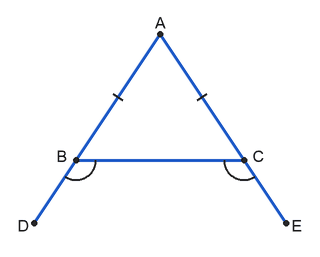
Step 2 — The base angles are equal and acute.
AB = AC, so ∠ABC = ∠ACB. Two equal angles of one triangle add up to less than 180°, so each is less than 90°.
Step 3 — The exterior angles are equal.
Each exterior angle forms a linear pair with a base angle.
The base angles are equal, so ∠DBC = ∠ECB.
Step 4 — The exterior angles are obtuse.
180° minus an acute angle is more than 90°, so each exterior angle is obtuse.
Watch out: The base angles must be shown acute first; that is what makes the exterior angles obtuse.
Therefore, the exterior angles so formed are obtuse and equal. Hence proved.
- 263 marks
Question 26
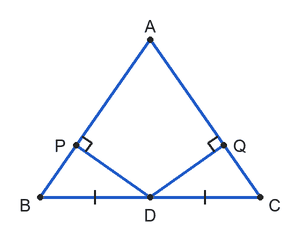
In the given figure, AB = AC. Prove that:
(i) DP = DQ
(ii) AP = AQ
(iii) AD bisects angle A
 Solve with AI
Written solution
Solution:
Concept: Angles opposite equal sides of a triangle are equal. Two triangles are congruent by S.S.S., S.A.S., A.S.A. (or A.A.S.) or R.H.S., and then their corresponding parts are equal (C.P.C.T.C.).
Given: AB = AC, BD = CD, DP ⊥ AB and DQ ⊥ AC (figure).
Step 1 — Read the figure.
The figure marks BD = CD (D is the mid-point of BC), DP ⊥ AB and DQ ⊥ AC. AB = AC, so ∠B = ∠C.
Step 2 — Part (i): ΔDPB and ΔDQC.
∠DPB = ∠DQC, since both are 90°
∠PBD = ∠QCD (the base angles B and C)
BD = CD (marked)
So ΔDPB ≅ ΔDQC (A.A.S.). Hence DP = DQ, and also BP = CQ (C.P.C.T.C.).
Step 3 — Part (ii): AP and AQ.
Take the equal pieces BP and CQ away from the equal sides AB and AC.
Since AB = AC and BP = CQ, we get AP = AQ.
Step 4 — Part (iii): AD bisects ∠A.
In ΔAPD and ΔAQD: AP = AQ, DP = DQ, and AD is common. So ΔAPD ≅ ΔAQD (S.S.S.), and ∠PAD = ∠QAD. So AD bisects ∠A.
Watch out: Part (ii) needs the extra equal parts BP = CQ from the congruence of part (i).
Therefore, (i) DP = DQ, (ii) AP = AQ and (iii) AD bisects ∠A. Hence proved.
- 273 marks
Question 27
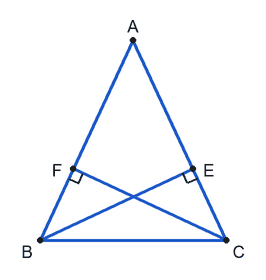
In triangle ABC, AB = AC; BE ⊥ AC and CF ⊥ AB. Prove that :
(i) BE = CF
(ii) AF = AE
 Solve with AI
Written solution
Solution:
Concept: Two triangles are congruent by S.S.S., S.A.S., A.S.A. (or A.A.S.) or R.H.S., and then their corresponding parts are equal (C.P.C.T.C.).
Given: AB = AC, BE ⊥ AC and CF ⊥ AB.
Step 1 — Compare ΔABE and ΔACF.
BE ⊥ AC and CF ⊥ AB, so each triangle has a right angle.
∠AEB = ∠AFC, since both are 90°
∠BAE = ∠CAF (the same angle A)
AB = AC (given)
So ΔABE ≅ ΔACF (A.A.S.).
Step 2 — Part (i).
The corresponding sides BE and CF are equal (C.P.C.T.C.).
Step 3 — Part (ii).
The corresponding sides AE and AF are equal (C.P.C.T.C.).
Watch out: ∠A is common to both triangles; it is the angle that makes A.A.S. work.
Therefore, (i) BE = CF and (ii) AF = AE. Hence proved.
- 283 marks
Question 28
In isosceles triangle ABC, AB = AC. The side BA is produced to D such that BA=AD.
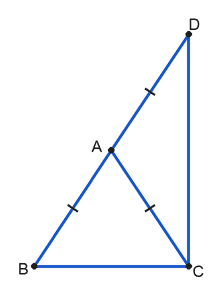
Prove that : ∠BCD = 90°.
Solve with AIWritten solution
Solution:
Concept: Angles opposite equal sides of a triangle are equal. The angles of a triangle add up to 180°.
Given: AB = AC, and BA is produced to D with AD = BA.
Step 1 — Equal angles in ΔABC.
AB = AC, so ∠ABC = ∠ACB. Call each of them x.
Step 2 — Equal angles in ΔACD.
AD equals BA, which equals AC, so in ΔACD the angles opposite AC and AD are equal: ∠ADC = ∠ACD. Call each of them y.
Step 3 — Angle sum of ΔBCD.
The angles of ΔBCD are ∠B = x, ∠D = y and ∠BCD = x + y (since ∠BCD is made of ∠ACB and ∠ACD).
Step 4 — Conclude.
∠BCD = x + y, so ∠BCD = 90°.
Watch out: ∠BCD is made of BOTH base angles x and y; count it once in the angle sum.
Therefore, ∠BCD = 90°. Hence proved.
- 293 marks
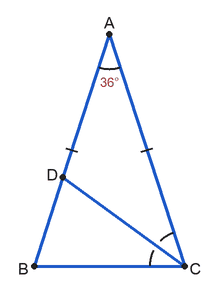
Question 29
In a triangle ABC, AB = AC and ∠A = 36°. If the internal bisector of ∠C meets AB at point D, prove that AD = BC.
 Solve with AI
Written solution
Solution:
Concept: Angles opposite equal sides of a triangle are equal. Sides opposite equal angles of a triangle are equal.
Given: AB = AC, ∠A = 36°, and the bisector of ∠C meets AB at D.
Step 1 — Base angles.
AB = AC, so ∠B = ∠ACB.
They share what is left of 180° after ∠A = 36°.
Step 2 — Halve ∠C.
CD bisects ∠ACB, so ∠ACD and ∠BCD are each half of 72°.
Step 3 — ΔADC is isosceles.
In ΔADC, ∠A = 36° and ∠ACD = 36°, so these angles are equal. The sides opposite them, CD and AD, are equal.
Step 4 — ΔBCD is isosceles.
In ΔBCD the angle at D is the third angle.
So ∠BDC = ∠B, and the sides opposite them, BC and CD, are equal.
Step 5 — Join the results.
AD = CD and CD = BC, so AD = BC.
Watch out: CD is the link: it equals AD in one triangle and BC in the other.
Therefore, AD = BC. Hence proved.
- 303 marks
Question 30
If the bisector of an angle of a triangle bisects the opposite side, prove that the triangle is isosceles.
Solve with AIWritten solution
Solution:
Concept: Two triangles are congruent by S.S.S., S.A.S., A.S.A. (or A.A.S.) or R.H.S., and then their corresponding parts are equal (C.P.C.T.C.). Sides opposite equal angles of a triangle are equal.
Given: The bisector of ∠A of ΔABC meets BC at D, and BD = DC.
Step 1 — Set up and construct.
In ΔABC let AD bisect ∠A, with D on BC and BD = DC.
Produce AD to E so that DE = AD, and join EC.
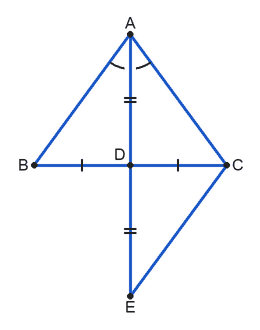
Step 2 — ΔABD ≅ ΔECD.
BD = CD (given)
∠ADB = ∠EDC (vertically opposite angles)
AD = ED (construction)
So ΔABD ≅ ΔECD (S.A.S.). Hence AB = EC and ∠BAD = ∠CED (C.P.C.T.C.).
Step 3 — ΔACE is isosceles.
∠BAD = ∠CAD (AD bisects ∠A), and ∠BAD = ∠CED, so ∠CED = ∠CAD. In ΔACE these are the angles at E and at A, so the sides opposite them are equal: AC = EC.
Step 4 — Conclude.
AB = EC and AC = EC, so AB = AC and ΔABC is isosceles.
Watch out: Doubling the median (DE = AD) is the key construction; without it there is no pair of congruent triangles.
Therefore, the triangle is isosceles (AB = AC). Hence proved.
- 313 marks
Question 31
Prove that the bisectors of the base angles of an isosceles triangle are equal.
Solve with AIWritten solution
Solution:
Concept: Angles opposite equal sides of a triangle are equal. Two triangles are congruent by S.S.S., S.A.S., A.S.A. (or A.A.S.) or R.H.S., and then their corresponding parts are equal (C.P.C.T.C.).
Given: ΔABC with AB = AC; BD and CE bisect ∠B and ∠C.
Step 1 — Set up.
Let AB = AC, and let BD and CE bisect ∠B and ∠C, with D on AC and E on AB. We prove BD = CE.
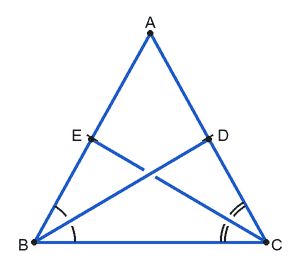
Step 2 — Equal halves.
AB = AC, so ∠ABC = ∠ACB. Halves of equal angles are equal, so ∠DBC = ∠ECB.
Step 3 — ΔDBC ≅ ΔECB.
∠DBC = ∠ECB (Step 2)
BC is common to both triangles.
∠DCB = ∠EBC (the whole base angles)
So ΔDBC ≅ ΔECB (A.S.A.), and BD = CE (C.P.C.T.C.).
Watch out: Use the HALF angle at one end of BC and the WHOLE base angle at the other end.
Therefore, the bisectors of the base angles are equal (BD = CE). Hence proved.
- 323 marks
Question 32
In the given figure, AB = AC and ∠DBC = ∠ECB = 90°.
Prove that :
(i) BD = CE
(ii) AD = AE
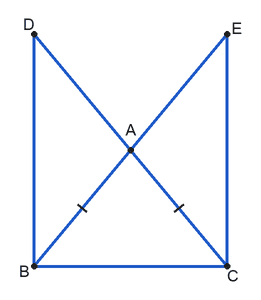 Solve with AI
Written solution
Solution:
Concept: Angles opposite equal sides of a triangle are equal. Two triangles are congruent by S.S.S., S.A.S., A.S.A. (or A.A.S.) or R.H.S., and then their corresponding parts are equal (C.P.C.T.C.).
Given: AB = AC, and ∠DBC and ∠ECB are both 90°; DC and EB meet at A.
Step 1 — Equal base angles.
AB = AC, so ∠ABC = ∠ACB.
A lies on DC and on EB, so ∠DCB = ∠ACB and ∠EBC = ∠ABC.
Hence ∠DCB = ∠EBC.
Step 2 — Part (i): ΔDBC ≅ ΔECB.
∠DBC = ∠ECB, since both are 90° (given)
BC is common to both triangles.
∠DCB = ∠EBC (Step 1)
So ΔDBC ≅ ΔECB (A.S.A.). Hence BD = CE, and also DC = EB (C.P.C.T.C.).
Step 3 — Part (ii): AD and AE.
Take the equal lengths AC and AB away from the equal lengths DC and EB.
Since DC = EB and AC = AB, AD = AE.
Watch out: Part (ii) uses the second pair of equal sides from the same congruence (DC = EB).
Therefore, (i) BD = CE and (ii) AD = AE. Hence proved.
- 333 marks
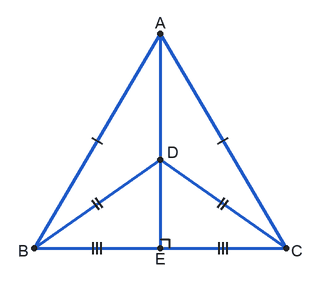
Question 33
ABC and DBC are two isosceles triangles on the same side of BC.

Prove that :
(i) DA (or AD) produced bisects BC at right angle.
(ii) ∠BDA = ∠CDA.
Solve with AIWritten solution
Solution:
Concept: Two triangles are congruent by S.S.S., S.A.S., A.S.A. (or A.A.S.) or R.H.S., and then their corresponding parts are equal (C.P.C.T.C.).
Given: ΔABC and ΔDBC are isosceles on the same side of BC, with AB = AC and DB = DC.
Step 1 — Set up.
AB = AC and DB = DC, with A and D on the same side of BC.
Step 2 — Part (ii): ΔABD ≅ ΔACD.
AB = AC, DB = DC, and AD is common. So ΔABD ≅ ΔACD (S.S.S.). Hence ∠BDA = ∠CDA, and also ∠BAD = ∠CAD.
Step 3 — Part (i): the meeting point E.
Let the line AD (produced as needed) meet BC at E. ∠BAE and ∠CAE are either the angles ∠BAD and ∠CAD themselves or their supplements, so in both cases ∠BAE = ∠CAE.
Step 4 — ΔABE ≅ ΔACE.
AB = AC, ∠BAE = ∠CAE, and AE is common. So ΔABE ≅ ΔACE (S.A.S.). Hence BE = CE and ∠AEB = ∠AEC.
Step 5 — The right angle.
∠AEB and ∠AEC form a linear pair on BC, and they are equal, so each is 90°.
Watch out: Prove part (ii) first; its equal angles at A are what part (i) needs.
Therefore, (i) AD produced bisects BC at right angles and (ii) ∠BDA = ∠CDA. Hence proved.
- 343 marks
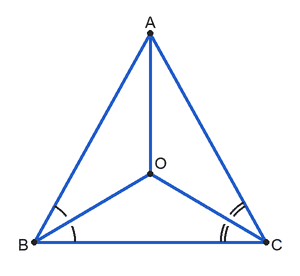
Question 34
The bisectors of the equal angles B and C of an isosceles triangle ABC meet at O. Prove that AO bisects angle A.
 Solve with AI
Written solution
Solution:
Concept: Sides opposite equal angles of a triangle are equal. Two triangles are congruent by S.S.S., S.A.S., A.S.A. (or A.A.S.) or R.H.S., and then their corresponding parts are equal (C.P.C.T.C.).
Given: ΔABC with ∠B = ∠C; the bisectors of ∠B and ∠C meet at O.
Step 1 — ΔOBC is isosceles.
∠B = ∠C, and OB, OC bisect them, so the halves ∠OBC and ∠OCB are equal. The sides opposite them are equal: OB = OC.
Step 2 — ΔAOB ≅ ΔAOC.
AB = AC (sides opposite the equal angles B and C)
OB = OC (Step 1)
AO is common to both triangles.
So ΔAOB ≅ ΔAOC (S.S.S.), and ∠BAO = ∠CAO (C.P.C.T.C.).
Watch out: First get OB = OC; only then do the two triangles at A have three pairs of equal sides.
Therefore, AO bisects ∠A. Hence proved.
- 353 marks
Question 35
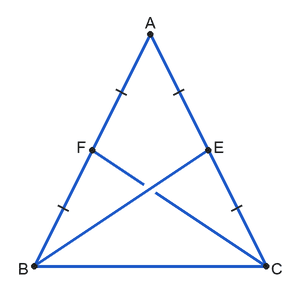
Prove that the medians corresponding to equal sides of an isosceles triangle are equal.
Solve with AIWritten solution
Solution:
Concept: Angles opposite equal sides of a triangle are equal. Two triangles are congruent by S.S.S., S.A.S., A.S.A. (or A.A.S.) or R.H.S., and then their corresponding parts are equal (C.P.C.T.C.).
Given: ΔABC with AB = AC; BE and CF are the medians to AC and AB.
Step 1 — Set up.
Let AB = AC, and let BE and CF be the medians to AC and AB, so E and F are the mid-points of AC and AB.
Step 2 — Equal halves and equal angles.
Halves of equal sides are equal, so CE = BF.
Also AB = AC, so ∠ECB = ∠FBC.
Step 3 — ΔEBC ≅ ΔFCB.
CE = BF (Step 2)
∠ECB = ∠FBC (Step 2)
BC is common to both triangles.
So ΔEBC ≅ ΔFCB (S.A.S.), and BE = CF (C.P.C.T.C.).
Watch out: A median joins a vertex to the MID-POINT of the opposite side; that is what gives CE = BF.
Therefore, the medians to the equal sides are equal (BE = CF). Hence proved.
- 363 marks
Question 36
Use the given figure to prove that, AB = AC.
 Solve with AI
Written solution
Solution:
Concept: Angles opposite equal sides of a triangle are equal. The angles of a triangle add up to 180°, and two angles on a straight line (a linear pair) also add up to 180°. Two triangles are congruent by S.S.S., S.A.S., A.S.A. (or A.A.S.) or R.H.S., and then their corresponding parts are equal (C.P.C.T.C.).
Given: AP = AQ and ∠BAP = ∠CAQ (figure).
Step 1 — Read the figure.
The figure marks AP = AQ and ∠BAP = ∠CAQ, with B, P, Q, C on one straight line.
Step 2 — Equal angles at P and Q.
AP = AQ, so in ΔAPQ the angles opposite them are equal: ∠APQ = ∠AQP. Their linear pairs are equal too.
So ∠APB = ∠AQC.
Step 3 — ΔABP ≅ ΔACQ.
∠BAP = ∠CAQ (marked)
AP = AQ (marked)
∠APB = ∠AQC (Step 2)
So ΔABP ≅ ΔACQ (A.S.A.), and AB = AC (C.P.C.T.C.).
Watch out: The equal angles inside ΔAPQ are not the ones needed; use their supplements ∠APB and ∠AQC.
Therefore, AB = AC. Hence proved.
- 373 marks
Question 37
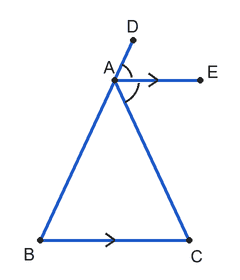
In the given figure; AE bisects exterior angle CAD and AE is parallel to BC.
Prove that : AB = AC.
 Solve with AI
Written solution
Solution:
Concept: When a line crosses two parallel lines, alternate angles are equal and corresponding angles are equal. Sides opposite equal angles of a triangle are equal.
Given: AE bisects the exterior angle CAD, and AE ∥ BC.
Step 1 — Corresponding angles.
D lies on BA produced. AE ∥ BC with BD as a transversal, so ∠DAE = ∠ABC.
Step 2 — Alternate angles.
AE ∥ BC with AC as a transversal, so ∠EAC = ∠ACB.
Step 3 — Use the bisector.
AE bisects ∠CAD, so ∠DAE = ∠EAC. Joining the three results, ∠ABC = ∠ACB.
Step 4 — Conclude.
In ΔABC the angles at B and C are equal, so the sides opposite them are equal: AB = AC.
Watch out: ∠DAE pairs with ∠ABC (corresponding) and ∠EAC pairs with ∠ACB (alternate); do not mix them up.
Therefore, AB = AC. Hence proved.
- 383 marks
Question 38
In an equilateral triangle ABC; points P, Q and R are taken on the sides AB, BC and CA respectively such that AP = BQ = CR.
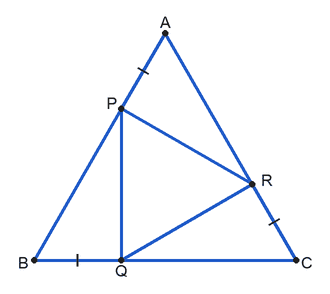
Prove that triangle PQR is equilateral.
Solve with AIWritten solution
Solution:
Concept: Each angle of an equilateral triangle is 60°. Two triangles are congruent by S.S.S., S.A.S., A.S.A. (or A.A.S.) or R.H.S., and then their corresponding parts are equal (C.P.C.T.C.).
Given: ABC is equilateral; P, Q, R lie on AB, BC, CA, and AP, BQ, CR are equal.
Step 1 — The remaining parts are equal.
The sides AB, BC, CA are equal, and the pieces AP, BQ, CR are equal. Taking the equal pieces from the equal sides leaves equal pieces:
So PB, QC and RA are equal.
Step 2 — Three congruent triangles.
Look at ΔAPR, ΔBQP and ΔCRQ at the three corners.
AP, BQ and CR are equal (given).
∠A, ∠B and ∠C are each 60°.
AR, BP and CQ are equal (Step 1).
So ΔAPR ≅ ΔBQP ≅ ΔCRQ (S.A.S.).
Step 3 — Conclude.
The third sides PR, QP and RQ are corresponding sides, so they are equal (C.P.C.T.C.). ΔPQR has three equal sides.
Watch out: In each corner triangle the angle (60°) must lie between the two sides you use.
Therefore, ΔPQR is equilateral. Hence proved.
- 393 marks
Question 39
In triangle ABC, altitudes BE and CF are equal.
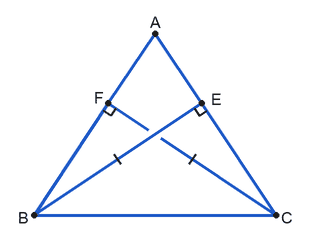
Prove that the triangle is isosceles.
Solve with AIWritten solution
Solution:
Concept: Two triangles are congruent by S.S.S., S.A.S., A.S.A. (or A.A.S.) or R.H.S., and then their corresponding parts are equal (C.P.C.T.C.). Sides opposite equal angles of a triangle are equal.
Given: BE and CF are altitudes of ΔABC with BE = CF.
Step 1 — Compare ΔBEC and ΔCFB.
BE ⊥ AC and CF ⊥ AB, so both triangles have a right angle.
∠BEC = ∠CFB, since both are 90°
BC is the common hypotenuse.
BE = CF (given)
So ΔBEC ≅ ΔCFB (R.H.S.).
Step 2 — Equal base angles.
The corresponding angles ∠ECB and ∠FBC are equal, that is ∠C = ∠B.
Step 3 — Conclude.
Sides opposite equal angles are equal, so AB = AC, and ΔABC is isosceles.
Watch out: The common side BC is the hypotenuse of both right triangles; that is why R.H.S. applies.
Therefore, ΔABC is isosceles (AB = AC). Hence proved.
- 403 marks
Question 40
Through any point in the bisector of an angle, a straight line is drawn parallel to either arm of the angle. Prove that the triangle so formed is isosceles.
Solve with AIWritten solution
Solution:
Concept: When a line crosses two parallel lines, alternate angles are equal and corresponding angles are equal. Sides opposite equal angles of a triangle are equal.
Given: OP bisects ∠XOY; P is any point on OP; PQ ∥ OY meets OX at Q.
Step 1 — Set up.
Let OP bisect ∠XOY, and let P be any point on it. Through P draw PQ ∥ OY, meeting OX at Q. We show ΔOQP is isosceles.

Step 2 — Alternate angles.
PQ ∥ OY with OP as a transversal, so ∠QPO = ∠POY.
Step 3 — Use the bisector.
OP bisects ∠XOY, so ∠POY = ∠POQ. Joining the two results, ∠QPO = ∠QOP.
Step 4 — Conclude.
In ΔOQP the angles at P and O are equal, so the sides opposite them are equal: QO = QP.
Watch out: The same proof works with a line parallel to OX, by symmetry.
Therefore, ΔOQP is isosceles. Hence proved.
- 413 marks
Question 41
In triangle ABC; AB = AC. P, Q and R are mid-points of sides AB, AC and BC respectively.

Prove that :
(i) PR = QR
(ii) BQ = CP
Solve with AIWritten solution
Solution:
Concept: Angles opposite equal sides of a triangle are equal. Two triangles are congruent by S.S.S., S.A.S., A.S.A. (or A.A.S.) or R.H.S., and then their corresponding parts are equal (C.P.C.T.C.).
Given: AB = AC; P, Q, R are the mid-points of AB, AC, BC.
Step 1 — Equal parts.
P and Q are the mid-points of the equal sides AB and AC, so BP = CQ.
R is the mid-point of BC, so BR = CR.
Also AB = AC, so the base angles B and C are equal.
Step 2 — Part (i): ΔBPR ≅ ΔCQR.
BP = CQ (Step 1)
∠PBR = ∠QCR (the base angles B and C)
BR = CR (Step 1)
So ΔBPR ≅ ΔCQR (S.A.S.), and PR = QR.
Step 3 — Part (ii): ΔPBC ≅ ΔQCB.
PB = QC (Step 1)
∠PBC = ∠QCB (the base angles B and C)
BC is common to both triangles.
So ΔPBC ≅ ΔQCB (S.A.S.), and CP = BQ.
Watch out: Use the base angles in both parts; the angle must be the one between the two sides used.
Therefore, (i) PR = QR and (ii) BQ = CP. Hence proved.
- 423 marks
Question 42
From the following figure, prove that :
(i) ∠ACD = ∠CBE
(ii) AD = CE
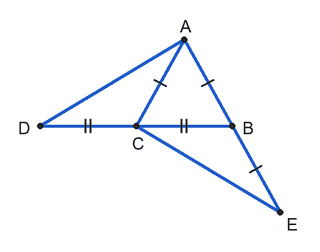 Solve with AI
Written solution
Solution:
Concept: Angles opposite equal sides of a triangle are equal. The angles of a triangle add up to 180°, and two angles on a straight line (a linear pair) also add up to 180°. Two triangles are congruent by S.S.S., S.A.S., A.S.A. (or A.A.S.) or R.H.S., and then their corresponding parts are equal (C.P.C.T.C.).
Given: AC, AB and BE are equal, and DC = CB (figure); DCB and ABE are straight lines.
Step 1 — Read the figure.
The figure marks AC, AB and BE as equal, and DC = CB, with D, C, B on one line and A, B, E on one line.
Step 2 — Part (i).
AC = AB, so ∠ACB = ∠ABC. Each of ∠ACD and ∠CBE is the linear pair of one of these angles.
So ∠ACD = ∠CBE.
Step 3 — Part (ii): ΔACD ≅ ΔEBC.
AC = EB (marked)
∠ACD = ∠EBC (part (i))
CD = BC (marked)
So ΔACD ≅ ΔEBC (S.A.S.), and AD = EC (C.P.C.T.C.).
Watch out: Match the triangles as A ↔ E, C ↔ B, D ↔ C, so that the angles of part (i) correspond.
Therefore, (i) ∠ACD = ∠CBE and (ii) AD = CE. Hence proved.
- 433 marks
Question 43
Equal sides AB and AC of an isosceles triangle ABC are produced. The bisectors of the exterior angles so formed meet at D.
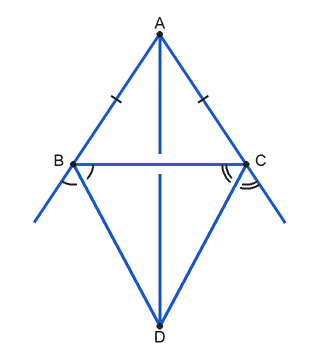
Prove that AD bisects angle A.
Solve with AIWritten solution
Solution:
Concept: Angles opposite equal sides of a triangle are equal. Sides opposite equal angles of a triangle are equal. Two triangles are congruent by S.S.S., S.A.S., A.S.A. (or A.A.S.) or R.H.S., and then their corresponding parts are equal (C.P.C.T.C.).
Given: AB = AC; AB and AC are produced; the bisectors of the exterior angles meet at D.
Step 1 — Equal exterior angles.
AB = AC, so ∠ABC = ∠ACB. Each exterior angle (at B and at C) is 180° minus one of these, so the exterior angles are equal.
Step 2 — ΔDBC is isosceles.
BD and CD bisect the equal exterior angles, so ∠DBC = ∠DCB.
The sides opposite them are equal:
DB = DC.
Step 3 — ΔABD ≅ ΔACD.
AB = AC (given)
DB = DC (Step 2)
AD is common to both triangles.
So ΔABD ≅ ΔACD (S.S.S.), and ∠BAD = ∠CAD (C.P.C.T.C.).
Watch out: ∠DBC is half the EXTERIOR angle at B, not half of ∠ABC.
Therefore, AD bisects ∠A. Hence proved.
- 443 marks
Question 44
ABC is a triangle. The bisector of the angle BCA meets AB in X. A point Y lies on CX such that AX = AY.
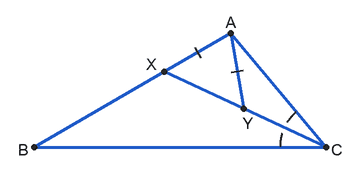
Prove that : ∠CAY = ∠ABC.
Solve with AIWritten solution
Solution:
Concept: Angles opposite equal sides of a triangle are equal. An exterior angle of a triangle equals the sum of the two interior opposite angles.
Given: CX bisects ∠BCA and meets AB at X; Y on CX with AX = AY.
Step 1 — Equal angles in ΔAXY.
AX = AY, so the angles opposite them are equal: ∠AXY = ∠AYX. Y lies on CX, so ∠AXY is the same angle as ∠AXC.
Step 2 — ∠AXC as an exterior angle.
X lies on AB, so ∠AXC is an exterior angle of ΔBXC.
Step 3 — ∠AYX as an exterior angle.
Y lies on CX, so ∠AYX is an exterior angle of ΔAYC.
Step 4 — Compare.
CX bisects ∠BCA, so ∠BCX = ∠ACY.
Since ∠AXC = ∠AYX, the two sums are equal, and taking away the equal angles ∠BCX and ∠ACY leaves ∠ABC = ∠CAY.
Watch out: Each exterior angle needs its own triangle: ΔBXC for the angle at X, ΔAYC for the angle at Y.
Therefore, ∠CAY = ∠ABC. Hence proved.
- 453 marks
Question 45
In triangle ABC; angle ABC = 90° and P is a point on AC such that ∠PBC = ∠PCB.

Show that : PA = PB.
Solve with AIWritten solution
Solution:
Concept: Sides opposite equal angles of a triangle are equal. The angles of a triangle add up to 180°.
Given: ∠ABC = 90°, P on AC with ∠PBC = ∠PCB.
Step 1 — PB = PC.
∠PBC = ∠PCB, so the sides opposite them in ΔPBC are equal: PB = PC.
Step 2 — The other two angles.
∠ABC = 90°, so ∠PBA = 90° − ∠PBC. In ΔABC, ∠A + ∠C = 90°, so ∠PAB = 90° − ∠PCB.
Step 3 — Compare in ΔPAB.
∠PBC = ∠PCB, so the two results in Step 2 are equal:
∠PBA = ∠PAB.
The sides opposite them in ΔPAB are equal:
PA = PB.
Watch out: P turns out to be the mid-point of the hypotenuse AC, since PA, PB and PC are all equal.
Therefore, PA = PB. Hence shown.
- 463 marks
Question 46
ABC is an equilateral triangle. Its side BC is produced upto point E such that C is mid-point of BE.
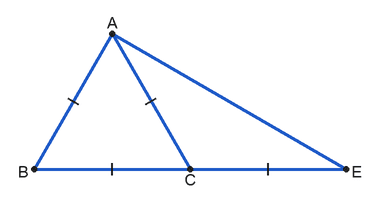
Calculate the measure of angles ACE and AEC.
Solve with AIWritten solution
Solution:
Concept: Each angle of an equilateral triangle is 60°. Angles opposite equal sides of a triangle are equal. The angles of a triangle add up to 180°, and two angles on a straight line (a linear pair) also add up to 180°.
Given: ABC is equilateral; BC is produced to E so that C is the mid-point of BE.
Step 1 — Find ∠ACE.
B, C and E are on one straight line, so ∠ACE is the linear pair of ∠ACB = 60°.
Step 2 — ΔACE is isosceles.
C is the mid-point of BE, so CE = CB.
Also CB = CA (equilateral triangle), so CE = CA.
The angles opposite them in ΔACE are equal:
∠CAE = ∠CEA.
Step 3 — Find ∠AEC.
These two equal angles share what is left of 180°.
Watch out: The equal angles are the ones OPPOSITE the equal sides, not the angles between them.
Therefore, ∠ACE = 120° and ∠AEC = 30°.
- 473 marks
Question 47
In triangle ABC, D is a point in AB such that AC = CD = DB. If ∠B = 28°, find the angle ACD.
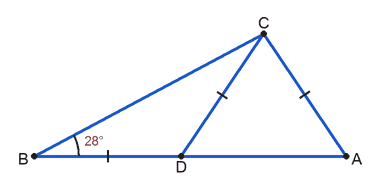 Solve with AI
Written solution
Solution:
Concept: Angles opposite equal sides of a triangle are equal. An exterior angle of a triangle equals the sum of the two interior opposite angles.
Given: In ΔABC, D is on AB with AC, CD and DB equal, and ∠B = 28°.
Step 1 — ΔDBC.
CD = DB, so the angles opposite them are equal: ∠DCB equals ∠B, which is 28°.
Step 2 — Exterior angle at D.
∠ADC is an exterior angle of ΔDBC, so it equals the sum of the interior opposite angles.
Step 3 — ΔACD.
AC = CD, so ∠CAD equals ∠CDA, which is 56°. The angle sum gives ∠ACD.
Watch out: The equal angles are the ones OPPOSITE the equal sides, not the angles between them.
Therefore, ∠ACD = 68°.
- 483 marks
Question 48
In the figure given alongside, AD = AB = AC, BD is parallel to CA and angle ACB = 65°. Find angle DAC.
 Solve with AI
Written solution
Solution:
Concept: Angles opposite equal sides of a triangle are equal. When a line crosses two parallel lines, alternate angles are equal and corresponding angles are equal.
Given: AD, AB and AC are equal, BD ∥ CA and ∠ACB = 65°.
Step 1 — Angles of ΔABC.
AB = AC, so ∠ABC equals ∠ACB, which is 65°.
Step 2 — Carry the angle across the parallels.
BD ∥ CA with AB as a transversal, so the alternate angles ∠DBA and ∠BAC are equal: ∠DBA = 50°.
Step 3 — Angles of ΔABD.
AD = AB, so ∠ADB equals ∠ABD, which is 50°.
Step 4 — Find ∠DAC.
∠DAC is made of ∠DAB and ∠BAC.
Watch out: ∠DBA and ∠BAC lie on opposite sides of AB, between the parallels; that makes them alternate angles.
Therefore, ∠DAC = 130°.
- 493 marks
Question 49
Prove that a triangle ABC is isosceles, if :
(i) altitude AD bisects angle ∠BAC, or
(ii) bisector of angle BAC is perpendicular to base BC.
 Solve with AI
Written solution
Solution:
Concept: Two triangles are congruent by S.S.S., S.A.S., A.S.A. (or A.A.S.) or R.H.S., and then their corresponding parts are equal (C.P.C.T.C.).
Given: ΔABC with AD the altitude from A that also bisects ∠BAC (or, the bisector of ∠BAC that is perpendicular to BC).
Step 1 — Part (i).
AD is an altitude, so ∠ADB = ∠ADC, since both are 90°. AD bisects ∠BAC, so ∠BAD = ∠CAD. In ΔABD and ΔACD: ∠BAD = ∠CAD, AD is common, and ∠ADB = ∠ADC. So ΔABD ≅ ΔACD (A.S.A.), and AB = AC.
Step 2 — Part (ii).
Let the bisector of ∠BAC meet BC at D, with AD ⊥ BC. Then ∠BAD = ∠CAD and the angles at D are both 90°, exactly as in part (i). So ΔABD ≅ ΔACD (A.S.A.) again, and AB = AC.
Watch out: Both parts describe the same situation: AD is at once the bisector of ∠A and perpendicular to BC.
Therefore, in each case AB = AC, so ΔABC is isosceles. Hence proved.
- 503 marks
Question 50
In the given figure; AB = BC and AD = EC.
Prove that : BD = BE.
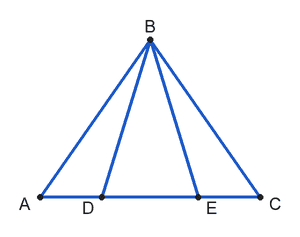 Solve with AI
Written solution
Solution:
Concept: Angles opposite equal sides of a triangle are equal. Two triangles are congruent by S.S.S., S.A.S., A.S.A. (or A.A.S.) or R.H.S., and then their corresponding parts are equal (C.P.C.T.C.).
Given: AB = BC and AD = EC, with D, E on AC (figure).
Step 1 — Equal base angles.
AB = BC, so the angles opposite them in ΔABC are equal: ∠A = ∠C.
Step 2 — ΔABD ≅ ΔCBE.
AB = CB (given)
∠BAD = ∠BCE (the base angles A and C)
AD = CE (given)
So ΔABD ≅ ΔCBE (S.A.S.), and BD = BE (C.P.C.T.C.).
Watch out: The equal angles are at A and C, opposite the equal sides BC and AB.
Therefore, BD = BE. Hence proved.
- 513 marks
Question 51
In the following figure; IA and IB are bisectors of angles CAB and CBA respectively. CP is parallel to IA and CQ is parallel to IB.
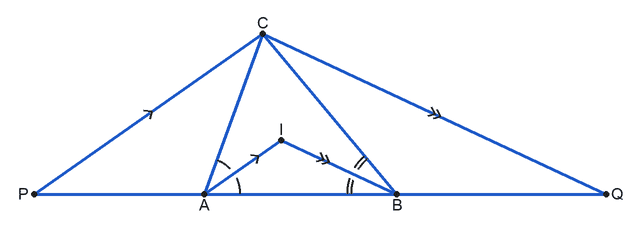
Prove that :
PQ = The perimeter of the Δ ABC.
Solve with AIWritten solution
Solution:
Concept: When a line crosses two parallel lines, alternate angles are equal and corresponding angles are equal. Sides opposite equal angles of a triangle are equal.
Given: IA and IB bisect ∠CAB and ∠CBA; CP ∥ IA and CQ ∥ IB (figure).
Step 1 — Two angle facts at A.
CP ∥ IA with AC as a transversal, so ∠ACP = ∠CAI (alternate angles). CP ∥ IA with PB as a transversal, so ∠APC = ∠IAB (corresponding angles).
Step 2 — ΔAPC is isosceles.
IA bisects ∠CAB, so ∠CAI = ∠IAB.
By Step 1, ∠ACP = ∠APC.
The sides opposite them in ΔAPC are equal:
AP = AC.
Step 3 — In the same way at B.
CQ ∥ IB gives ∠BCQ = ∠CBI and ∠BQC = ∠IBA, and IB bisects ∠CBA. So ∠BCQ = ∠BQC, and BQ = BC.
Step 4 — Add the pieces of PQ.
P, A, B and Q lie on one line, so PQ is made of PA, AB and BQ.
Replacing PA by AC and BQ by BC, PQ = AC + AB + BC, which is the perimeter of ΔABC.
Watch out: Each parallel gives two angle facts (one alternate, one corresponding); the bisector joins them.
Therefore, PQ is equal to the perimeter of ΔABC. Hence proved.
- 523 marks
Question 52
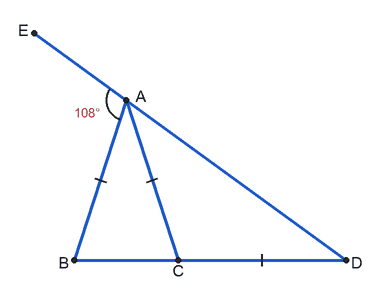
Sides AB and AC of a triangle ABC are equal. BC is produced through C upto point D such that AC = CD. D and A are joined and produced (through vertex A) upto point E. If angle BAE = 108°; find angle ADB.
 Solve with AI
Written solution
Solution:
Concept: Angles opposite equal sides of a triangle are equal. An exterior angle of a triangle equals the sum of the two interior opposite angles.
Given: AB = AC, AC = CD with D on BC produced, E on DA produced, ∠BAE = 108°.
Step 1 — Let ∠ADB = x.
AC = CD, so in ΔACD the angles opposite them are equal. Call each of ∠CAD and ∠CDA x.
Step 2 — Exterior angle at C.
∠ACB is an exterior angle of ΔACD, so it is the sum of the two angles x.
AB = AC, so ∠ABC equals ∠ACB, which is 2x.
Step 3 — Exterior angle at A.
E lies on DA produced, so ∠BAE is an exterior angle of ΔABD. It equals the sum of the interior opposite angles ∠ABD (which is ∠ABC = 2x) and ∠ADB = x.
Put in the values and solve for x.
Watch out: ∠BAE is the exterior angle of ΔABD at A (not an angle of ΔABC), so use the two angles of ΔABD at B and D.
Therefore, ∠ADB = 36°.
- 533 marks
Question 53
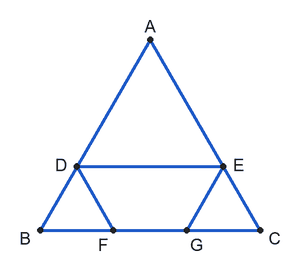
The given figure shows an equilateral triangle ABC with each side 15 cm. Also DE//BC, DF//AC and EG//AB.
If DE + DF + EG = 20 cm, find FG.
 Solve with AI
Written solution
Solution:
Concept: A triangle with all angles 60° is equilateral. When a line crosses two parallel lines, alternate angles are equal and corresponding angles are equal.
Given: ABC is equilateral with side 15 cm; DE ∥ BC, DF ∥ AC, EG ∥ AB; DE + DF + EG = 20 cm.
Step 1 — Three small equilateral triangles.
DE ∥ BC, DF ∥ AC and EG ∥ AB, so each small triangle has the same angles as ΔABC (corresponding angles), all 60°. So ΔADE, ΔDBF and ΔEGC are equilateral.
Step 2 — Find EG.
DE = AD and DF = DB, so DE + DF = AD + DB, which is the side AB = 15 cm.
So EG = 5 cm.
Step 3 — Find GC and BF.
ΔEGC is equilateral, so GC and EC are both equal to EG, that is 5 cm. E lies on AC, so AE is what is left of AC.
ΔADE is equilateral, so AD is also 10 cm, and DB is the rest of AB.
ΔDBF is equilateral, so BF is also 5 cm.
Step 4 — Find FG.
F and G lie on BC, so FG is what is left of BC after taking away BF and GC.
Watch out: Each small triangle is equilateral, so every length can be moved round to a side of ΔABC.
Therefore, FG = 5 cm.
- 543 marks
Question 54
If all the three altitudes of a triangle are equal, the triangle is equilateral. Prove it.
Solve with AIWritten solution
Solution:
Concept: Two triangles are congruent by S.S.S., S.A.S., A.S.A. (or A.A.S.) or R.H.S., and then their corresponding parts are equal (C.P.C.T.C.). Sides opposite equal angles of a triangle are equal.
Given: The three altitudes of ΔABC are equal.
Step 1 — Set up.
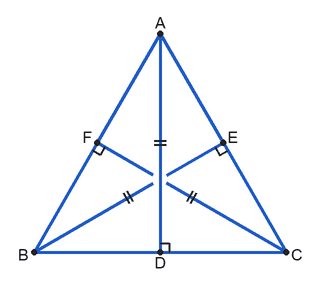
In ΔABC let the altitudes AD, BE and CF be equal.
Step 2 — Use the equal altitudes BE and CF.
In right triangles BEC and CFB, BC is the common hypotenuse and BE = CF. So ΔBEC ≅ ΔCFB (R.H.S.), and ∠C = ∠B. Sides opposite equal angles are equal, so AB = AC.
Step 3 — Use the equal altitudes AD and BE.
In the same way, in right triangles ADB and BEA, AB is the common hypotenuse and AD = BE.
So ΔADB ≅ ΔBEA (R.H.S.), and ∠B = ∠A.
So AC = BC.
Step 4 — Conclude.
AB = AC and AC = BC, so all three sides are equal.
Watch out: Each pair of equal altitudes gives one pair of equal angles; two pairs are enough.
Therefore, the triangle is equilateral. Hence proved.
- 553 marks
Question 55
In a Δ ABC, the internal bisector of angle A meets opposite side BC at point D. Through vertex C, line CE is drawn parallel to DA which meets BA produced at point E.
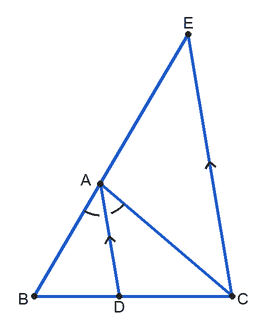
Show that Δ ACE is isosceles.
Solve with AIWritten solution
Solution:
Concept: When a line crosses two parallel lines, alternate angles are equal and corresponding angles are equal. Sides opposite equal angles of a triangle are equal.
Given: AD bisects ∠A and meets BC at D; CE ∥ DA meets BA produced at E.
Step 1 — Corresponding angles.
DA ∥ CE with BE as a transversal, so ∠BAD = ∠AEC.
Step 2 — Alternate angles.
DA ∥ CE with AC as a transversal, so ∠DAC = ∠ACE.
Step 3 — Use the bisector.
AD bisects ∠A, so ∠BAD = ∠DAC. Joining the three results, ∠AEC = ∠ACE.
Step 4 — Conclude.
In ΔACE the angles at E and C are equal, so the sides opposite them are equal: AC = AE.
Watch out: ∠AEC is opposite AC and ∠ACE is opposite AE, so the equal sides are AC and AE.
Therefore, ΔACE is isosceles (AC = AE). Hence shown.
- 563 marks
Question 56
In triangle ABC, bisector of angle BAC meets opposite side BC at point D. If BD = CD, prove that Δ ABC is isosceles.
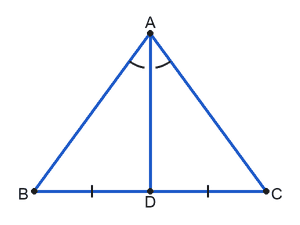 Solve with AI
Written solution
Solution:
Concept: Two triangles are congruent by S.S.S., S.A.S., A.S.A. (or A.A.S.) or R.H.S., and then their corresponding parts are equal (C.P.C.T.C.). Sides opposite equal angles of a triangle are equal.
Given: The bisector of ∠BAC meets BC at D, and BD = CD.
Step 1 — Construct.
Produce AD to E so that DE = AD, and join EC.
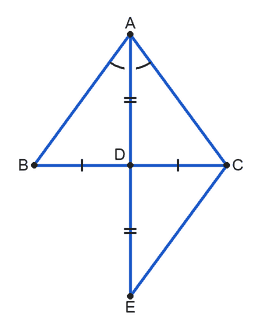
Step 2 — ΔABD ≅ ΔECD.
BD = CD (given)
∠ADB = ∠EDC (vertically opposite angles)
AD = ED (construction)
So ΔABD ≅ ΔECD (S.A.S.). Hence AB = EC and ∠BAD = ∠CED (C.P.C.T.C.).
Step 3 — ΔACE is isosceles.
AD bisects ∠BAC, so ∠BAD = ∠CAD. With Step 2, ∠CED = ∠CAD. In ΔACE these are the angles at E and at A, so the sides opposite them are equal: AC = EC.
Step 4 — Conclude.
AB = EC and AC = EC, so AB = AC.
Watch out: Doubling AD (DE = AD) is the key construction; it moves AB across to EC.
Therefore, ΔABC is isosceles. Hence proved.
- 573 marks
Question 57
In Δ ABC, D is a point on BC such that AB = AD = BD = DC.

Show that :
∠ADC : ∠C = 4 : 1.
Solve with AIWritten solution
Solution:
Concept: Each angle of an equilateral triangle is 60°. Angles opposite equal sides of a triangle are equal.
Given: D on BC, with AB, AD, BD and DC all equal.
Step 1 — ΔABD is equilateral.
AB, AD and BD are equal, so ΔABD is equilateral and each of its angles is 60°. In particular, ∠ADB = 60°.
Step 2 — Find ∠ADC.
B, D and C are on one straight line, so ∠ADC is the linear pair of ∠ADB.
Step 3 — Find ∠C.
AD = DC, so ∠DAC and ∠C are equal and share what is left of 180°.
Step 4 — Form the ratio.
Divide both angles by 30°.
Watch out: The equal angles are the ones OPPOSITE the equal sides, not the angles between them.
Therefore, ∠ADC : ∠C = 4 : 1. Hence shown.
- 583 marks
Question 58
Using the information, given in each of the following figures, find the values of and .
(i)
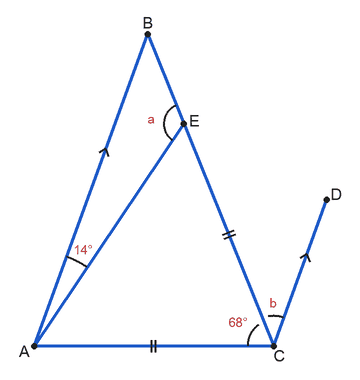
[Given : CE = AC]
(ii)
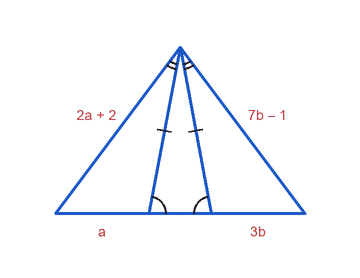 Solve with AI
Written solution
Solution:
Concept: Angles opposite equal sides of a triangle are equal. When a line crosses two parallel lines, alternate angles are equal and corresponding angles are equal. Two triangles are congruent by S.S.S., S.A.S., A.S.A. (or A.A.S.) or R.H.S., and then their corresponding parts are equal (C.P.C.T.C.).
Given: (i) CE = AC, AB ∥ CD, ∠BAE = 14°, ∠ACB = 68°; (ii) the marked parts of the second figure.
Step 1 — Figure (i): ΔACE.
CE = AC, so ∠CAE and ∠CEA are equal and share what is left of 180° after ∠ACE = 68°.
Step 2 — Figure (i): find a.
B, E and C are on one line, so a = ∠AEB is the linear pair of ∠CEA.
Step 3 — Figure (i): find b.
∠BAC is made of the 14° angle and ∠CAE = 56°, so ∠BAC = 70°.
AB ∥ CD with BC as a transversal, so b = ∠BCD and ∠ABC are alternate angles: b = 42°.
Step 4 — Figure (ii): name the points.
Call the top vertex T, the outer base ends L (left) and R (right), and the feet of the two inner lines M (left) and N (right). The figure marks TM = TN, ∠LTM = ∠NTR, and LT = 2a + 2, TR = 7b − 1, LM = a, NR = 3b.
Step 5 — Figure (ii): ΔTLM ≅ ΔTRN.
TM = TN, so ∠TMN = ∠TNM, and their linear pairs are equal too: ∠TML = ∠TNR. In ΔTLM and ΔTRN: ∠LTM = ∠RTN, TM = TN and ∠TML = ∠TNR. So ΔTLM ≅ ΔTRN (A.S.A.), giving LT = RT and LM = RN.
Step 6 — Figure (ii): solve.
LM and RN are equal, so a = 3b.
Put this into LT = RT.
Then a is three times 3, so a = 9.
Watch out: In figure (ii) the equal angles at the feet are inside ΔTMN; use their supplements, which belong to the outer triangles.
Therefore, (i) a = 124° and b = 42°; (ii) a = 9 and b = 3.
What Class 9 Maths Ch 10 covers
The sections of the chapter, in the order the book takes them. Every question above comes from one of these.
- 01Theorem 1: Angles Opposite Equal Sides Are Equal
- 02Theorem 2: Sides Opposite Equal Angles Are Equal
More ways to study this chapter
The same chapter asked three other ways. Practise it, revise it, and see what the board has set on Ch 10 before.
Class 9 Maths Ch 10 questions students ask
How many questions are there in Class 9 Maths Ch 10?
58 questions. Every one is solved step by step on this page.
Are these Class 9 Maths solutions free?
Yes. Every question and its full working is free to read, with no account needed.
Can I download the Class 9 Maths Ch 10 solutions as a PDF?
There is no PDF to download. Every solution is on this page instead, which means it is searchable, always the current syllabus, and readable on a phone. Use your browser's print option if you want it on paper.