
Opening your dashboard
Class 9 Maths Chapter 10 Isosceles Triangles: Competency-Based Questions (CBQ)
40 questions on Chapter 10, each worked through on its own page with the AI tutor. Class 9 Maths, ICSE 2026-27.
40 questions
1–5 marks · Mixed difficulty
- 11 mark
Question 1
Competency: Understanding
A tile maker says, "Every equilateral tile is also an isosceles tile, but not every isosceles tile is equilateral."
Which triangular tile, with the sides given, is isosceles but not equilateral?
- 21 mark
Question 2
Competency: Application
A pair of compasses has two arms of equal length. It is opened so that the angle between the arms is 50°, and its two tips rest on a sheet of paper.
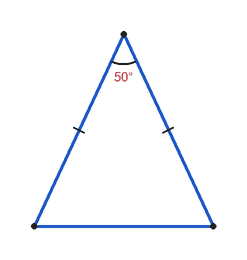
The angle that each arm makes with the line joining the two tips is
- 31 mark
Question 3
Competency: Analysis
One exterior angle of an isosceles triangle is 100°.
Which of the following cannot be an interior angle of this triangle?
- 41 mark
Question 4
Competency: Application
A sports-day pennant is an isosceles triangle. Its vertex angle is twice as large as each base angle.
The pennant is
- 51 mark
Question 5
Competency: Application
At a certain time of the day, the sun's rays make an angle of 45° with the level ground. At that time a vertical lamp-post casts a shadow 6.5 m long on the ground.
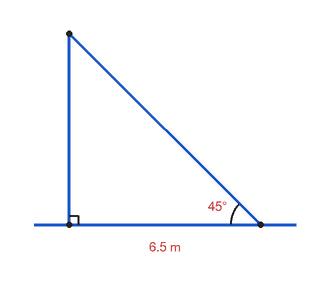
The height of the lamp-post is
- 61 mark
Question 6
Competency: Evaluation
Assertion (A): In ΔABC with AB = AC, the bisector of ∠A passes through the mid-point of BC.
Reason (R): In every triangle, the bisector of an angle bisects the opposite side.
- 72 marks
Question 7
Competency: Application
A floor tile is a regular pentagon ABCDE, so all its sides are equal and each interior angle is 108°. A line is scored along the diagonal AC.
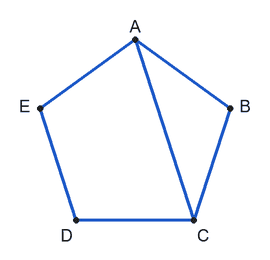
Find ∠BAC and ∠ACD.
- 82 marks
Question 8
Competency: Analysis
A house-shaped signboard is made of a square ABCD with an equilateral triangle DCE on top of it. Thin strips are fixed along AE and BE.
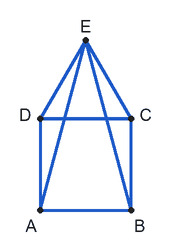
Find ∠DAE and ∠AEB.
- 92 marks
Question 9
Competency: Evaluation
In ΔABC, AB = AC. Rohan says, "Because the triangle is isosceles, the median from B to AC is also perpendicular to AC."
Is Rohan's statement always true? Justify your answer. For which isosceles triangles ABC (with AB = AC) is it true?
- 102 marks
Question 10
Competency: Analysis
Three paths in a park form a triangle ABC with ∠ABC = 72° and ∠ACB = 36°. A new path BD is laid along the bisector of ∠ABC, meeting AC at D.
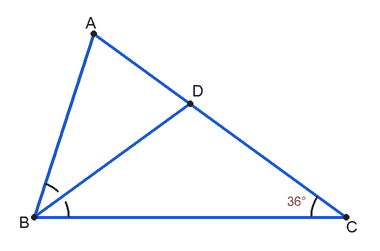
Show that the three stretches AB, BD and DC are equal in length.
- 113 marks
Question 11
Competency: Application
A step ladder has two equal legs AB and AC and stands on a level floor BC. A brace DE joins the legs, with D on AB and E on AC, and it is fixed parallel to the floor.
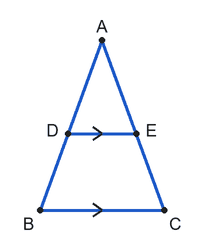
Prove that AD = AE. Hence show that the brace is fixed at the same distance from the feet of the two legs, that is, DB = EC.
- 123 marks
Question 12
Competency: Analysis & Evaluation
The textbook proves Theorem 1 (if AB = AC, then ∠B = ∠C) by drawing AD perpendicular to BC. Two students try other constructions.
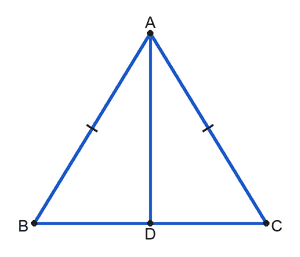
Meena: "Draw AD, the bisector of ∠A, meeting BC at D. In ΔABD and ΔACD : AB = AC, ∠BAD = ∠CAD, AD = AD. So the triangles are congruent by S.A.S., and ∠B = ∠C."
Kiran: "Join A to D, the mid-point of BC. In ΔABD and ΔACD : AB = AC, BD = CD, AD = AD. So the triangles are congruent by S.A.S., and ∠B = ∠C."
Examine each proof. Say whether it is fully correct, and correct it if it is not.
- 133 marks
Question 13
Competency: Creativity
Points B, C and D lie in that order on a straight line, and A is a point above the line such that AB = AC = CD. So ΔABC and ΔACD are both isosceles.
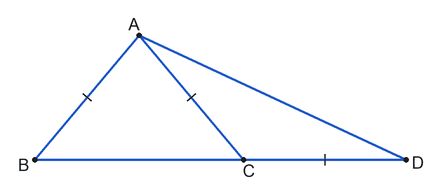
Make your own numerical problem from this figure: choose a value for ∠ABC (any acute angle of your choice), and then find ∠ADC and ∠BAD. Finally, state the general relation between ∠ADC and ∠ABC that your working shows.
- 145 marks
Question 14
Competency: Application & Analysis
Case study — The giant wheel
A giant wheel at a fair has its centre at O and 9 cabins equally spaced on its rim. Every cabin is joined to O by a spoke, and all spokes are equal. A, B and C are three cabins next to one another. Straight struts AB and AC are fixed for strength.
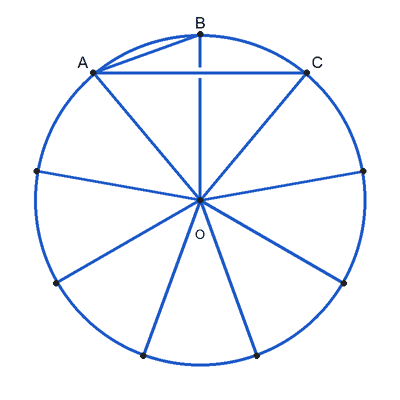
(a) Find the angle between two neighbouring spokes, ∠AOB.
(b) Find ∠OAB.
(c) Find ∠OAC, and hence ∠BAC. Also decide, with a reason, whether the strut AB is longer or shorter than a spoke.
- 154 marks
Question 15
Competency: Analysis & Evaluation
Case study — The surveyor's notebook
A surveyor measures two angles of each of four triangular plots, all named ABC.
Plot ∠A ∠B 1 52° 76° 2 60° 60° 3 35° 70° 4 90° 45° (a) Find ∠C for each plot.
(b) Say which plots are isosceles. For each isosceles plot, name the equal sides and give the reason.
(c) A helper says, "Plot 3 is isosceles too, because one of its angles is double another." Is the helper right? In Plot 1, AB = 40 m and AC = 49 m. Find the length of fencing needed to go once around Plot 1.
- 161 mark
Question 16
Competency: Understanding
A craft teacher says that the three angles of a triangular card are whole numbers of degrees and that the card is an isosceles triangle.
Which of the following can be the three angles of this card?
- 171 mark
Question 17
Competency: Application
A steel rod PQ is fixed along the top of a triangular gate frame ABC so that it passes through the corner A and is parallel to the base BC. The two sloping sides AB and AC of the frame are equal, and ∠PAB = 34°.

The angle ∠BAC at the top of the frame is
- 181 mark
Question 18
Competency: Analysis
In an isosceles triangle, one of the angles is four times another angle of the same triangle.
The largest angle of this triangle can be
- 191 mark
Question 19
Competency: Evaluation
Assertion (A): Each of the two equal angles of an isosceles triangle is always less than .
Reason (R): The three angles of a triangle add up to , so two equal angles together are always less than .
- 201 mark
Question 20
Competency: Evaluation
Assertion (A): A triangle whose angles are , and has two equal sides.
Reason (R): The three angles of every triangle add up to .
- 211 mark
Question 21
Competency: Recall
The textbook proves Theorem 2 (if ∠B = ∠C in ΔABC, then AB = AC) by drawing AD perpendicular to BC. In this proof, the triangles ABD and ACD are shown to be congruent by the condition
- 221 mark
Question 22
Competency: Application
A floor tile is a rhombus ABCD, so all four of its sides are equal. A line is scored along the diagonal AC. The angle ∠ABC is 110°.

The angle ∠BAC is
- 231 mark
Question 23
Competency: Analysis & Evaluation
In ΔPQR, ∠P = 80° and ∠Q = ∠R = 50°. Two students make claims about its sides.
Priya: "PQ = PR, because they are the sides opposite the two equal angles."
Sam: "PQ = QR, because both of these sides meet at Q."
Which of the following is correct?
- 241 mark
Question 24
Competency: Analysis
In ΔABC, AB = AC and ∠A = 40°. The bisectors of ∠B and ∠C meet at the point O.

The angle ∠BOC is
- 251 mark
Question 25
Competency: Application & Analysis
(Hypothetical data.) In a toy clock the hour hand and the minute hand have the same length. At a certain whole hour, the line joining the tips of the two hands makes an angle of 30° with each hand.
At which of the following times could this happen?
- 262 marks
Question 26
Competency: Application
(Hypothetical data.) A gardener has 38 m of fencing wire and uses all of it to fence an isosceles triangular flower bed. Each of the two equal sides is 4 m longer than the third side.
Find the lengths of the three sides of the bed.
- 272 marks
Question 27
Competency: Analysis
The three angles of a triangle, taken from the smallest to the largest, increase by the same number of degrees each time. For example, , , increase by each time. The same number may also be zero.
Show that if such a triangle is isosceles, it must be equilateral.
- 282 marks
Question 28
Competency: Application & Analysis
A kite-shaped frame ABCD has AB = AD and CB = CD. The diagonal BD is joined, ∠BAD = 70° and ∠BCD = 100°.
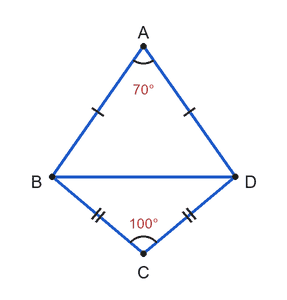
Find ∠ABC.
- 292 marks
Question 29
Competency: Application
(Hypothetical data.) A triangular garden PQR has ∠Q = ∠R and ∠P = 48°. The fence along PQ is (2x + 3) m long and the fence along PR is (4x − 5) m long.
Find and ∠Q.
- 302 marks
Question 30
Competency: Analysis
ABCD is a square. Its diagonals AC and BD meet at O. Use the fact that the diagonals of a square are equal and bisect each other.
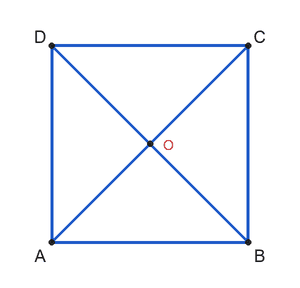
How many triangles in the figure are isosceles? Name them and give a reason for each kind.
- 312 marks
Question 31
Competency: Analysis
In ΔABC, AB = AC and ∠BAC = 20°. An equilateral triangle ABD is drawn on AB, outside ΔABC, and DC is joined.
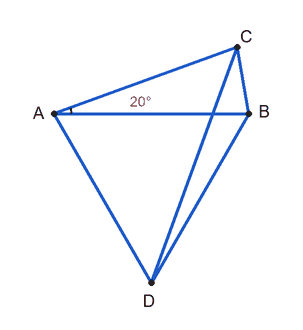
Find ∠ADC and ∠BDC.
- 323 marks
Question 32
Competency: Analysis
In ΔABC, AB = AC. P is a point on BC. The perpendicular to BC at P meets AC at Q and BA produced at R.

Prove that ΔAQR is isosceles, with AQ = AR.
- 333 marks
Question 33
Competency: Creativity
A garden designer must lay out a triangular lawn PQR in which the sides PQ and PR are equal. She will fix the corners with a protractor.
Choose a value of your own for ∠Q (a whole number of degrees between 30° and 80°). Say what ∠R must be so that PQ = PR, find ∠P, and name the theorem that guarantees PQ = PR.
- 343 marks
Question 34
Competency: Application
(Hypothetical data.) The side frame of a sign stand is a triangle ABC. Its two legs AB and AC are equal, BC is the bottom bar, and ∠BAC = 40°. A support strut DE runs from a point D on BC to a point E on AC, and it is fixed parallel to the leg AB. The length EC is 0.9 m.

Find (i) ∠EDC, giving the reason, (ii) the length of the strut DE, giving a reason, (iii) ∠DEC.
- 353 marks
Question 35
Competency: Evaluation
A question says: "In ΔABC, AB = AC and ∠A = 70°. Find ∠B and ∠C." Ravi writes:
"AB = AC, so ∠A = ∠B = 70°. Then ∠C = 180° − 70° − 70° = 40°."
Find the mistake in Ravi's working, write the correct angles, and say which pair of equal sides in the question would have made Ravi's working correct.
- 363 marks
Question 36
Competency: Analysis
In ΔABC, AB = AC. The exterior angle at B, formed by producing CB beyond B, and the interior angle ∠A are in the ratio 13 : 8.
Find the three angles of ΔABC.
- 375 marks
Question 37
Competency: Application & Analysis
Case study — The folding stool
A folding stool has two legs AC and BD of the same length. The legs cross and are pivoted at their common mid-point O, so OA = OB = OC = OD. The seat joins A and B, and a bar joins D and C. When the stool is open, ∠AOB = 70°.
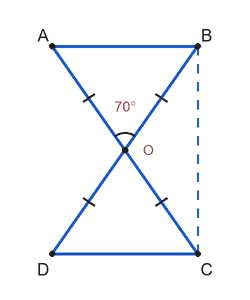
(a) Find ∠OAB and ∠OBA.
(b) Find ∠BOC, and hence ∠OBC. Also find ∠ABC.
(c) Show that the seat AB is parallel to the floor bar DC.
- 384 marks
Question 38
Competency: Analysis & Evaluation
Case study — The truss inspector
(Hypothetical data.) A roof is held up by four triangular trusses. Each truss is named ABC, and AB and AC are its two sloping rafters. An inspector measured the angles at B and C and the lengths of the rafters.
Truss ∠B ∠C AB (m) AC (m) T1 55° 55° 4.2 4.2 T2 62° 62° 3.8 4.1 T3 50° 70° 5.0 5.0 T4 48° 48° 5.5 5.5 (a) For which trusses do the angles show that the two rafters must be equal? Name the theorem you use.
(b) Two rows of the table cannot be correct as recorded. Name them and explain what is wrong in each.
(c) For T3 the inspector finds that the lengths 5.0 m and 5.0 m and the angle ∠B = 50° were correct. Find the correct ∠C and the angle ∠A at the ridge.
- 394 marks
Question 39
Competency: Application & Analysis
Case study — The folded sheet
A rectangular sheet ABCD is folded along its diagonal AC so that the corner B falls at B′. The edge AB′ crosses the edge DC at E. Before folding, the diagonal made an angle of 36° with the edge AB, that is ∠CAB = 36°. Folding does not change any angle, so ∠B′AC = 36° too.
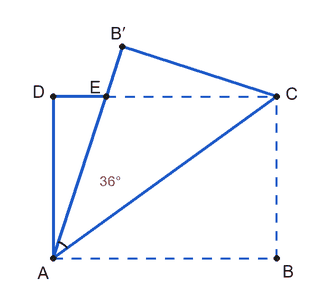
(a) Find ∠ACD and give the reason.
(b) Show that EA = EC.
(c) Find ∠AEC, and hence ∠AED.
- 405 marks
Question 40
Competency: Application & Analysis
Case study — The bunting
A string PR carries two identical triangular flags, PSQ and QTR. Their bases PQ and QR lie along the string, SP = SQ and TQ = TR, and the angle at the tip of each flag is 30°. The tips S and T are joined by a thin dashed thread.

(a) Find the angle ∠SPQ at the base of a flag.
(b) Find ∠SQT between the two neighbouring flag edges QS and QT.
(c) Show that ΔSQT is isosceles, find ∠QST, and hence show that the thread ST is parallel to the string PR.