
Question 143 marksEasy
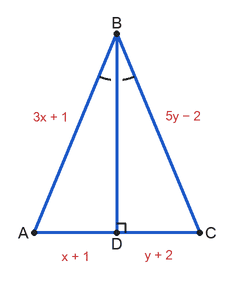
In the triangle ABC, BD bisects angle B and is perpendicular to AC. If the lengths of the sides of the triangle are expressed in terms of and as shown, find the values of and .
Confirming your payment
Sign up now and get 250 free tokens.
Isosceles Triangles · Question 14 of 58
In the triangle ABC, BD bisects angle B and is perpendicular to AC. If the lengths of the sides of the triangle are expressed in terms of and as shown, find the values of and .
Solution:
Concept: Two triangles are congruent by S.S.S., S.A.S., A.S.A. (or A.A.S.) or R.H.S., and then their corresponding parts are equal (C.P.C.T.C.).
Given: BD bisects ∠B and BD ⊥ AC; AB = 3x + 1, BC = 5y − 2, AD = x + 1, DC = y + 2.
Step 1 — Show ΔABD ≅ ΔCBD.
BD bisects ∠B and is perpendicular to AC.
∠ABD = ∠CBD (BD bisects ∠B)
BD is common to both triangles.
∠ADB = ∠CDB, since both are 90°.
So ΔABD ≅ ΔCBD (A.S.A.), and the corresponding sides give AD = CD and AB = CB.
Step 2 — Use AD = CD.
Write the two lengths from the figure and simplify.
Step 3 — Use AB = CB.
Write the two lengths from the figure, then put x = y + 1.
Step 4 — Find x.
Put y = 3 into the result of Step 2.
Step 5 — Check.
With x = 4 and y = 3, AB and CB are both 13, and AD and CD are both 5, so both pairs are equal.
Watch out: Both pairs of equal sides are needed: AD = CD gives one equation and AB = CB the other.
Therefore, x = 4 and y = 3.