
Question 51 markMCQEasy
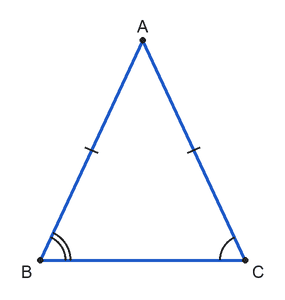
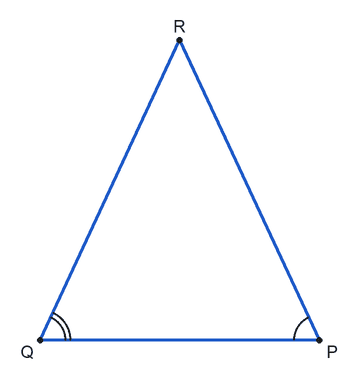
In ΔABC and ΔPQR, AB = AC, ∠C = ∠P and ∠B = ∠Q; then triangles are :
Confirming your payment
Sign up now and get 250 free tokens.
Isosceles Triangles · Question 5 of 58
In ΔABC and ΔPQR, AB = AC, ∠C = ∠P and ∠B = ∠Q; then triangles are :
(A) isosceles but not congruent
(B) isosceles and congruent
(C) congruent but not isosceles
(D) neither isosceles nor congruent.
Answer: (A) isosceles but not congruent
Concept: Angles opposite equal sides of a triangle are equal. Sides opposite equal angles of a triangle are equal. Equal angles alone (A.A.A.) do not prove two triangles congruent.
Step 1 — ΔABC is isosceles.
AB = AC is given, so ΔABC is isosceles. The angles opposite the equal sides are equal: ∠B = ∠C.
Step 2 — ΔPQR is isosceles.
∠P = ∠C and ∠Q = ∠B, and ∠B = ∠C, so ∠P and ∠Q are equal. The sides opposite them, QR and PR, are therefore equal, so ΔPQR is isosceles too.
Step 3 — Are they congruent?
All three angles of ΔPQR equal those of ΔABC, but no side of ΔPQR is given equal to a side of ΔABC. Triangles with equal angles can differ in size (one can be an enlargement of the other), so they need not be congruent.
Watch out: A.A.A. is not a congruence rule; at least one pair of corresponding sides must be equal.
Why the other options are wrong:
Therefore, the triangles are isosceles but not (necessarily) congruent, option (A).