
Question 513 marksMedium
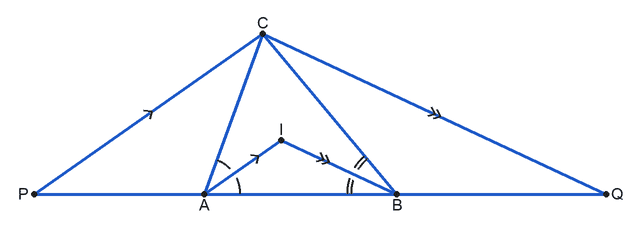
In the following figure; IA and IB are bisectors of angles CAB and CBA respectively. CP is parallel to IA and CQ is parallel to IB.
Prove that :
PQ = The perimeter of the Δ ABC.
Confirming your payment
Sign up now and get 250 free tokens.
Isosceles Triangles · Question 51 of 58
In the following figure; IA and IB are bisectors of angles CAB and CBA respectively. CP is parallel to IA and CQ is parallel to IB.
Prove that :
PQ = The perimeter of the Δ ABC.
Solution:
Concept: When a line crosses two parallel lines, alternate angles are equal and corresponding angles are equal. Sides opposite equal angles of a triangle are equal.
Given: IA and IB bisect ∠CAB and ∠CBA; CP ∥ IA and CQ ∥ IB (figure).
Step 1 — Two angle facts at A.
CP ∥ IA with AC as a transversal, so ∠ACP = ∠CAI (alternate angles). CP ∥ IA with PB as a transversal, so ∠APC = ∠IAB (corresponding angles).
Step 2 — ΔAPC is isosceles.
IA bisects ∠CAB, so ∠CAI = ∠IAB.
By Step 1, ∠ACP = ∠APC.
The sides opposite them in ΔAPC are equal:
AP = AC.
Step 3 — In the same way at B.
CQ ∥ IB gives ∠BCQ = ∠CBI and ∠BQC = ∠IBA, and IB bisects ∠CBA. So ∠BCQ = ∠BQC, and BQ = BC.
Step 4 — Add the pieces of PQ.
P, A, B and Q lie on one line, so PQ is made of PA, AB and BQ.
Replacing PA by AC and BQ by BC, PQ = AC + AB + BC, which is the perimeter of ΔABC.
Watch out: Each parallel gives two angle facts (one alternate, one corresponding); the bisector joins them.
Therefore, PQ is equal to the perimeter of ΔABC. Hence proved.