
Question 83 marksMedium
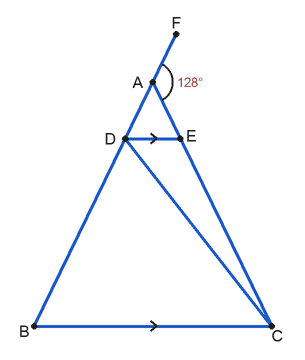
In the following figure, AB = AC; BC = CD and DE is parallel to BC. Calculate :
(i) ∠CDE
(ii) ∠DCE
Confirming your payment
Sign up now and get 250 free tokens.
Isosceles Triangles · Question 8 of 58
In the following figure, AB = AC; BC = CD and DE is parallel to BC. Calculate :
(i) ∠CDE
(ii) ∠DCE
Solution:
Concept: Angles opposite equal sides of a triangle are equal. The angles of a triangle add up to 180°, and two angles on a straight line (a linear pair) also add up to 180°. When a line crosses two parallel lines, alternate angles are equal and corresponding angles are equal.
Given: AB = AC, BC = CD, DE ∥ BC and ∠FAC = 128°.
Step 1 — Find ∠BAC.
F lies on BA produced, so ∠BAC is the linear pair of ∠FAC = 128°.
Step 2 — Base angles of ΔABC.
AB = AC, so ∠B = ∠ACB. They share what is left of 180°.
Step 3 — Angles of ΔBCD.
BC = CD, so in ΔBCD the angles opposite these sides are equal: ∠CDB equals ∠B, which is 64°.
Step 4 — Part (i): ∠CDE.
DE ∥ BC and DC is a transversal, so the alternate angles ∠CDE and ∠BCD are equal. So ∠CDE = 52°.
Step 5 — Part (ii): ∠DCE.
E lies on AC, so ∠DCE is the part of ∠ACB left after taking away ∠BCD.
Watch out: In ΔBCD the equal sides are BC and CD, so the equal angles are at B and D (opposite them), not at C.
Therefore, (i) ∠CDE = 52° and (ii) ∠DCE = 12°.