
Question 93 marksEasy
Calculate :
(i)
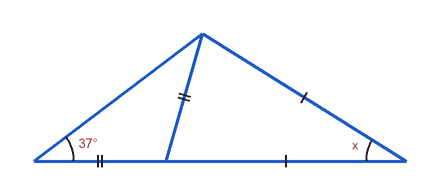
(ii)

Confirming your payment
Sign up now and get 250 free tokens.
Isosceles Triangles · Question 9 of 58
Calculate :
(i)
(ii)
Solution:
Concept: Angles opposite equal sides of a triangle are equal. An exterior angle of a triangle equals the sum of the two interior opposite angles.
Step 1 — Name the points.
In each figure call the left vertex P, the top vertex Q, the right vertex R and the point where the inner line meets the base S. The angle x is ∠R.
Step 2 — Figure (i): left triangle.
PS and SQ carry the same (double) marks, so in ΔPSQ the angles opposite them are equal: ∠PQS equals ∠P, which is 37°. ∠QSR is the exterior angle of ΔPSQ at S.
Step 3 — Figure (i): right triangle.
SR and QR carry the same (single) marks, so in ΔQSR the angles opposite them are equal: ∠SQR equals ∠QSR, which is 74°. The angle sum of ΔQSR gives x.
Step 4 — Figure (ii): left triangle.
PS, SQ and SR all carry the same mark. In ΔPSQ, PS = SQ, so ∠PQS equals ∠P, which is 50°. The exterior angle of ΔPSQ at S is the sum of these two angles.
Step 5 — Figure (ii): right triangle.
In ΔQSR, SQ = SR, so the angles opposite them, ∠R and ∠SQR, are equal. They share what is left of 180°.
Watch out: The equal angles are the ones OPPOSITE the equal sides, not the angles between them.
Therefore, (i) x = 32° and (ii) x = 40°.