
Question 333 marksMedium
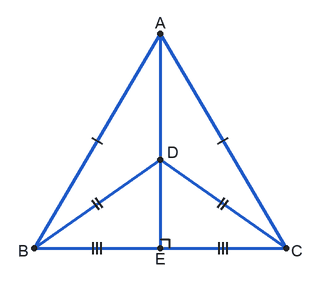
ABC and DBC are two isosceles triangles on the same side of BC.

Prove that :
(i) DA (or AD) produced bisects BC at right angle.
(ii) ∠BDA = ∠CDA.
Confirming your payment
Sign up now and get 250 free tokens.
Isosceles Triangles · Question 33 of 58
ABC and DBC are two isosceles triangles on the same side of BC.
Prove that :
(i) DA (or AD) produced bisects BC at right angle.
(ii) ∠BDA = ∠CDA.
Solution:
Concept: Two triangles are congruent by S.S.S., S.A.S., A.S.A. (or A.A.S.) or R.H.S., and then their corresponding parts are equal (C.P.C.T.C.).
Given: ΔABC and ΔDBC are isosceles on the same side of BC, with AB = AC and DB = DC.
Step 1 — Set up.
AB = AC and DB = DC, with A and D on the same side of BC.
Step 2 — Part (ii): ΔABD ≅ ΔACD.
AB = AC, DB = DC, and AD is common. So ΔABD ≅ ΔACD (S.S.S.). Hence ∠BDA = ∠CDA, and also ∠BAD = ∠CAD.
Step 3 — Part (i): the meeting point E.
Let the line AD (produced as needed) meet BC at E. ∠BAE and ∠CAE are either the angles ∠BAD and ∠CAD themselves or their supplements, so in both cases ∠BAE = ∠CAE.
Step 4 — ΔABE ≅ ΔACE.
AB = AC, ∠BAE = ∠CAE, and AE is common. So ΔABE ≅ ΔACE (S.A.S.). Hence BE = CE and ∠AEB = ∠AEC.
Step 5 — The right angle.
∠AEB and ∠AEC form a linear pair on BC, and they are equal, so each is 90°.
Watch out: Prove part (ii) first; its equal angles at A are what part (i) needs.
Therefore, (i) AD produced bisects BC at right angles and (ii) ∠BDA = ∠CDA. Hence proved.