
Question 553 marksMedium
In a Δ ABC, the internal bisector of angle A meets opposite side BC at point D. Through vertex C, line CE is drawn parallel to DA which meets BA produced at point E.
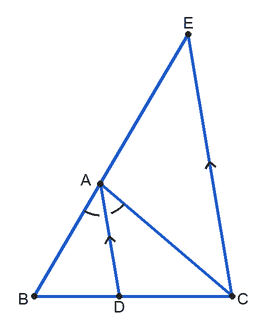
Show that Δ ACE is isosceles.
Confirming your payment
Sign up now and get 250 free tokens.
Isosceles Triangles · Question 55 of 58
In a Δ ABC, the internal bisector of angle A meets opposite side BC at point D. Through vertex C, line CE is drawn parallel to DA which meets BA produced at point E.
Show that Δ ACE is isosceles.
Solution:
Concept: When a line crosses two parallel lines, alternate angles are equal and corresponding angles are equal. Sides opposite equal angles of a triangle are equal.
Given: AD bisects ∠A and meets BC at D; CE ∥ DA meets BA produced at E.
Step 1 — Corresponding angles.
DA ∥ CE with BE as a transversal, so ∠BAD = ∠AEC.
Step 2 — Alternate angles.
DA ∥ CE with AC as a transversal, so ∠DAC = ∠ACE.
Step 3 — Use the bisector.
AD bisects ∠A, so ∠BAD = ∠DAC. Joining the three results, ∠AEC = ∠ACE.
Step 4 — Conclude.
In ΔACE the angles at E and C are equal, so the sides opposite them are equal: AC = AE.
Watch out: ∠AEC is opposite AC and ∠ACE is opposite AE, so the equal sides are AC and AE.
Therefore, ΔACE is isosceles (AC = AE). Hence shown.